


Back 1/1
E-auction 262-185222 - fme_367373 - LOUIS-PHILIPPE I Médaille de la chapelle du château de Dreux
You must signin and be an approved bidder to bid, LOGIN TO BID. Accounts are subject to approval and the approval process takes place within 48 hours. Do not wait until the day a sale closes to register. Clicking on « bid » constitutes acceptance of the terms of use of cgb.fr private e-auctions.
Bids must be placed in whole Euro amounts only. The sale will start closing at the time stated on the item description; any bids received at the site after the closing time will not be executed. Transmission times may vary and bids could be rejected if you wait until the last second. For further information ckeck the E-auctions F.A.Q.
NO BUYER'S FEE.
NO BUYER'S FEE.
| Estimate : | 75 € |
| Price : | 6 € |
| Maximum bid : | 14 € |
| End of the sale : | 23 April 2018 18:29:00 |
| bidders : | 4 bidders |
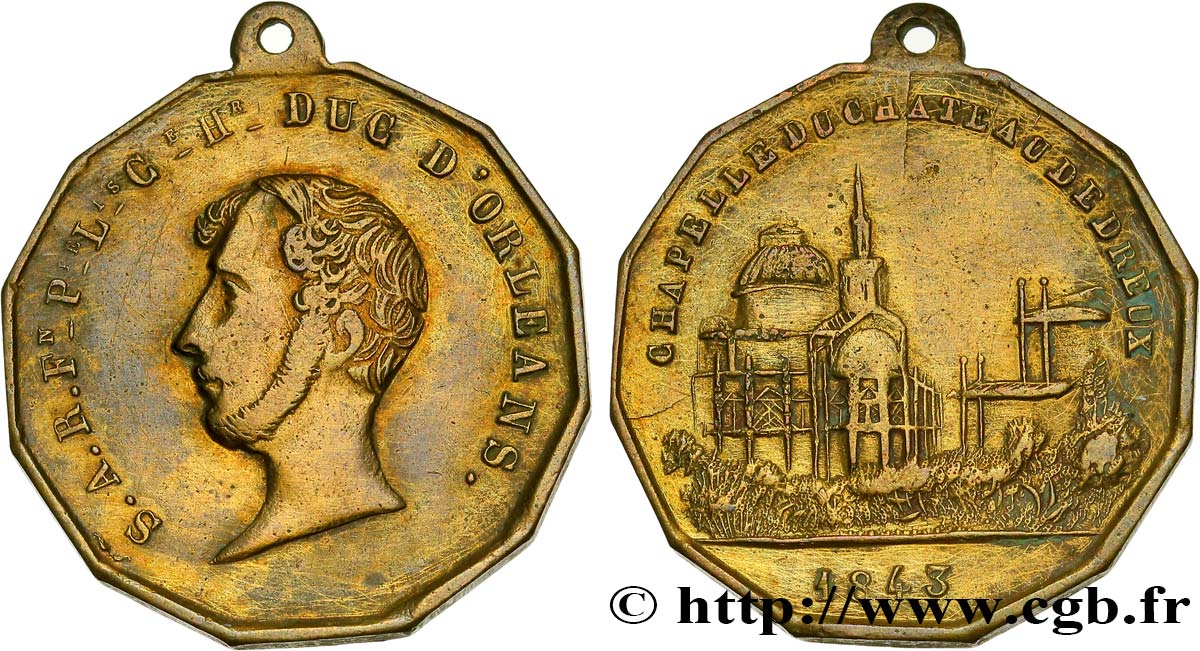
Type : Médaille de la chapelle du château de Dreux
Date: 1843
Mint name / Town : 28 - Dreux
Metal : copper
Diameter : 25 mm
Orientation dies : 12 h.
Weight : 6,2 g.
Edge : lisse
Coments on the condition:
Intéressante petite médaille, avec une usure marquée mais de beaux reliefs et un aspect homogène
Obverse
Obverse legend : S. A. R. F P L C H DUC D’ORLÉANS..
Obverse description : Tête à gauche de Louis-Philippe-Albert d'Orléans.
Reverse
Reverse legend : CHAPELLE DU CHATEAU DE DREUX.
Reverse description : Vue de la Chapelle du château de Dreux en travaux.
Commentary
Signature indéterminée sur la ligne d’exergue au revers.
Louis-Philippe-Albert d'Orléans, comte de Paris, est un aristocrate français né au palais des Tuileries à Paris, le 24 août 1838 et mort à Stowe House, dans le Buckinghamshire (Royaume-Uni) le 8 septembre 1894 à 56 ans.
Prince royal de France de 1842 à 1848, il est prétendant orléaniste au trône de France de 1848 à 1883 sous le nom de Louis-Philippe II, puis de 1883 à 1894 sous celui de Philippe VII. C’est également un écrivain et un combattant de la guerre de Sécession.
À sa naissance, le prince Philippe incarne la vitalité de la maison d’Orléans et reçoit le titre de comte de Paris de son grand-père, le roi des Français Louis-Philippe Ier. Quatre ans plus tard, en 1842, l’enfant perd son père, Ferdinand-Philippe de France, et devient donc l’héritier de la monarchie de Juillet. Or, le tout nouveau prince royal est trop jeune pour représenter la stabilité et pour rassurer les opposants à la politique de son grand-père. Par conséquent, lorsque éclate la révolution de 1848, sa famille est incapable de le faire proclamer roi des Français et la Deuxième République se met en place. Commence alors une longue période d’exil qui dure jusqu’en 1871 et durant laquelle le prétendant orléaniste trompe difficilement son ennui. Au début des années 1860, Philippe d’Orléans se rend aux États-Unis pour s’engager dans la guerre de Sécession et, de cette expérience, il ramène une Histoire de la Guerre civile en Amérique.
La chapelle royale Saint-Louis de Dreux est la nécropole de la famille d'Orléans. Elle est située dans l'enceinte du château de Dreux.
La chapelle primitive de 1816 fut alors complétée par des ajouts de style néo-gothique et de 1843 à 1845 ses nombreuses fenêtres furent garnies de somptueux vitraux exécutés à la manufacture de Sèvres, selon la technique de fabrication des verres teints dans la masse. Les douze grandes fenêtres ogivales du transept sont ornées de vitraux représentant des saints sur fond "bleu de Sèvres", dont les cartons ont été dessinés par Ingres, qui reproduisit à cette occasion quatre des vitraux qu'il exécuta pour la chapelle funéraire de Neuilly en mémoire du prince Ferdinand, fils aîné de Louis-Philippe, mort dans un accident en 1842. Viollet-le-Duc a dessiné les pinacles gothiques encadrant chacun des douze personnages. Cinq autres vitraux illustrant la vie de Saint-Louis ornent la chapelle de la Vierge ; trois ont disparu. Les dessins sont d'Eugène Delacroix, Hippolyte Flandrin, Georges Rouget, Claudius Jacquand, Horace Vernet, Charles-Marie Bouton et Wattier.
La chapelle royale fait l’objet d’un classement au titre des monuments historiques depuis le 12 décembre 19771..
Undetermined signature on the exergue line on the reverse.
Louis-Philippe-Albert d'Orléans, Count of Paris, was a French aristocrat born at the Tuileries Palace in Paris on August 24, 1838 and died at Stowe House, Buckinghamshire (United Kingdom) on September 8, 1894 at the age of 56..
Prince Royal of France from 1842 to 1848, he was an Orleanist pretender to the throne of France from 1848 to 1883 under the name of Louis-Philippe II, then from 1883 to 1894 under that of Philippe VII. He was also a writer and a Civil War fighter..
At his birth, Prince Philippe embodied the vitality of the House of Orléans and received the title of Count of Paris from his grandfather, King Louis-Philippe I of France.. Four years later, in 1842, the child lost his father, Ferdinand-Philippe of France, and thus became the heir to the July Monarchy.. However, the brand new royal prince is too young to represent stability and to reassure opponents of his grandfather's policies.. Therefore, when the revolution of 1848 broke out, his family was unable to have him proclaimed King of the French and the Second Republic was established.. Then began a long period of exile which lasted until 1871 and during which the Orleanist pretender had difficulty in overcoming his boredom.. In the early 1860s, Philippe d'Orléans went to the United States to fight in the American Civil War and, from this experience, he brought back a History of the Civil War in America.
The royal chapel of Saint-Louis de Dreux is the necropolis of the Orléans family. It is located within the grounds of the Château de Dreux.
The original chapel of 1816 was then completed with neo-Gothic style additions and from 1843 to 1845 its numerous windows were decorated with sumptuous stained glass windows made at the Sèvres factory, using the technique of manufacturing mass-dyed glass.. The twelve large ogival windows of the transept are decorated with stained glass windows representing saints on a \\\"Sèvres blue\\\" background, the cartoons for which were designed by Ingres, who reproduced on this occasion four of the stained glass windows he executed for the funeral chapel of Neuilly in memory of Prince Ferdinand, eldest son of Louis-Philippe, who died in an accident in 1842.. Viollet-le-Duc designed the Gothic pinnacles framing each of the twelve figures. Five other stained glass windows illustrating the life of Saint Louis adorn the chapel of the Virgin; three have disappeared. The drawings are by Eugène Delacroix, Hippolyte Flandrin, Georges Rouget, Claudius Jacquand, Horace Vernet, Charles-Marie Bouton and Wattier.
The royal chapel has been classified as a historic monument since December 12, 19771.
Louis-Philippe-Albert d'Orléans, comte de Paris, est un aristocrate français né au palais des Tuileries à Paris, le 24 août 1838 et mort à Stowe House, dans le Buckinghamshire (Royaume-Uni) le 8 septembre 1894 à 56 ans.
Prince royal de France de 1842 à 1848, il est prétendant orléaniste au trône de France de 1848 à 1883 sous le nom de Louis-Philippe II, puis de 1883 à 1894 sous celui de Philippe VII. C’est également un écrivain et un combattant de la guerre de Sécession.
À sa naissance, le prince Philippe incarne la vitalité de la maison d’Orléans et reçoit le titre de comte de Paris de son grand-père, le roi des Français Louis-Philippe Ier. Quatre ans plus tard, en 1842, l’enfant perd son père, Ferdinand-Philippe de France, et devient donc l’héritier de la monarchie de Juillet. Or, le tout nouveau prince royal est trop jeune pour représenter la stabilité et pour rassurer les opposants à la politique de son grand-père. Par conséquent, lorsque éclate la révolution de 1848, sa famille est incapable de le faire proclamer roi des Français et la Deuxième République se met en place. Commence alors une longue période d’exil qui dure jusqu’en 1871 et durant laquelle le prétendant orléaniste trompe difficilement son ennui. Au début des années 1860, Philippe d’Orléans se rend aux États-Unis pour s’engager dans la guerre de Sécession et, de cette expérience, il ramène une Histoire de la Guerre civile en Amérique.
La chapelle royale Saint-Louis de Dreux est la nécropole de la famille d'Orléans. Elle est située dans l'enceinte du château de Dreux.
La chapelle primitive de 1816 fut alors complétée par des ajouts de style néo-gothique et de 1843 à 1845 ses nombreuses fenêtres furent garnies de somptueux vitraux exécutés à la manufacture de Sèvres, selon la technique de fabrication des verres teints dans la masse. Les douze grandes fenêtres ogivales du transept sont ornées de vitraux représentant des saints sur fond "bleu de Sèvres", dont les cartons ont été dessinés par Ingres, qui reproduisit à cette occasion quatre des vitraux qu'il exécuta pour la chapelle funéraire de Neuilly en mémoire du prince Ferdinand, fils aîné de Louis-Philippe, mort dans un accident en 1842. Viollet-le-Duc a dessiné les pinacles gothiques encadrant chacun des douze personnages. Cinq autres vitraux illustrant la vie de Saint-Louis ornent la chapelle de la Vierge ; trois ont disparu. Les dessins sont d'Eugène Delacroix, Hippolyte Flandrin, Georges Rouget, Claudius Jacquand, Horace Vernet, Charles-Marie Bouton et Wattier.
La chapelle royale fait l’objet d’un classement au titre des monuments historiques depuis le 12 décembre 19771..
Undetermined signature on the exergue line on the reverse.
Louis-Philippe-Albert d'Orléans, Count of Paris, was a French aristocrat born at the Tuileries Palace in Paris on August 24, 1838 and died at Stowe House, Buckinghamshire (United Kingdom) on September 8, 1894 at the age of 56..
Prince Royal of France from 1842 to 1848, he was an Orleanist pretender to the throne of France from 1848 to 1883 under the name of Louis-Philippe II, then from 1883 to 1894 under that of Philippe VII. He was also a writer and a Civil War fighter..
At his birth, Prince Philippe embodied the vitality of the House of Orléans and received the title of Count of Paris from his grandfather, King Louis-Philippe I of France.. Four years later, in 1842, the child lost his father, Ferdinand-Philippe of France, and thus became the heir to the July Monarchy.. However, the brand new royal prince is too young to represent stability and to reassure opponents of his grandfather's policies.. Therefore, when the revolution of 1848 broke out, his family was unable to have him proclaimed King of the French and the Second Republic was established.. Then began a long period of exile which lasted until 1871 and during which the Orleanist pretender had difficulty in overcoming his boredom.. In the early 1860s, Philippe d'Orléans went to the United States to fight in the American Civil War and, from this experience, he brought back a History of the Civil War in America.
The royal chapel of Saint-Louis de Dreux is the necropolis of the Orléans family. It is located within the grounds of the Château de Dreux.
The original chapel of 1816 was then completed with neo-Gothic style additions and from 1843 to 1845 its numerous windows were decorated with sumptuous stained glass windows made at the Sèvres factory, using the technique of manufacturing mass-dyed glass.. The twelve large ogival windows of the transept are decorated with stained glass windows representing saints on a \\\"Sèvres blue\\\" background, the cartoons for which were designed by Ingres, who reproduced on this occasion four of the stained glass windows he executed for the funeral chapel of Neuilly in memory of Prince Ferdinand, eldest son of Louis-Philippe, who died in an accident in 1842.. Viollet-le-Duc designed the Gothic pinnacles framing each of the twelve figures. Five other stained glass windows illustrating the life of Saint Louis adorn the chapel of the Virgin; three have disappeared. The drawings are by Eugène Delacroix, Hippolyte Flandrin, Georges Rouget, Claudius Jacquand, Horace Vernet, Charles-Marie Bouton and Wattier.
The royal chapel has been classified as a historic monument since December 12, 19771.
Historical background
LOUIS-PHILIPPE I
(7/08/1830-24/02/1848)
Born in Paris in 1773, Louis-Philippe is the eldest son of Louis-Philippe Joseph, Duke of Orléans (Philippe-Égalité), guillotined in 1793 for corruption after having voted for the death of his cousin Louis XVI. He successively bears the titles of Duke of Valois, Chartres and Orleans from 1793. Favorable to the Revolution, like his father, he nevertheless had to take refuge in Switzerland then he traveled to Scandinavia, the United States and finally settled in England in 1801.. The Restoration allows him to find the immense possessions of his family but he remains considered as a potential rival by Louis XVIII who receives him coldly. Refugee in England during the Hundred Days, he returned to France in 1817. Greedy for gain, he gave his support to the opposition represented by the liberal party while relying on the possessing upper middle class.. The days of 1830 gave him the opportunity to come to power after having adhered to the tricolor flag and multiplied the promises. He became on July 31, 1830 lieutenant general of the kingdom then king of the French on August 7. His reign, under a liberal appearance, will become that of the bourgeoisie and business circles while the oppositions (Legitimists, Bonapartists, Republicans and Socialists) are maintained illegally.. His peace policy and his authority then earned him significant prestige with the European courts.. The banker Laffitte is Prime Minister. La Fayette is one of the architects of this "bourgeois revolution". On March 13, 1831, Casimir Périer replaced Laffitte. France intervenes in Belgium in August 1831 to counter the Dutch. The Legitimists, with the rue des Prouvaires plot, try to establish Henry V as king while his mother tries to raise the Vendée. She was arrested on December 3, 1832 in Nantes.. The cholera epidemic kills more than ten thousand people in Paris, including Casimir Périer. General Lamarque's funeral was the occasion for an attempted republican uprising, crushed in blood (see. Wretched). The French occupy Antwerp on December 23, 1832.. Fieschi's attack of July 28, 1835 against Louis-Philippe kills eighteen people including Marshal Mortier. The first Paris-Orléans railway line and the July column were inaugurated on October 24, 1837 and July 28, 1840 respectively.. The year 1840 marked a turning point in the regime, with great ministerial instability before having the Guizot ministry ("Get rich!").. Prince Louis-Napoleon Bonaparte, after a second putsch attempt, was sentenced to life imprisonment and locked up in Fort Ham from which he escaped in 1846. Napoleon's ashes are brought from Saint Helena and transferred to Les Invalides. From 1841, Louis-Philippe committed France to the path of the total conquest of Algeria, already begun under Charles X, while a major economic boom developed in Metropolitan France.. A law in 1841 limits child labor to 12 hours. The first serious railway accident took place on the Paris-Versailles line and caused 45 deaths on May 8, 1842. On July 13, the Duke of Orleans, the king's eldest son, died accidentally. On May 16, 1843, the Duke of Aumale took the smala of Abd-el-Kader who managed to escape. Bugeaud, Governor of Algeria, is made Marshal. 1843 is also the beginning of the Entente Cordiale and the visit of Queen Victoria to France. The French beat the Moroccans at Isly. Abd-el-Kader surrenders on December 23, 1847. The refusal of reforms leads to the fall of the regime during the Banquet Campaign and Louis-Philippe, dethroned on February 24, 1848, takes refuge in England after having abdicated in favor of his grandson..
 Report a mistake
 Print the page
 Share my selection
 Ask a question
 Consign / sell
Related articles
 Full data



Your Recently Viewed Items

1000 Francs Fauté WEST AFRICAN STATES 1981 P.707Kb VF
10.00 €

200 Francs MONTESQUIEU FRANCE 1981 F.70.01 F+
6.00 €

GALLIA BELGICA - REMI (Area of Reims) Potin au guerrier courant XF
29.00 €
CARIA - CARIAN ISLANDS - PERAIA OF RHODES Drachme MS
320.00 €

ADVERTISING AND ADVERTISING TOKENS AND JETONS Léonard de Vinci XF
3.00 €

Traiano e la Guerra Partica nelle fonti numismatiche PETTAZZONI Fabio
20.00 €
cgbfr.com numismatists


