


fme_687095 - THE 100 GREATEST MASTERPIECES Médaille, Marc-Aurèle
Not available.
Item sold on our e-shop (2021)
Price : 55.00 €
Item sold on our e-shop (2021)
Price : 55.00 €
Type : Médaille, Marc-Aurèle
Date: 1974
Metal : silver
Millesimal fineness : 800 ‰
Diameter : 50,5 mm
Orientation dies : 12 h.
Engraver BLAKER Clayton
Weight : 64,98 g.
Edge : lisse + ARGENT 1ER TITRE + losange + 74 + P + CRABE
Puncheon : Crabe
Coments on the condition:
Traces de manipulation et d’oxydation irisée et noire sur la tranche et le dessus de la médaille
Obverse
Obverse legend : ANÉPIGRAPHE.
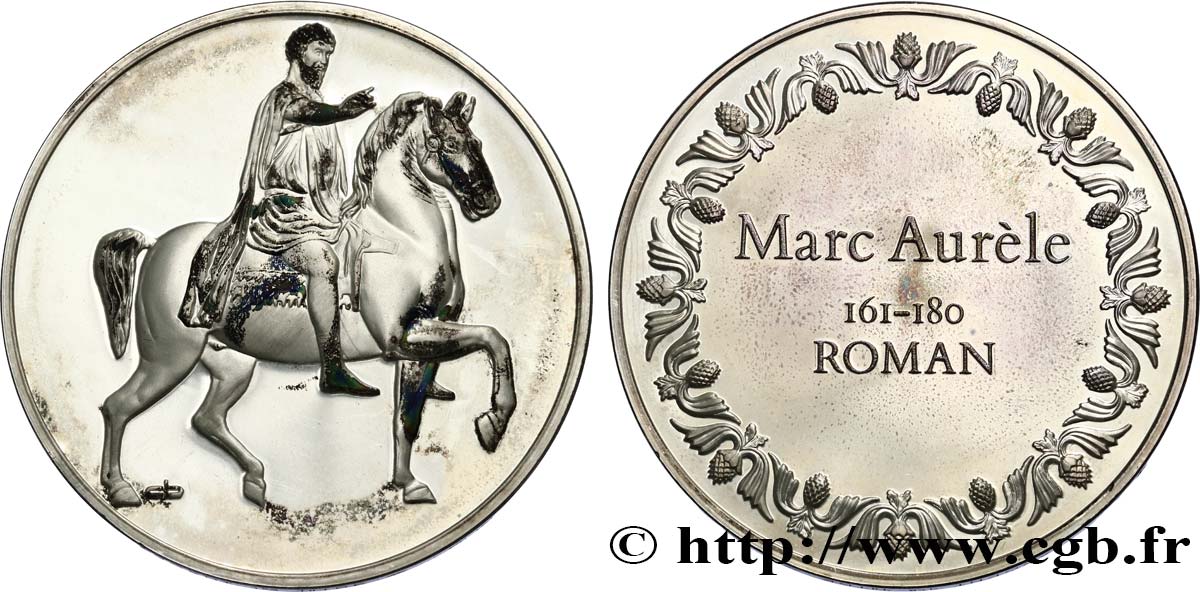
Obverse description : Représentation de la statue de Marc-Aurèle (161-180 après J.-C).
Monogramme du graveur.
Reverse
Reverse legend : MARC AURÈLE / 161-180 / ROMAN.
Reverse description : Légende en 3 lignes entourée d’une frise végétale.
Commentary
Exemplaire issu du médaillier Franklin qui met à l’honneur la statue de Marc-Aurèle. Il était un empereur romain et le dernier des souverains connus sous le nom des “cinq bons empereurs”. Son règne fut marqué par des conflits militaires notamment avec l’empire Parthe, les peuples germaniques et le royaume rebelle d’Arménie. Sa statue équestre fut érigée pour célébrer ses victoires militaires. Elle fut, à l’origine, installée dans l’un des forums impériaux de Rome puis déplacée plusieurs fois. Elle est maintenant conservée dans les musées du Capitole à Rome. une copie a été installé sur son dernier emplacement connu sur la place du Capitole en 1538
Médaille sculptée par Clayton Blaker.
Théoriquement, le poinçon crabe est censé indiquer un titrage à 800 millièmes.
example from the Franklin medalist that honors the statue of Marcus Aurelius. He was a Roman emperor and the last of the sovereigns known as the “five good emperors”. His reign was marked by military conflicts, notably with the Parthian Empire, the Germanic peoples and the rebel kingdom of Armenia. His equestrian statue was erected to celebrate his military victories. It was originally installed in one of the imperial forums of Rome and then moved several times. It is now kept in the Capitoline Museums in Rome. A example was installed in its last known location in the Capitoline Square in 1538. Medal sculpted by Clayton Blaker. Theoretically, the crab mark is supposed to indicate a fineness of 800 thousandths.
Médaille sculptée par Clayton Blaker.
Théoriquement, le poinçon crabe est censé indiquer un titrage à 800 millièmes.
example from the Franklin medalist that honors the statue of Marcus Aurelius. He was a Roman emperor and the last of the sovereigns known as the “five good emperors”. His reign was marked by military conflicts, notably with the Parthian Empire, the Germanic peoples and the rebel kingdom of Armenia. His equestrian statue was erected to celebrate his military victories. It was originally installed in one of the imperial forums of Rome and then moved several times. It is now kept in the Capitoline Museums in Rome. A example was installed in its last known location in the Capitoline Square in 1538. Medal sculpted by Clayton Blaker. Theoretically, the crab mark is supposed to indicate a fineness of 800 thousandths.
Historical background
THE 100 GREATEST MASTERPIECES
(1974-1982)
Collection of medals issued by the Medallier in a limited edition. Once a month, at the price of 180 Frs, a medal was sent. This collection took place between 1974 and 1982. Each medal normally bears on the edge the state hallmark guaranteeing the silver mintage, the P mark for the Proof quality, the year of minting and the hallmark of Master of the Medallion..
 Report a mistake
 Print the page
 Share my selection
 Ask a question
 Consign / sell
 Full data
cgbfr.com numismatists


