


- Accueil
- >
- >
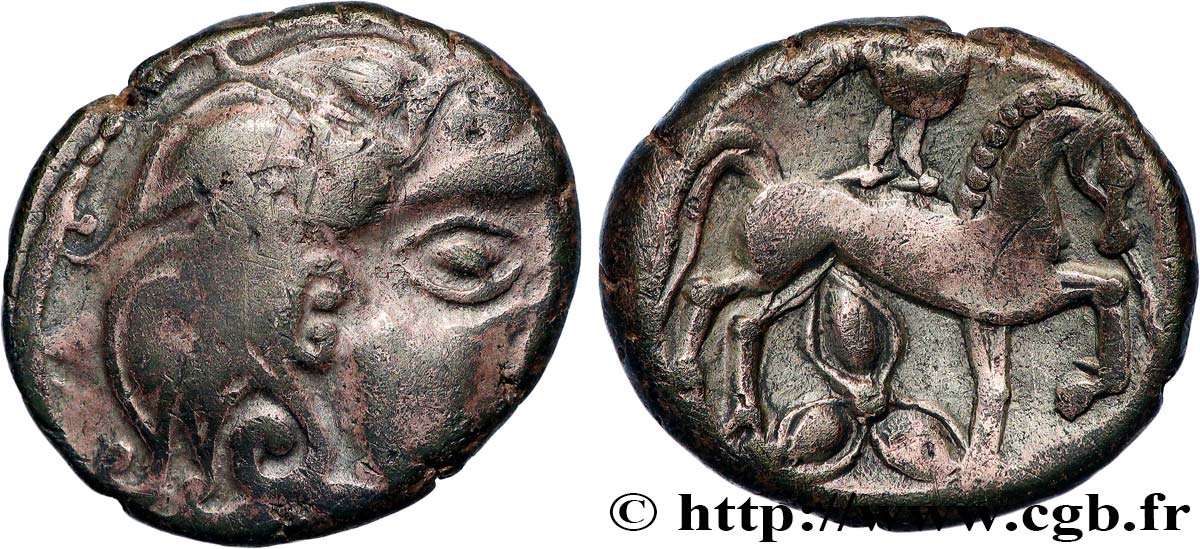
bga_843126 - GALLIA - LEMOVICES (Area of Limoges) Statère à la grue
Not available.
Item sold on our e-shop (2024)
Price : 800.00 €
Item sold on our e-shop (2024)
Price : 800.00 €
Type : Statère à la grue
Date: c. 100-50 BC.
Mint name / Town : Limoges (87)
Metal : electrum
Diameter : 18 mm
Orientation dies : 2 h.
Weight : 5,52 g.
Rarity : R2
Coments on the condition:
Flan épais et ovale, centré. Une tête agréable au droit, quelques faiblesses. Beau revers bien venu à la frappe, usure superficielle. Patine de collection
Catalogue references :
Obverse
Obverse legend : ANÉPIGRAPHE.
Obverse description : Tête à droite, la chevelure en grosses mèches aquitaniques.
Reverse
Reverse legend : ANÉPIGRAPHE.
Reverse description : Cheval à droite, une grue posée sur la croupe et un trèfle entre les jambes.
Commentary
Cette variété correspond à la classe II de la série 1076 “à la grue et au trèfle” du Nouvel Atlas.
Le motif d‘accolade partant de la bouche, devant le visage, est parfois interprété comme le signe de la parole ; on retrouve ce détail sur les statères des Bituriges, mais aussi sous forme des deux dauphins, plus ou moins stylisés, sur la plupart des monnaies d’argent du sud, dites “à la croix”. On notera qu’au revers, le cheval a lui aussi une sorte de volute qui lui sort de la bouche.
This variety corresponds to class II of series 1076 “with the crane and the clover” of the New Atlas. The hug pattern starting from the mouth, in front of the face, is sometimes interpreted as the sign of speech; we find this detail on the staters of the Bituriges, but also in the form of the two dolphins, more or less stylized, on most of the silver coins of the south, known as “the cross”. Note that on the reverse, the horse also has a sort of volute coming out of its mouth.
Le motif d‘accolade partant de la bouche, devant le visage, est parfois interprété comme le signe de la parole ; on retrouve ce détail sur les statères des Bituriges, mais aussi sous forme des deux dauphins, plus ou moins stylisés, sur la plupart des monnaies d’argent du sud, dites “à la croix”. On notera qu’au revers, le cheval a lui aussi une sorte de volute qui lui sort de la bouche.
This variety corresponds to class II of series 1076 “with the crane and the clover” of the New Atlas. The hug pattern starting from the mouth, in front of the face, is sometimes interpreted as the sign of speech; we find this detail on the staters of the Bituriges, but also in the form of the two dolphins, more or less stylized, on most of the silver coins of the south, known as “the cross”. Note that on the reverse, the horse also has a sort of volute coming out of its mouth.
Historical background
GALLIA - LEMOVICES (Area of Limoges)
(2nd - 1st century BC)
Celtic people who left their name in Limoges and Limousin. The origin of its name comes once again from lemo or limo which can be translated as elm. Skilled traders, specialized in export, they were perhaps the secret allies of the Romans which could explain Caesar's silence on this people who nevertheless extended their power to the Atlantic coasts. Nevertheless, Caesar estimates at ten thousand men the Lemovice contingent sent against him to clear Alesia in 52 BC. After the conquest, from 50 BC, Caesar would have installed several Roman camps on the Lemovice territory in order to be able to monitor the Arvernian territory. Caesar (BG. VII, 4, 75, 88). Strabo (G. IV, 2, 2).
 Report a mistake
 Print the page
 Share my selection
 Ask a question
 Consign / sell
Related articles

 Full data


Your Recently Viewed Items
5 Dollars CONFEDERATE STATES OF AMERICA 1861 P.16b F
240.00 €
20 Dollars CONFEDERATE STATES OF AMERICA 1863 P.61b VF
40.00 €

100 Patacas MACAU 1984 P.061a UNC-
86.00 €
CARACALLA Tétradrachme syro-phénicien AU
600.00 €

TETRICUS I Antoninien AU
40.00 €
100 Francs REUNION ISLAND 1944 P.24 AU-
2898.00 €
cgbfr.com numismatists


