


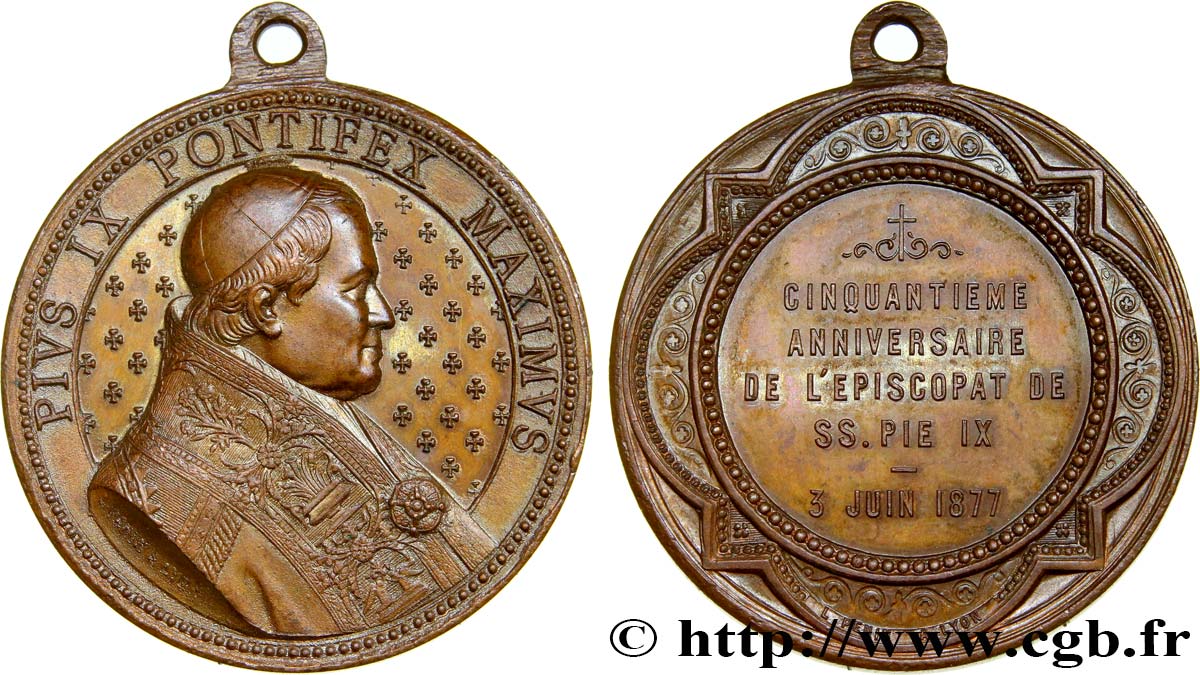
E-auction 411-323538 - fme_438668 - ITALY - PAPAL STATES - PIUS IX (Giovanni Maria Mastai Ferretti) Médaille, Cinquantième anniversaire de l’épiscopat
You must signin and be an approved bidder to bid, LOGIN TO BID. Accounts are subject to approval and the approval process takes place within 48 hours. Do not wait until the day a sale closes to register. Clicking on « bid » constitutes acceptance of the terms of use of cgb.fr private e-auctions.
Bids must be placed in whole Euro amounts only. The sale will start closing at the time stated on the item description; any bids received at the site after the closing time will not be executed. Transmission times may vary and bids could be rejected if you wait until the last second. For further information ckeck the E-auctions F.A.Q.
NO BUYER'S FEE.
NO BUYER'S FEE.
| Estimate : | 80 € |
| Price : | 18 € |
| Maximum bid : | 25 € |
| End of the sale : | 01 March 2021 18:37:30 |
| bidders : | 7 bidders |
Type : Médaille, Cinquantième anniversaire de l’épiscopat
Date: 1877
Mint name / Town : France
Metal : copper
Diameter : 37,5 mm
Orientation dies : 12 h.
Engraver PENIN Ludovic (1830-1868),Maison PENIN PONCET
Weight : 14,61 g.
Edge : Lisse
Puncheon : sans poinçon
Coments on the condition:
Superbe exemplaire avec une agréable patine brune et brillante. Bélière d’origine
Obverse
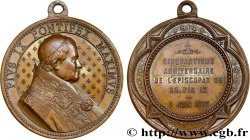
Obverse legend : PIVS IX PONTIFEX MAXIMVS.
Obverse description : Buste habillé à droite du pape Pie IX sur fond de petites croix, signé sur le tranché du bras : L. PENIN à LYON.
Reverse
Reverse legend : CINQUANTIÈME / ANNIVERSAIRE / DE L’ÉPISCOPAT DE / SS. PIE IX / - / 3 JUIN 1877.
Reverse description : Légende en 5 lignes horizontales. Signé : L. PENIN à LYON.
Commentary
Diamètre sans bélière : 32,5 mm.
Selon l’article de Jean-Pol Donné dans le Bulletin Municipal Officiel de Lyon, « Les Pénin, 170 ans de médailles (1ère partie et deuxième partie)», Ludovic Penin (1830-1868), fils de Marius Penin (1807-1880) et élève de Vibert et Fabisch à l’Ecole des Beaux-Arts de Lyon composera surtout des médailles religieuses et obtiendra d’ailleurs le titre de « graveur pontifical » en 1864. En 1867, Ludovic Penin décide l’acquisition de l’atelier d’estampage de boutons métalliques Mouterde-Billion à Monchat afin de fabriquer les médailles qu’il grave et édite. Ainsi est née la Maison Penin qui a poursuivi son activité sur le même site jusqu’au début du XXIe.
Mais en février 1868, la mort de Ludovic Penin, à l’âge de 38 ans, met en péril cette entreprise. Sur la recommandation de son ami Fabisch, Marius, revenu à Lyon, forma un jeune sculpteur : Alexandre Poncet. En deux ans, Poncet réussit à maîtriser la technique de la gravure en médailles. Dès lors, il se partage entre ses créations propres et la diffusion des médailles issues des poinçons laissés par Marius et Ludovic Penin. La Maison Penin, devenue Penin-Poncet après le mariage d’Alexandre Poncet avec la fille de Ludovic Penin, connait alors une grande prospérité favorisée par l’abandon du privilège de la Monnaie de Paris en 1893.
Diameter without bail: 32.5 mm.
According to the article by Jean-Pol Donné in the Official Municipal Bulletin of Lyon, \\\"The Pénins, 170 years of medals (part 1 and part 2)\\\", Ludovic Penin (1830-1868), son of Marius Penin (1807-1880) and student of Vibert and Fabisch at the Ecole des Beaux-Arts in Lyon, mainly composed religious medals and obtained the title of \\\"pontifical engraver\\\" in 1864.. In 1867, Ludovic Penin decided to acquire the Mouterde-Billion metal button stamping workshop in Monchat in order to manufacture the medals that he engraved and published.. This is how Maison Penin was born, which continued its activity on the same site until the beginning of the 21st century..
But in February 1868, the death of Ludovic Penin, at the age of 38, jeopardized this enterprise.. On the recommendation of his friend Fabisch, Marius, having returned to Lyon, trained a young sculptor: Alexandre Poncet. In two years, Poncet succeeded in mastering the technique of medal engraving.. From then on, he divided his time between his own creations and the distribution of medals from the hallmarks left by Marius and Ludovic Penin.. The Maison Penin, which became Penin-Poncet after the marriage of Alexandre Poncet to the daughter of Ludovic Penin, then enjoyed great prosperity, encouraged by the abandonment of the privilege of the Paris Mint in 1893.
Selon l’article de Jean-Pol Donné dans le Bulletin Municipal Officiel de Lyon, « Les Pénin, 170 ans de médailles (1ère partie et deuxième partie)», Ludovic Penin (1830-1868), fils de Marius Penin (1807-1880) et élève de Vibert et Fabisch à l’Ecole des Beaux-Arts de Lyon composera surtout des médailles religieuses et obtiendra d’ailleurs le titre de « graveur pontifical » en 1864. En 1867, Ludovic Penin décide l’acquisition de l’atelier d’estampage de boutons métalliques Mouterde-Billion à Monchat afin de fabriquer les médailles qu’il grave et édite. Ainsi est née la Maison Penin qui a poursuivi son activité sur le même site jusqu’au début du XXIe.
Mais en février 1868, la mort de Ludovic Penin, à l’âge de 38 ans, met en péril cette entreprise. Sur la recommandation de son ami Fabisch, Marius, revenu à Lyon, forma un jeune sculpteur : Alexandre Poncet. En deux ans, Poncet réussit à maîtriser la technique de la gravure en médailles. Dès lors, il se partage entre ses créations propres et la diffusion des médailles issues des poinçons laissés par Marius et Ludovic Penin. La Maison Penin, devenue Penin-Poncet après le mariage d’Alexandre Poncet avec la fille de Ludovic Penin, connait alors une grande prospérité favorisée par l’abandon du privilège de la Monnaie de Paris en 1893.
Diameter without bail: 32.5 mm.
According to the article by Jean-Pol Donné in the Official Municipal Bulletin of Lyon, \\\"The Pénins, 170 years of medals (part 1 and part 2)\\\", Ludovic Penin (1830-1868), son of Marius Penin (1807-1880) and student of Vibert and Fabisch at the Ecole des Beaux-Arts in Lyon, mainly composed religious medals and obtained the title of \\\"pontifical engraver\\\" in 1864.. In 1867, Ludovic Penin decided to acquire the Mouterde-Billion metal button stamping workshop in Monchat in order to manufacture the medals that he engraved and published.. This is how Maison Penin was born, which continued its activity on the same site until the beginning of the 21st century..
But in February 1868, the death of Ludovic Penin, at the age of 38, jeopardized this enterprise.. On the recommendation of his friend Fabisch, Marius, having returned to Lyon, trained a young sculptor: Alexandre Poncet. In two years, Poncet succeeded in mastering the technique of medal engraving.. From then on, he divided his time between his own creations and the distribution of medals from the hallmarks left by Marius and Ludovic Penin.. The Maison Penin, which became Penin-Poncet after the marriage of Alexandre Poncet to the daughter of Ludovic Penin, then enjoyed great prosperity, encouraged by the abandonment of the privilege of the Paris Mint in 1893.
Historical background
ITALY - PAPAL STATES - PIUS IX (Giovanni Maria Mastai Ferretti)
(1792-1878)
Pius IX (1792-1878), elected after a vacancy of only fifteen days, had the longest pontificate of the 19th century. After a happy start, showing in him, if not a liberal, at least an innovator between 1846-1848, the Roman revolution threw him back into conservatism. After the February Revolution in France, unrest spread throughout Europe and even Rome. Faced with the refusal of Pius IX to declare war on Austria, the republic was proclaimed on February 9 at the instigation of Mazzini and Garibaldi. On June 1, an expeditionary force was sent to Rome to restore order. The French seized the city on July 3 and restored Pius IX. He could not prevent Victor Emmanuel II from achieving Italian unity and found himself isolated from 1861. Rome resisted for another nine years before falling into the hands of the King of Italy and becoming the capital in 1870. Pius IX saw the nine last years of his life considering himself a prisoner of Italian power.
 Report a mistake
 Print the page
 Share my selection
 Ask a question
 Consign / sell
Related articles

 Full data



Your Recently Viewed Items
ARDENNES - PRINCIPALITY OF ARCHES-CHARLEVILLE - CHARLES I GONZAGA Double tournoi
5.00 €
ILE DE FRANCE - TOWNS AND GENTRY Daniel Voysin de La Noiraye, maître des requê
18.00 €
ITALY - PAPAL STATES - PIUS IX (Giovanni Maria Mastai Ferretti) Médaille, Cinqu
18.00 €

RUSSIA 1 Rouble 300e anniversaire de la Dynastie des Romanov 1913 Saint-Petersbo
300.00 €

ARDENNES - PRINCIPALITY OF SEDAN - FREDERIC-MAURICE DE LA TOUR D'AUVERGNE Double
45.00 €

HENRY VI OF LANCASTER Blanc aux écus 23/11/1422 Rouen AU
130.00 €
cgbfr.com numismatists


