


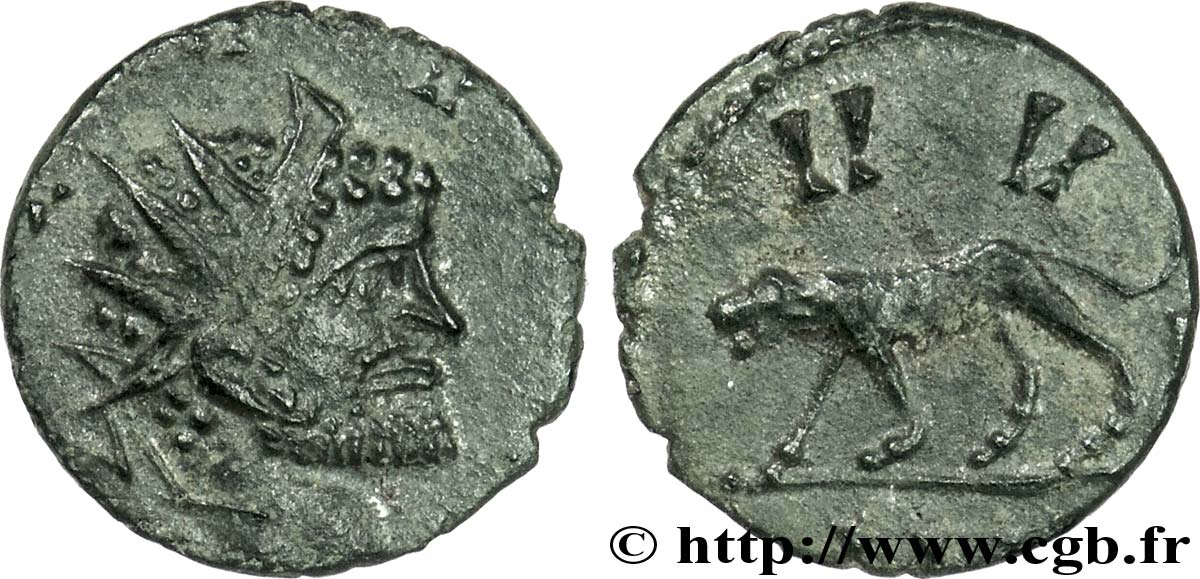
v31_0470 - IMITATIONS OF ROMAN COINS Minimi (imitation d’antoninien)
MONNAIES 31 (2007)
Starting price : 120.00 €
Estimate : 180.00 €
unsold lot
Starting price : 120.00 €
Estimate : 180.00 €
unsold lot
Type : Minimi (imitation d’antoninien)
Date: c. 275-280
Mint name / Town : atelier incertain
Metal : billon
Diameter : 11,5 mm
Orientation dies : 12 h.
Weight : 0,76 g.
Coments on the condition:
Exemplaire sur un tout petit flan, bien centré où les légendes ne sont pas visibles au droit et tronquées au revers. Portrait magnifique. Joli revers. Magnifique patine vert profond
Obverse
Obverse description : Tête radiée à droite (O).
Reverse
Reverse legend : V V.
Reverse description : Panthère passant à gauche.
Commentary
Poids très léger. Sans argenture. Le revers fait penser à l’émission dite du “bestiaire” de Gallien (267-268) tandis que le portrait semble emprunté au monnayage de Claude II le Gothique. Ruban de type 1. .
Very light weight. Without silver plating. The reverse is reminiscent of the so-called “bestiary” issue of Gallienus (267-268) while the portrait seems to be borrowed from the coinage of Claudius II the Gothic. Type 1 ribbon.
Very light weight. Without silver plating. The reverse is reminiscent of the so-called “bestiary” issue of Gallienus (267-268) while the portrait seems to be borrowed from the coinage of Claudius II the Gothic. Type 1 ribbon.
Historical background
IMITATIONS OF ROMAN COINS
(3rd century AD)
After the defeat of Vercingetorix in 52 BC. -VS. , the pacification was done quickly from the following year. In 50 BC. -VS. , Gaul is subjugated, but the assimilation took place slowly. We know today that Romanization was slow. At the monetary level, the manufacture of Gallic coins did not stop immediately and Roman coins did not flood the new territory.. In fact, the penetration of Roman coins had begun at the end of the 2nd century BC.. -VS. The imitation or copying of Roman coins by Celtic tribes is proof of this.. At the end of hostilities, Gallic coins continued to circulate. New types appeared and types of Celtic inspiration continued to be minted in Gaul until our era, or even later.. They circulated for at least another fifty years until the fall of Nero.. Assimilation was never complete and we still note in the middle of the 3rd century AD, a Celtic reminiscence under the Gallic Empire (260-274). Very quickly, the Gallic engravers seized Roman or Gallo-Roman prototypes, imitated them, copied them, falsified them for the greatest pleasure of modern numismatists..
 Report a mistake
 Print the page
 Share my selection
 Ask a question
 Consign / sell
Your Recently Viewed Items

5 francs IIe type Domard 1833 Lille F.324/28 AU55
156.00 €

Cinq centimes Dupré, grand module 1799 Lille/Paris F.115/82 VF25
33.00 €

10 centimes Marianne, BE (Belle Épreuve) 1991 Pessac F.144/31 var. MS63
5.00 €

2 francs France 1944 F.271/1 XF
4.00 €

50 centimes Morlon, légère 1947 F.194/10 MS62
11.00 €
cgbfr.com numismatists


