


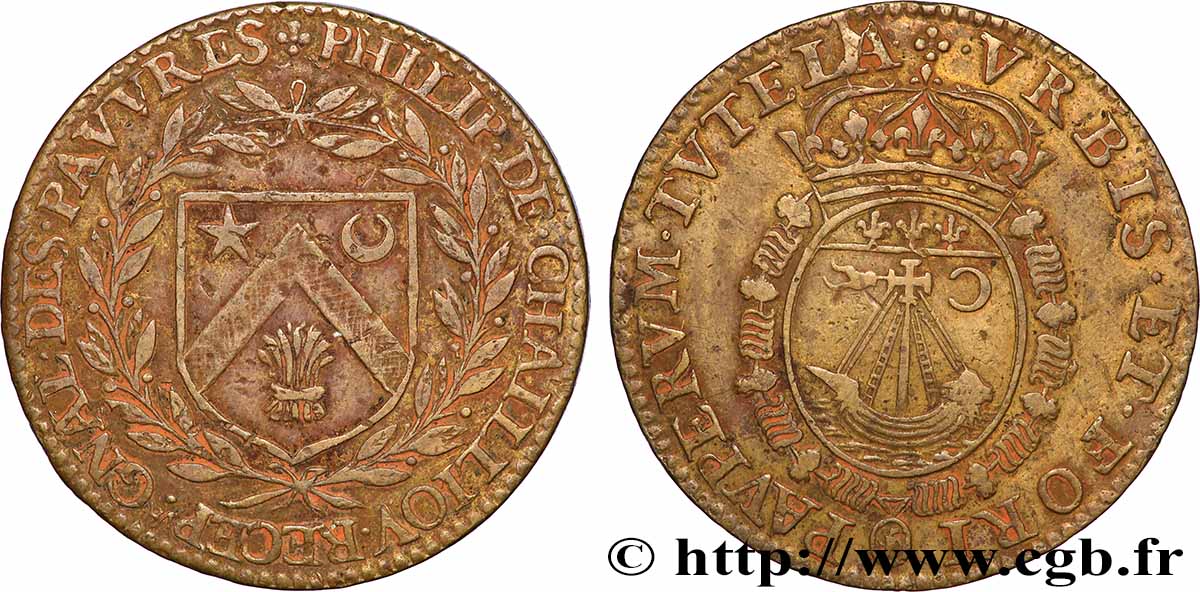
fjt_1167687 - ILE DE FRANCE - TOWNS AND GENTRY Philippe de Chaillol, receveur général des pauvres n.d.
30.00 €(Approx. 34.20$ | 25.80£)
Quantity
Add to your cart

Type : Philippe de Chaillol, receveur général des pauvres
Date: n.d.
Metal : copper
Diameter : 27?5 mm
Orientation dies : 6 h.
Weight : 6,19 g.
Edge : Lisse
Catalogue references :
Predigree :
Collection Henri Labouret
Obverse
Obverse legend : (FLEUR) PHILIP. DE. CHAILLOV. RECEVR. GNAL. DES. PAVVRES.
Obverse description : Armes de Philippe de Chaillou : au chevron, accompagné en chef d'une étoile et d'un croissant, et en pointe d'une gerbe.
Reverse
Reverse legend : (FLEUR). VRBIS. ET. FORI. PAUPERVM. TVTELA..
Reverse description : Armes de la Recette de pauvres de Paris entourées du collier de l'ordre de St Michel.
Reverse translation : La protection des pauvres de la ville et de la voie publique.
Commentary
En 1544, l'administration des pauvres de la ville de Paris fut confié à un Bureau des pauvres: l'administration publique relayait ainsi le clergé dans le rôle d'assistance aux plus démunis. Ce bureau était composé de six membres du Parlement, six avocats, un conseiller à la Chambre des comptes, deux chanoines, trois curés, quatre procureurs au Châtelet et seize notables. Parmi les bourgeois les plus riches était choisi un receveur des pauvres, élu pour deux années et chargé de lever les diverses taxes établies à cet usage.
In 1544, the administration of the poor in the city of Paris was entrusted to a Bureau of the Poor: the public administration thus replaced the clergy in the role of assisting the most destitute. This bureau was composed of six members of Parliament, six lawyers, a councilor at the Chamber of Accounts, two canons, three curates, four prosecutors at the Châtelet and sixteen notables. From among the richest bourgeois was chosen a receiver of the poor, elected for two years and responsible for levying the various taxes established for this purpose
In 1544, the administration of the poor in the city of Paris was entrusted to a Bureau of the Poor: the public administration thus replaced the clergy in the role of assisting the most destitute. This bureau was composed of six members of Parliament, six lawyers, a councilor at the Chamber of Accounts, two canons, three curates, four prosecutors at the Châtelet and sixteen notables. From among the richest bourgeois was chosen a receiver of the poor, elected for two years and responsible for levying the various taxes established for this purpose
Historical background
ILE DE FRANCE - TOWNS AND GENTRY
 Report a mistake
 Print the page
 Share my selection
 Ask a question
 Consign / sell
Related articles

 Full data


Your Recently Viewed Items

ILE DE FRANCE - TOWNS AND GENTRY R. Lescot, receveur général des pauvres de Pa
30.00 €

ILE DE FRANCE - TOWNS AND GENTRY Philippe de Chaillol, receveur général des pa
30.00 €
cgbfr.com numismatists


