


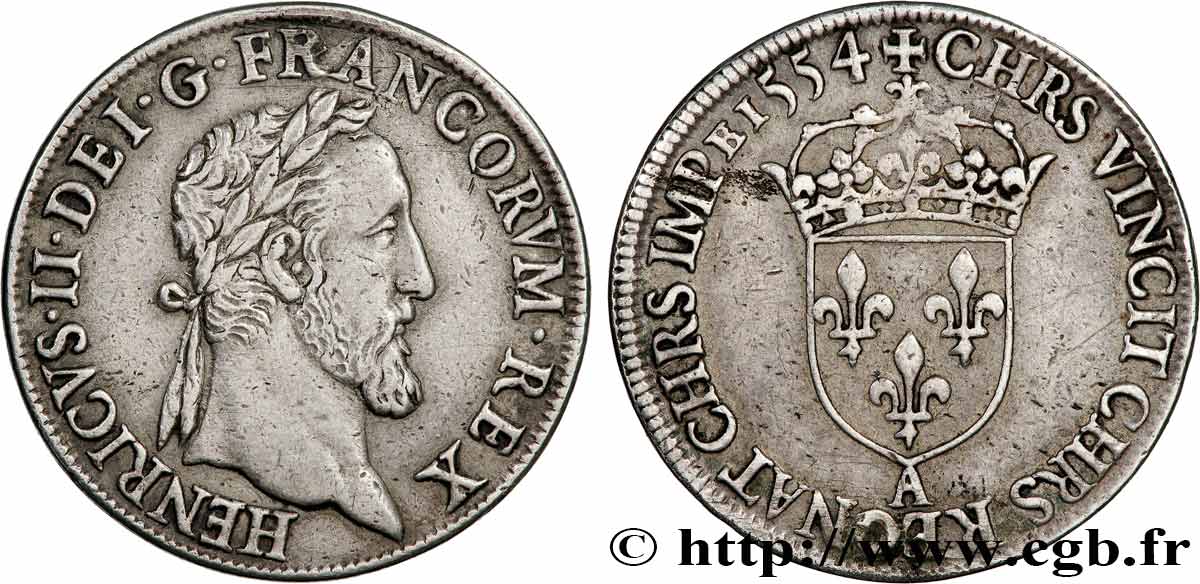
Live auction - bry_778781 - HENRY II Teston à la tête laurée, fabriqué au moulin 1554 Paris, Moulin des Étuves
You must signin and be an approved bidder to bid, LOGIN TO BID. Accounts are subject to approval and the approval process takes place within 48 hours. Do not wait until the day a sale closes to register. Clicking on "BID" constitutes acceptance of the terms of use of cgb.fr private live auctions.
Bids must be placed in whole Euro amounts only. The sale will start closing at the time stated on the item description; any bids received at the site after the closing time will not be executed. Transmission times may vary and bids could be rejected if you wait until the last second. For further information check the Live auction FAQ
All winning bids are subject to a 18% buyer’s fee.
All winning bids are subject to a 18% buyer’s fee.
| Estimate : | 1 200 € |
| Price : | 870 € |
| Maximum bid : | 1 300 € |
| End of the sale : | 07 March 2023 15:49:39 |
| bidders : | 3 bidders |
Type : Teston à la tête laurée, fabriqué au moulin
Date: 1554
Mint name / Town : Paris, Moulin des Étuves
Quantity minted : 544603
Metal : silver
Millesimal fineness : 898 ‰
Diameter : 27,5 mm
Orientation dies : 6 h.
Weight : 9,45 g.
Edge : Lisse
Rarity : R1
Coments on the condition:
Teston frappé sur un flan large et régulier. De petits défauts de flan au revers
Catalogue references :
Predigree :
Monnaie provenant de la collection GS
Obverse
Obverse legend : HENRICVS. II. DEI. G. FRANCOR REX.
Obverse description : Tête laurée de Henri II à droite.
Obverse translation : (Henri II, par la grâce de Dieu, roi des Francs).
Reverse
Reverse legend : + CHRS VINCIT CHRS REGNAT CHRS IMP (MM) 1554.
Reverse description : Écu de France couronné ; lettre d'atelier à la pointe de l'écu.
Reverse translation : (Le Christ vainc, le Christ règne, le Christ commande).
Historical background
HENRY II
(03/31/1547-07/10/1559)
Born in Saint-Germain-en-Laye in 1519, Henri II was the second son of François I and Claude of France. Dauphin on the death of his eldest François (1536), he ascended the throne in 1547. Continuing the policy of his father, the new king soon came into conflict with the Emperor, in the East and in Italy.. Victorious in 1552 (expedition against Metz), beaten at Saint-Quentin (1557), again victorious at Calais and Gravelines (1558), Henri II succeeded better than his father. An era ended with the signing of the Treaty of Cateau-Cambrésis (April 2 and 3, 1559): France kept Calais and, without this being explicitly mentioned, kept the Trois-Évêchés (Metz, Toul and Verdun), but definitively renounced to the Italian dream. Philippe II married Élisabeth de France, daughter of Henri II, and Emmanuel-Philibert de Savoie Marguerite, daughter of François I. For his part, Charles V had to renounce the universal monarchy and divide his vast empire into a Spanish monarchy and a Germanic monarchy, which would keep the imperial title.. He abdicated in 1556. The same continuity is emerging in domestic politics. The first absolutism is affirmed, the persecution against the Protestants takes all its rise: an ardent Chamber is instituted in the Parliament of Paris to fight against the heretics. The Business Council or Narrow Council separated definitively from the Grand Council and the Privy Council. The institution of the presidial bailiwicks, in 1552, supposed to accelerate the course of justice, served above all to bring money into the royal coffers. The court of France was then dominated by Diane de Poitiers, mistress of the king, by the constable of Montmorency, always favorite, and by the three Coligny brothers: Odet, bishop-count of Beauvais, Gaspard, admiral in 1551, François d'Andelot , Colonel General of the Infantry. Facing the Colignys stood the party of the Guise, cadets of the house of Lorraine: Claude, duke and peer, Cardinal Jean de Lorraine, his brother, who both died in 1550, then François de Guise, son of Claude, and his brother , Cardinal Charles of Lorraine. The authority of the king prevented these rivalries from degenerating. The reign of Henry II saw above all the development of Protestantism in France, in the form given to it by Calvin, who, having taken refuge in Geneva, was master of the city from 1541 to 1564.. Married to Catherine de Medici in 1533, Henri II had thirteen children, including five sons.. Three of them succeeded him: François II (1559-1560), Charles IX (1560-1574), Henri III (1574-1589).
 Report a mistake
 Print the page
 Share my selection
 Ask a question
 Consign / sell
Related articles

 Full data


Your Recently Viewed Items
LOUIS XV THE BELOVED Louis d'or aux écus ovales, buste habillé 1734 Paris AU
800.00 €
LOUIS XIV "THE SUN KING" Demi-écu aux trois couronnes 1714 Paris AU
380.00 €

V REPUBLIC Plaquette, Les armoiries des provinces de France, Dauphine AU
30.00 €
THE CONVENTION Médaille, Jean Fernel et Ambroise Paré, Décret du 14 Frimaire
100.00 €
ITALY - PAPAL STATES - PAUL II (Pietro Barbo) 1/3 Grosso n.d. Ancône VF/VF
150.00 €

CHINA - REPUBLIC OF CHINA 1 Dollar ou Yuan Sun Yat-Sen - Naissance de la Républ
321.00 €
cgbfr.com numismatists


