


fme_1101269 - HENRY II Fonte postérieure, Henri II par Étienne de Laulne

200.00 €(Approx. 224.00$ | 168.00£)
Quantity
Add to your cart

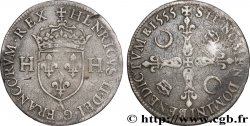
Type : Fonte postérieure, Henri II par Étienne de Laulne
Date: (1552)
Metal : gilt bronze
Diameter : 53,5 mm
Orientation dies : 6 h.
Engraver DE LAULNE Etienne
Weight : 39 g.
Edge : lisse
Puncheon : sans poinçon
Rarity : R1
Coments on the condition:
Jolie médaille dorée, présentant quelques points d’usure
Catalogue references :
Jones.164 struck bronze : 55 mm - Jones.165 cast silver : 53,5 mm - Maz.vol.I n°99 - TNG XII, 1 - BN ParisArmand-Valton 1946 cast bronze : 54,5 mm
Obverse
Obverse legend : HENRICVS. II. GALLIARVM REX INVICTISS. PP..
Obverse description : Buste cuirassé et lauré à droite, avec le collier de l’ordre de Saint-Michel.
Obverse translation : (Henri II, invincible roi des Francs, Père de la patrie).
Reverse
Reverse legend : (LAURIER) OB RES IN - ITAL. GERM. ET GAL. FORTIFER AC FOEL - IC. GESTAS.
Reverse description : La Victoire tenant une palme et l’Abondance tenant une corne d’abondance, assise dans un char dirigé par la Renommée, tenant une trompette d’où tombe un drapeau aux armes de France, le tout sur les armes des vaincus ; à l’exergue EX VOTO PVB/ 1552.
Reverse translation : (Pour la conduite réussie et courageuse des affaires d’Italie, Allemagne et France - Par la volonté du peuple).
Commentary
Médaille attribuée à De Laulne par Mazard qui trouve une similarité de style avec celles signées S (Stephanus pour Étienne). Fonte ancienne .
Medal attributed to De Laulne by Mazard, who found a stylistic similarity with those signed S (Stephanus for Étienne). Antique cast
Medal attributed to De Laulne by Mazard, who found a stylistic similarity with those signed S (Stephanus for Étienne). Antique cast
Historical background
HENRY II
(03/31/1547-07/10/1559)
Born in Saint-Germain-en-Laye in 1519, Henri II was the second son of François I and Claude of France. Dauphin on the death of his eldest François (1536), he ascended the throne in 1547. Continuing the policy of his father, the new king soon came into conflict with the Emperor, in the East and in Italy.. Victorious in 1552 (expedition against Metz), beaten at Saint-Quentin (1557), again victorious at Calais and Gravelines (1558), Henri II succeeded better than his father. An era ended with the signing of the Treaty of Cateau-Cambrésis (April 2 and 3, 1559): France kept Calais and, without this being explicitly mentioned, kept the Trois-Évêchés (Metz, Toul and Verdun), but definitively renounced to the Italian dream. Philippe II married Élisabeth de France, daughter of Henri II, and Emmanuel-Philibert de Savoie Marguerite, daughter of François I. For his part, Charles V had to renounce the universal monarchy and divide his vast empire into a Spanish monarchy and a Germanic monarchy, which would keep the imperial title.. He abdicated in 1556. The same continuity is emerging in domestic politics. The first absolutism is affirmed, the persecution against the Protestants takes all its rise: an ardent Chamber is instituted in the Parliament of Paris to fight against the heretics. The Business Council or Narrow Council separated definitively from the Grand Council and the Privy Council. The institution of the presidial bailiwicks, in 1552, supposed to accelerate the course of justice, served above all to bring money into the royal coffers. The court of France was then dominated by Diane de Poitiers, mistress of the king, by the constable of Montmorency, always favorite, and by the three Coligny brothers: Odet, bishop-count of Beauvais, Gaspard, admiral in 1551, François d'Andelot , Colonel General of the Infantry. Facing the Colignys stood the party of the Guise, cadets of the house of Lorraine: Claude, duke and peer, Cardinal Jean de Lorraine, his brother, who both died in 1550, then François de Guise, son of Claude, and his brother , Cardinal Charles of Lorraine. The authority of the king prevented these rivalries from degenerating. The reign of Henry II saw above all the development of Protestantism in France, in the form given to it by Calvin, who, having taken refuge in Geneva, was master of the city from 1541 to 1564.. Married to Catherine de Medici in 1533, Henri II had thirteen children, including five sons.. Three of them succeeded him: François II (1559-1560), Charles IX (1560-1574), Henri III (1574-1589).
 Report a mistake
 Print the page
 Share my selection
 Ask a question
 Consign / sell
Related articles

 Full data



cgbfr.com numismatists


