


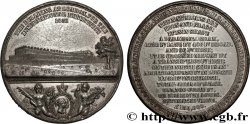
fme_1126944 - GREAT-BRITAIN - VICTORIA Médaille, Exposition internationale, Bâtiment par la vue Ouest

75.00 €(Approx. 84.00$ | 63.00£)
Quantity
Add to your cart

Type : Médaille, Exposition internationale, Bâtiment par la vue Ouest
Date: 1862
Mint name / Town : UK, Londres
Metal : tin
Diameter : 51,5 mm
Orientation dies : 9 h.
Engraver MOORE - Birmingham
Weight : 37,77 g.
Edge : lisse
Puncheon : sans poinçon
Coments on the condition:
Patine hétérogène. Présence de coups et rayures
Obverse
Obverse legend : VICTORIA, QUEEN OF - GREAT BRITAIN..
Obverse description : Buste couronné, en tenue d’apparat, de Victoria à gauche, entouré d’une frise végétale composée de roses, chardon, trèfle, chêne.
Reverse
Reverse legend : INTERNATIONAL EXHIBITION, LONDON / (WEST FRONT VIEW) / OPENED I MAY 1862 // À L’EXERGUE : COVERS A SPACE OF 26 ACRES / 1200 F.T LONG, 700 F.T WIDE / NAVE 85 F.T WIDE / DOMES 250 F.T HIGH / COST £300.000.
Reverse description : Vue du Hall d’exposition et légende en 6 lignes à l’exergue, le tout entouré de palmes. Signé : J. MOORE - BIRM..
Commentary
L’Exposition universelle de 1862 se tint à Londres du 1er mai au 1er novembre 1862. Outre les jardins de la Royal Horticultural Society, dans South Kensington, elle occupait l'emplacement des actuels Musée d'histoire naturelle de Londres et Science Museum.
Elle s’étendait sur 9 hectares de terrain, avec une halle construite pour l'occasion par Charles et Thomas Lucas, et Sir John Kelk, sur des plans du capitaine Francis Fowke (1823-1865). Le coût des travaux, de 300 000 £, était couvert par les profits de l’Exposition universelle de 1851. Cet édifice comportait un corps principal et deux ailes à angle droit de ce corps, pour abriter les machines industrielles et l'outillage agricole ; ces ailes furent démolies à la fin de l'Exposition. La grande façade, qui s'ouvrait le long de Cromwell Road était longue de 351 m, et ornée de deux coupoles de verre, de 79 m de hauteur chacune. Bien qu'elles eussent été alors les plus grandes coupoles du monde, elles firent peu d'impression, moquées dans la presse comme de « grands bols de soupe » (colossal soup bowls) et « une horreur nationale » ; quant au bâtiment, The Art Journal le taxa de « cabane délabrée » (a wretched shed). Le Parlement repoussa la proposition du gouvernement de racheter le bâtiment, si bien que les matériaux de construction furent revendus et réutilisés pour la construction d’Alexandra Palace.
The Great Exhibition of 1862 was held in London from May 1st to November 1st, 1862.. Besides the gardens of the Royal Horticultural Society in South Kensington, it occupied the site of the present-day Natural History Museum and Science Museum in London..
It covered 9 hectares of land, with a hall built for the occasion by Charles and Thomas Lucas, and Sir John Kelk, based on plans by Captain Francis Fowke (1823-1865). The cost of the works, £300,000, was covered by the profits of the 1851 Universal Exhibition.. This building comprised a main section and two wings at right angles to this section, to house industrial machinery and agricultural equipment; these wings were demolished at the end of the Exposition.. The grand facade, which opened along Cromwell Road, was 351 m long and adorned with two glass domes, each 79 m high.. Although they were then the largest domes in the world, they made little impression, mocked in the press as \\\"colossal soup bowls\\\" and \\\"a national horror\\\"; as for the building, The Art Journal called it \\\"a wretched shed\\\".. Parliament rejected the government's proposal to buy back the building, so the building materials were sold off and reused in the construction of Alexandra Palace.
Elle s’étendait sur 9 hectares de terrain, avec une halle construite pour l'occasion par Charles et Thomas Lucas, et Sir John Kelk, sur des plans du capitaine Francis Fowke (1823-1865). Le coût des travaux, de 300 000 £, était couvert par les profits de l’Exposition universelle de 1851. Cet édifice comportait un corps principal et deux ailes à angle droit de ce corps, pour abriter les machines industrielles et l'outillage agricole ; ces ailes furent démolies à la fin de l'Exposition. La grande façade, qui s'ouvrait le long de Cromwell Road était longue de 351 m, et ornée de deux coupoles de verre, de 79 m de hauteur chacune. Bien qu'elles eussent été alors les plus grandes coupoles du monde, elles firent peu d'impression, moquées dans la presse comme de « grands bols de soupe » (colossal soup bowls) et « une horreur nationale » ; quant au bâtiment, The Art Journal le taxa de « cabane délabrée » (a wretched shed). Le Parlement repoussa la proposition du gouvernement de racheter le bâtiment, si bien que les matériaux de construction furent revendus et réutilisés pour la construction d’Alexandra Palace.
The Great Exhibition of 1862 was held in London from May 1st to November 1st, 1862.. Besides the gardens of the Royal Horticultural Society in South Kensington, it occupied the site of the present-day Natural History Museum and Science Museum in London..
It covered 9 hectares of land, with a hall built for the occasion by Charles and Thomas Lucas, and Sir John Kelk, based on plans by Captain Francis Fowke (1823-1865). The cost of the works, £300,000, was covered by the profits of the 1851 Universal Exhibition.. This building comprised a main section and two wings at right angles to this section, to house industrial machinery and agricultural equipment; these wings were demolished at the end of the Exposition.. The grand facade, which opened along Cromwell Road, was 351 m long and adorned with two glass domes, each 79 m high.. Although they were then the largest domes in the world, they made little impression, mocked in the press as \\\"colossal soup bowls\\\" and \\\"a national horror\\\"; as for the building, The Art Journal called it \\\"a wretched shed\\\".. Parliament rejected the government's proposal to buy back the building, so the building materials were sold off and reused in the construction of Alexandra Palace.
Historical background
GREAT-BRITAIN - VICTORIA
(20/06/1837-22/01/1901)
Victoria (1819-1901) was the daughter of Edward, Duke of Kent, and granddaughter of George III. She succeeded her uncle Guillaume IV in 1837 and married her cousin Albert, Prince of Saxe-Coburg in 1840, against her mother's advice. She had nine children by him but became a widow in 1861. While respecting the rules of the parliamentary system, she tried to impose her views in the field of foreign affairs. Her favourite, Disraeli, had her given the title of Empress of India in 1876. Respected and loved, active and authoritarian, Victoria appeared in her time as the symbol of imperialist England. His reign marks the height of British power.
 Report a mistake
 Print the page
 Share my selection
 Ask a question
 Consign / sell
Related articles

 Full data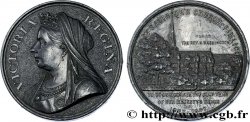


Your Recently Viewed Items
TURONES (Area of Touraine) Bronze TVRONOS TRICCOS au bige XF
271.00 €

SAN MARINO LOT DE 8 PIÈCES EURO (1 Cent - 2 Euro Domus Magna) 2006-2007 MS
36.00 €

FRANCE 1/4 Euro COUPE DU MONDE FÉMININE DE FOOTBALL 2019 MS
6.00 €
ALGERIA Lot de 10 et 5 Centimes Chambre de Commerce d’Alger caducéee entre de
100.00 €
cgbfr.com numismatists


