


E-auction 306-225283 - fme_475772 - GERMANY - KINGDOM OF PRUSSIA - FREDERICK II THE GREAT Médaille de la bataille de Prague

You must signin and be an approved bidder to bid, LOGIN TO BID. Accounts are subject to approval and the approval process takes place within 48 hours. Do not wait until the day a sale closes to register. Clicking on « bid » constitutes acceptance of the terms of use of cgb.fr private e-auctions.
Bids must be placed in whole Euro amounts only. The sale will start closing at the time stated on the item description; any bids received at the site after the closing time will not be executed. Transmission times may vary and bids could be rejected if you wait until the last second. For further information ckeck the E-auctions F.A.Q.
NO BUYER'S FEE.
NO BUYER'S FEE.
| Estimate : | 180 € |
| Price : | 33 € |
| Maximum bid : | 41 € |
| End of the sale : | 25 February 2019 18:29:30 |
| bidders : | 7 bidders |
Type : Médaille de la bataille de Prague
Date: 1757
Mint name / Town : Allemagne
Metal : bronze
Diameter : 48 mm
Orientation dies : 12 h.
Engraver HOLTZHEY Johann Georg (1729-1808)
Weight : 38,48 g.
Edge : Lisse
Coments on the condition:
Présence de taches. Patine hétérogène
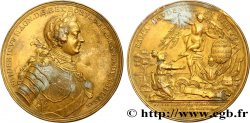
Obverse
Obverse legend : FRIDERICVS MAGN. D. G. REX BORVSS. FL. BRAND. DVX SILES ET.
Obverse description : Buste cuirassé de Frédéric II de Prusse à droite.
Reverse
Reverse legend : FAMA. PRVDENTIA ET VIRTVTE, (LÉGENDE CIRCULAIRE) // AVSTIR. EXERC. PROPE. PRAG. EVNDIT / CÆSO ET PRAGA OBSESSA / VI MAJI MDCCLVII., (À L’EXERGUE).
Reverse description : Personnification de la Victoire ailée au centre, tenant la foudre, donnant un coup de pied dans la couronne de l’impératrice autrichienne Maria Theresia agenouillée ; bouclier iinscrit «VICTORIA FRIDERI / CI MAGN.” ; ALBISIL et MOLDA inscrit sur deux cruches, canon et armure en trophée.
Commentary
Médaille attribué au graveur hollandais Johann Georg Holtzhey (1729-1808).
Lors de la guerre de Sept Ans, la bataille de Prague voit, le 6 mai 1757, la victoire des Prussiens commandés par Frédéric II sur les Autrichiens de Charles-Alexandre de Lorraine. Le général autrichien Maximilian Ulysses Browne y est mortellement blessé, de même que le feld-maréchal prussien Curt Christophe de Schwerin. Cette victoire prussienne est suivie par le siège de Prague (mai-juin 1757) (en) mais Frédéric II, battu à la bataille de Kolin le 18 juin, doit se retirer et ne peut s'emparer de Prague.
Frédéric II de Prusse, dit Frédéric le Grand (en allemand, Friedrich der Große), né le 24 janvier 1712 à Berlin, mort le 17 août 1786 à Potsdam, de la maison de Hohenzollern, est roi de Prusse de 1740 à 1786, le premier à porter officiellement ce titre1. Il est simultanément le 14e prince-électeur de Brandebourg. Il est parfois surnommé affectueusement der alte Fritz (le vieux Fritz). Agrandissant notablement le territoire de ses États aux dépens de l'Autriche (Silésie, 1742) et de la Pologne (Prusse-Occidentale, 1772), il fait entrer son pays dans le cercle des grandes puissances européennes. Ami de Voltaire, il est l'un des principaux représentants du courant du «despotisme éclairé»..
Medal attributed to the Dutch engraver Johann Georg Holtzhey (1729-1808).
During the Seven Years' War, the Battle of Prague saw, on May 6, 1757, the victory of the Prussians commanded by Frederick II over the Austrians of Charles-Alexander of Lorraine.. Austrian General Maximilian Ulysses Browne was mortally wounded there, as was Prussian Field Marshal Curt Christophe of Schwerin.. This Prussian victory was followed by the siege of Prague (May-June 1757) but Frederick II, defeated at the Battle of Kolin on June 18, had to withdraw and could not capture Prague..
Frederick II of Prussia, known as Frederick the Great (in German, Friedrich der Große), born on January 24, 1712 in Berlin, died on August 17, 1786 in Potsdam, of the House of Hohenzollern, was King of Prussia from 1740 to 1786, the first to officially bear this title1. He was simultaneously the 14th Prince-Elector of Brandenburg.. He is sometimes affectionately known as der alte Fritz (old Fritz). Significantly expanding the territory of his states at the expense of Austria (Silesia, 1742) and Poland (West Prussia, 1772), he brought his country into the circle of the great European powers.. A friend of Voltaire, he is one of the main representatives of the \\\"enlightened despotism\\\" movement..
Lors de la guerre de Sept Ans, la bataille de Prague voit, le 6 mai 1757, la victoire des Prussiens commandés par Frédéric II sur les Autrichiens de Charles-Alexandre de Lorraine. Le général autrichien Maximilian Ulysses Browne y est mortellement blessé, de même que le feld-maréchal prussien Curt Christophe de Schwerin. Cette victoire prussienne est suivie par le siège de Prague (mai-juin 1757) (en) mais Frédéric II, battu à la bataille de Kolin le 18 juin, doit se retirer et ne peut s'emparer de Prague.
Frédéric II de Prusse, dit Frédéric le Grand (en allemand, Friedrich der Große), né le 24 janvier 1712 à Berlin, mort le 17 août 1786 à Potsdam, de la maison de Hohenzollern, est roi de Prusse de 1740 à 1786, le premier à porter officiellement ce titre1. Il est simultanément le 14e prince-électeur de Brandebourg. Il est parfois surnommé affectueusement der alte Fritz (le vieux Fritz). Agrandissant notablement le territoire de ses États aux dépens de l'Autriche (Silésie, 1742) et de la Pologne (Prusse-Occidentale, 1772), il fait entrer son pays dans le cercle des grandes puissances européennes. Ami de Voltaire, il est l'un des principaux représentants du courant du «despotisme éclairé»..
Medal attributed to the Dutch engraver Johann Georg Holtzhey (1729-1808).
During the Seven Years' War, the Battle of Prague saw, on May 6, 1757, the victory of the Prussians commanded by Frederick II over the Austrians of Charles-Alexander of Lorraine.. Austrian General Maximilian Ulysses Browne was mortally wounded there, as was Prussian Field Marshal Curt Christophe of Schwerin.. This Prussian victory was followed by the siege of Prague (May-June 1757) but Frederick II, defeated at the Battle of Kolin on June 18, had to withdraw and could not capture Prague..
Frederick II of Prussia, known as Frederick the Great (in German, Friedrich der Große), born on January 24, 1712 in Berlin, died on August 17, 1786 in Potsdam, of the House of Hohenzollern, was King of Prussia from 1740 to 1786, the first to officially bear this title1. He was simultaneously the 14th Prince-Elector of Brandenburg.. He is sometimes affectionately known as der alte Fritz (old Fritz). Significantly expanding the territory of his states at the expense of Austria (Silesia, 1742) and Poland (West Prussia, 1772), he brought his country into the circle of the great European powers.. A friend of Voltaire, he is one of the main representatives of the \\\"enlightened despotism\\\" movement..
Historical background
GERMANY - KINGDOM OF PRUSSIA - FREDERICK II THE GREAT
(1740-08/17/1786)
Frederic was born in Berlin on January 24, 1712 and is the son of Frederick William I. It was first France's ally in the War of the Austrian Succession (1740-1748) then there was a reversal of alliance during the Seven Years' War (1756-1763). He was one of the great winners of the Treaty of Paris (1763) and took part in the first dismemberment of Poland (1772). Frederick II (1712-1786) was the greatest king of Prussia. Friend of Voltaire, he wrote in French and was the model of the enlightened despot of the second half of the 18th century. He succeeded his father Frédéric-Guillaume, King Sergent and made Berlin a real capital and the Château de Sans Souci in Potsdam a little Versailles. Thanks to a warlike policy, he made Prussia the most powerful state in Eastern Europe and counterbalanced the influence of Austria and Russia. He died at the castle of Sans-Souci (Potsdam), August 17, 1786.
 Report a mistake
 Print the page
 Share my selection
 Ask a question
 Consign / sell
Related articles
 Full data



Your Recently Viewed Items
GERMANY - KINGDOM OF PRUSSIA - FREDERICK II THE GREAT Médaille de la bataille d
33.00 €
cgbfr.com numismatists


