


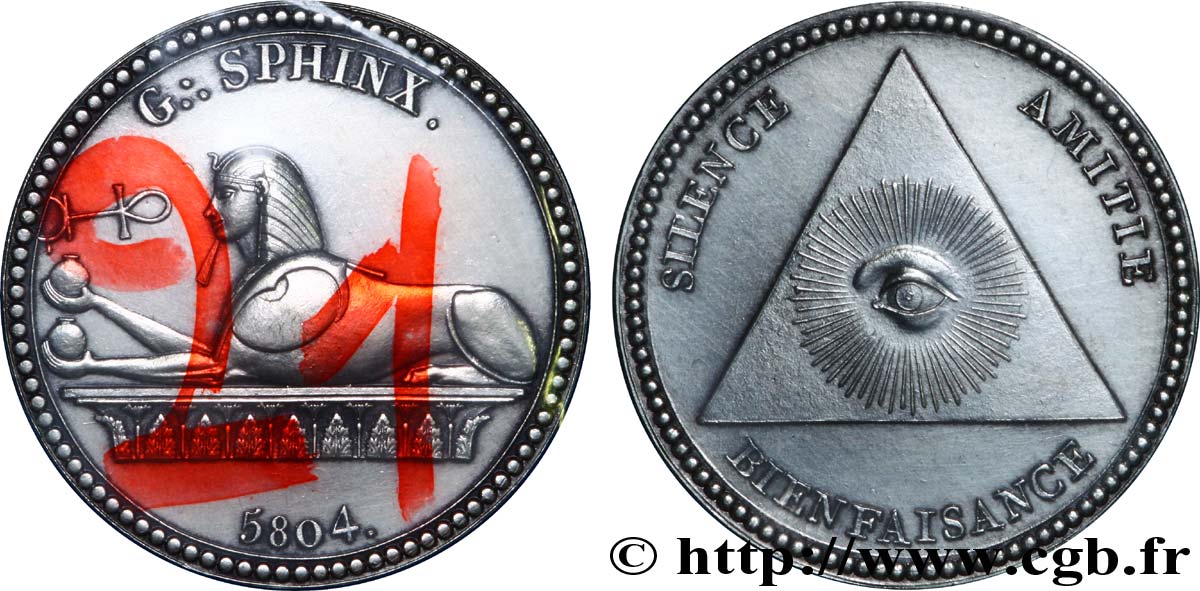
fjt_235118 - FREEMASONRY LOGE LE GRAND SPHINX, REFRAPPE 1804
Not available.
Item sold on our e-shop (2011)
Price : 45.00 €
Item sold on our e-shop (2011)
Price : 45.00 €
Type : LOGE LE GRAND SPHINX, REFRAPPE
Date: 1804
Quantity minted : 500
Metal : silver
Diameter : 26 mm
Orientation dies : 12 h.
Edge : inscrite
Puncheon : (corne) 1*
Catalogue references :
Obverse
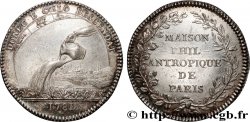
Obverse legend : G.:. SPHINX.
Obverse description : Sphinx égyptien sur un fut de chapiteau, tenant deux vases et levant une main, devant lui un signe Ankh.
Reverse
Reverse legend : SILENCE AMITIE BIENFAISANCE.
Reverse description : Un œil rayonnant dans un triangle.
Commentary
Cette médaille est une refabrication à l’identique, probablement par la Monnaie de Paris, probablement dans les années 1980. La tranche porte la mention n° 21/500 ce qui laisse supposer une fabrication de 500 avec au moins 21 émises. Cette médaille est dans un sachet plastique scellé marqué du chiffre 21, ce qui laisse à penser que le numéro faisait sens pour les responsables de la Loge. Le tout est présenté dans une petite boîte bleue typique de la Monnaie de Paris marquée 241/500 sur le couvercle mais il est notoire que la Monnaie de Paris a toujours eu de grosses difficultés à faire coïncider les différentes références de ses produits numérotés.
La franc-maçonnerie s’implante en France aux alentours du premier quart du XVIIIe s. sous l’influence d’aristocrates anglais. Initiatique, elle est fondée sur le rite hiramique, du nom d’Hiram de Tyr, personnage biblique, architecte du roi Salomon sur le chantier du Temple et qui a résisté à la torture sans livrer ses secrets. Hiram a aussi donné un point de départ du calendrier maçonnique commençant 4000 ans avant le calendrier chrétien. Les symboles servent de signes de reconnaissance entre les initiés, notamment des outils de constructeur de cathédrales (équerre, compas, niveau, maillet, etc.), des formes (triangle, étoile), des nombres (trois, cinq, sept) et des lettres.
This medal is an identical re-production, probably by the Monnaie de Paris, probably in the 1980s. The slice bears the mention n° 21/500 which suggests a production of 500 with at least 21 issued. This medal is in a sealed plastic bag marked with the number 21, which suggests that the number was meaningful to the Lodge officials.. The whole thing is presented in a small blue box typical of the Monnaie de Paris marked 241/500 on the lid but it is well known that the Monnaie de Paris has always had great difficulty in matching the different references of its numbered products..
Freemasonry was established in France around the first quarter of the 18th century.. under the influence of English aristocrats. Initiatory, it is based on the Hiramic rite, named after Hiram of Tyre, a biblical character, architect of King Solomon on the construction site of the Temple and who resisted torture without revealing his secrets.. Hiram also gave a starting point for the Masonic calendar beginning 4000 years before the Christian calendar. Symbols serve as signs of recognition between initiates, including cathedral builder tools (square, compass, level, mallet, etc.). ), shapes (triangle, star), numbers (three, five, seven) and letters
La franc-maçonnerie s’implante en France aux alentours du premier quart du XVIIIe s. sous l’influence d’aristocrates anglais. Initiatique, elle est fondée sur le rite hiramique, du nom d’Hiram de Tyr, personnage biblique, architecte du roi Salomon sur le chantier du Temple et qui a résisté à la torture sans livrer ses secrets. Hiram a aussi donné un point de départ du calendrier maçonnique commençant 4000 ans avant le calendrier chrétien. Les symboles servent de signes de reconnaissance entre les initiés, notamment des outils de constructeur de cathédrales (équerre, compas, niveau, maillet, etc.), des formes (triangle, étoile), des nombres (trois, cinq, sept) et des lettres.
This medal is an identical re-production, probably by the Monnaie de Paris, probably in the 1980s. The slice bears the mention n° 21/500 which suggests a production of 500 with at least 21 issued. This medal is in a sealed plastic bag marked with the number 21, which suggests that the number was meaningful to the Lodge officials.. The whole thing is presented in a small blue box typical of the Monnaie de Paris marked 241/500 on the lid but it is well known that the Monnaie de Paris has always had great difficulty in matching the different references of its numbered products..
Freemasonry was established in France around the first quarter of the 18th century.. under the influence of English aristocrats. Initiatory, it is based on the Hiramic rite, named after Hiram of Tyre, a biblical character, architect of King Solomon on the construction site of the Temple and who resisted torture without revealing his secrets.. Hiram also gave a starting point for the Masonic calendar beginning 4000 years before the Christian calendar. Symbols serve as signs of recognition between initiates, including cathedral builder tools (square, compass, level, mallet, etc.). ), shapes (triangle, star), numbers (three, five, seven) and letters
Historical background
FREEMASONRY
The compass and the square are very often associated in an ambivalent symbol of balance: fixity and mobility, passive and active, matter and spirit.. The compass is the tool of the Creator and of the great Architect of the Universe. The spacing of the branches of the compass obeys precise rules and varies according to the three degrees: apprentice, companion, master. The Napoleonic era, in the activity of lodges as in that of many groups, saw a flowering after the terrible years of the revolutionary period. Masonic activity, rid of its republican theories and firmly controlled by a Grand-Master appointed by the Emperor, experienced a vigor in unity never found since.. It is considered that each regiment, each garrison, each city had its Lodge. The testimonies that the sumptuous tokens of the period leave us show that these lodges were rich and influential.. The symbolism is sought after, without comparison with the later eras, which were much more conventional, even bland or destitute at the beginning of the 20th century.. Freemasonry had more than a thousand lodges spread over one hundred and thirty departments and more than sixty thousand Brothers.
 Report a mistake
 Print the page
 Share my selection
 Ask a question
 Consign / sell
Related articles
 Full data
cgbfr.com numismatists


