


fmd_216125 - Faux de Demi-franc Napoléon Ier tête laurée, République française 1808 Paris F./ var.

Not available.
Item sold on our e-shop (2013)
Price : 280.00 €
Item sold on our e-shop (2013)
Price : 280.00 €
Type : Faux de Demi-franc Napoléon Ier tête laurée, République française
Date: 1808
Mint name / Town : Paris
Quantity minted : ---
Metal : silver
Millesimal fineness : 900 ‰
Diameter : 17,87 mm
Orientation dies : 6 h.
Weight : 2,42 g.
Edge : lisse
Rarity : R3
Coments on the condition:
Des marques de manipulation dans les champs. Superbe exemplaire avec une grande partie de son brillant d’origine, très bien centré avec une jolie frappe pour ce type monétaire. Début de patine aux reflets légèrement iridescents
Catalogue references :
Obverse
Obverse legend : NAPOLEON EMPEREUR (PETIT LOSANGE).
Obverse description : Tête laurée de Napoléon Ier à droite, un ruban descendant derrière la nuque ; au-dessous Tiolier en cursif.
Reverse
Reverse legend : RÉPUBLIQUE FRANÇAISE (PETIT LOSANGE) / (DIFFÉRENT) 1808 (PETIT LOSANGE) A.
Reverse description : DEMI / FRANC (petit losange), en deux lignes, dans une couronne composée de deux branches de laurier, nouées à leur base par un ruban.
Commentary
Exemplaire avec le buste fin. Il s’agit du second type. Le son est excellent, le poids plus que correct compte tenu de l’usure de circulation. Au droit, la principale marque de fausseté se situe sur la joue et le sourcil de l’Empereur. Il ne s’agit pas de taches ni d’usure mais d’une sorte de seconde couche ce qui laisse présumer que la monnaie a été frappée certainement en cuivre et recouverte d’argent. La couleur tire légèrement sur le jaune notamment au niveau des légendes et le listel est très plat près de NAPOLEON. Au revers, on note un coup sur le listel à 6h avec la marque d’un trait vertical... peut-être a-t-on voulu tester la pièce pour en connaître sa composition métallique ? D’après les recherches inédites de Stéphane Desrousseaux sur la période impériale aux archives de la Monnaie de Paris, il circulait, notamment dans la région parisienne, des faux de 1 franc et de demi-franc 1808, de très belle qualité, et qui auraient été saisis lors d’une fête foraine à Dourdan en 1814. Peut-être sommes-nous en présence de l’un d’entre eux... En tout cas, c’est de loin le plus beau faux connu pour ce type et suffisamment dangereux pour piéger aujourd’hui encore un collectionneur de monnaies modernes.
example with the thin bust. This is the second type. The sound is excellent, the weight more than correct considering the wear of circulation. On the right, the main mark of falsehood is on the Emperor's cheek and eyebrow.. These are not stains or wear but a sort of second layer which suggests that the coin was certainly struck in copper and covered with silver.. The color is slightly yellow, especially at the level of the legends, and the strip is very flat near NAPOLEON.. On the reverse, we note a blow on the rim at 6 o'clock with the mark of a vertical line. . . Perhaps the coin was tested to determine its metallic composition? According to Stéphane Desrousseaux's unpublished research on the imperial period in the archives of the Paris Mint, there were, particularly in the Paris region, counterfeit 1 franc and half-franc 1808 coins of very good quality, which were apparently seized at a funfair in Dourdan in 1814.. Perhaps we are in the presence of one of them.. . . In any case, it is by far the most beautiful known fake of this type and sufficiently dangerous to trap a collector of modern coins even today.
example with the thin bust. This is the second type. The sound is excellent, the weight more than correct considering the wear of circulation. On the right, the main mark of falsehood is on the Emperor's cheek and eyebrow.. These are not stains or wear but a sort of second layer which suggests that the coin was certainly struck in copper and covered with silver.. The color is slightly yellow, especially at the level of the legends, and the strip is very flat near NAPOLEON.. On the reverse, we note a blow on the rim at 6 o'clock with the mark of a vertical line. . . Perhaps the coin was tested to determine its metallic composition? According to Stéphane Desrousseaux's unpublished research on the imperial period in the archives of the Paris Mint, there were, particularly in the Paris region, counterfeit 1 franc and half-franc 1808 coins of very good quality, which were apparently seized at a funfair in Dourdan in 1814.. Perhaps we are in the presence of one of them.. . . In any case, it is by far the most beautiful known fake of this type and sufficiently dangerous to trap a collector of modern coins even today.
Historical background
PREMIER EMPIRE / FIRST FRENCH EMPIRE
(18/05/1804-6/04/1814)
Reinforced by the Cadoudal conspiracy of March 1804, the idea of hereditary power found its culmination on May 18, 1804 when Napoleon Bonaparte became Emperor of the French under the name of Napoleon I.. Ratified by plebiscite, the Empire was consecrated on December 2, 1804 during the coronation of Notre-Dame. With the Constitution of Year XII still in effect, the First Empire seems to function as a continuation of the French Republic led by an emperor. It is actually a personal dictatorship where the emperor appoints and dismisses ministers, initiates laws and controls the Legislative Body.. In the departments, the prefects inform the Ministry of the Interior. The posts, the press, the printing press are controlled by censorship. The great bodies of the State are reorganized as well as Justice with the Penal Code which completes the Civil Code completed under the Consulate. Universities and schools are supervised. In 1805, Napoleon became King of Italy while coalitions formed against the Empire. Despite the naval defeat of Trafalgar, the imperial armies won many land victories such as Austerlitz, Jena or Eylau which ensured control of continental Europe. Dismembered, it is attributed to the Bonaparte family which seems to triumph everywhere. Fortified by the continental blockade, industry is prosperous but trade suffers. In 1808, the continental blockade was reinforced by a second decree issued in Milan on December 17, 1807.. The war in Spain begins after Junot conquers Portugal, which refuses to apply the blockade. Quickly, the people of Madrid rise up against the French occupation of Murat. On May 1 and 2, the French fiercely repress guerrilla movements. Mass executions take place. They are immortalized by Goya in his famous Primer y Dos de Mayo. Joseph, King of Naples, is reluctantly appointed King of Spain. Murat replaces him on the throne of Naples with his wife Caroline. Despite the forced abdications of Charles IV and Ferdinand VII in Bayonne, in the presence of Napoleon, the French witness a general uprising in Spain and are beaten in Bailen on July 22: they lose Madrid. Wellington and an English expeditionary force land in Portugal on August 1. Junot must capitulate at Cintra on August 30. The French retake Madrid on December 4, 1808.. In April 1809, Pius VII excommunicated Napoleon who had him sequestered in retaliation. The allies form the fifth coalition, but the Austrians are defeated at Eckmühl on April 12, Essling on May 21 and Wagram on July 6, 1809. At the Treaty of Vienna, Austria cedes Carniola, Carinthia and Croatia which will form the Illyrian provinces which are incorporated into the Empire. The Vendôme column was inaugurated in 1810. That year, Napoleon was at the height of his power and France had 130 departments from the Tiber to the Elbe.. After divorcing Josephine in December 1809, he married Marie-Louise of Austria on April 2, 1810. Louis abdicated from the throne of Holland on July 9, 1810, refusing to apply the Continental Blockade and the Kingdom was annexed to France. In 1811, the Emperor, who had his marriage with Joséphine dissolved, married Archduchess Marie-Louise, who gave him a son, the King of Rome, who was born in the Tuileries on March 20, 1811.. Franco-Russian relations deteriorated after Austrian marriage. Finally, Napoleon crossed the Niemen on June 24, 1812. This is the beginning of the Russian campaign. At the head of the Grande Armée, he took Vilna (June 28), won the victory of Smolensk (August 18), then the difficult battle of the Moscova (September 5-7). He takes Moscow between September 15 and 18. The city is set on fire by the Russians and the French must evacuate it. The Grande Armée is forced to retreat with the Russian winter starting very early and an enemy practicing a scorched earth policy. It is the battle of Berezina on November 27-29, 1812. Over 600. 000 men, less than 30. 000 crossed the Russian border. General Malet attempts a coup in Paris on October 23. He was shot on the 29th. The Russians occupy Warsaw, Hamburg and Dresden. The Prussians win the victories of Lutzen and Bautzen on May 2 and 21, 1813. All of Europe leagued against Napoleon during the sixth coalition and he was defeated in the Battle of Nations on October 16-19, 1813. The French campaign begins in January 1814. Despite the victories of Montmirail and Montereau on February 10 and 18, Napoleon could not prevent the capitulation of Paris on March 31. He was forced to abdicate on April 6, 1814 and left for the island of Elba..
 Report a mistake
 Print the page
 Share my selection
 Ask a question
 Consign / sell
 Full data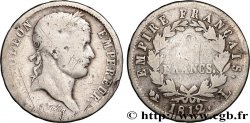



cgbfr.com numismatists


