


Not available.
Item sold on our e-shop (2019)
Price : 10 000.00 €
Item sold on our e-shop (2019)
Price : 10 000.00 €
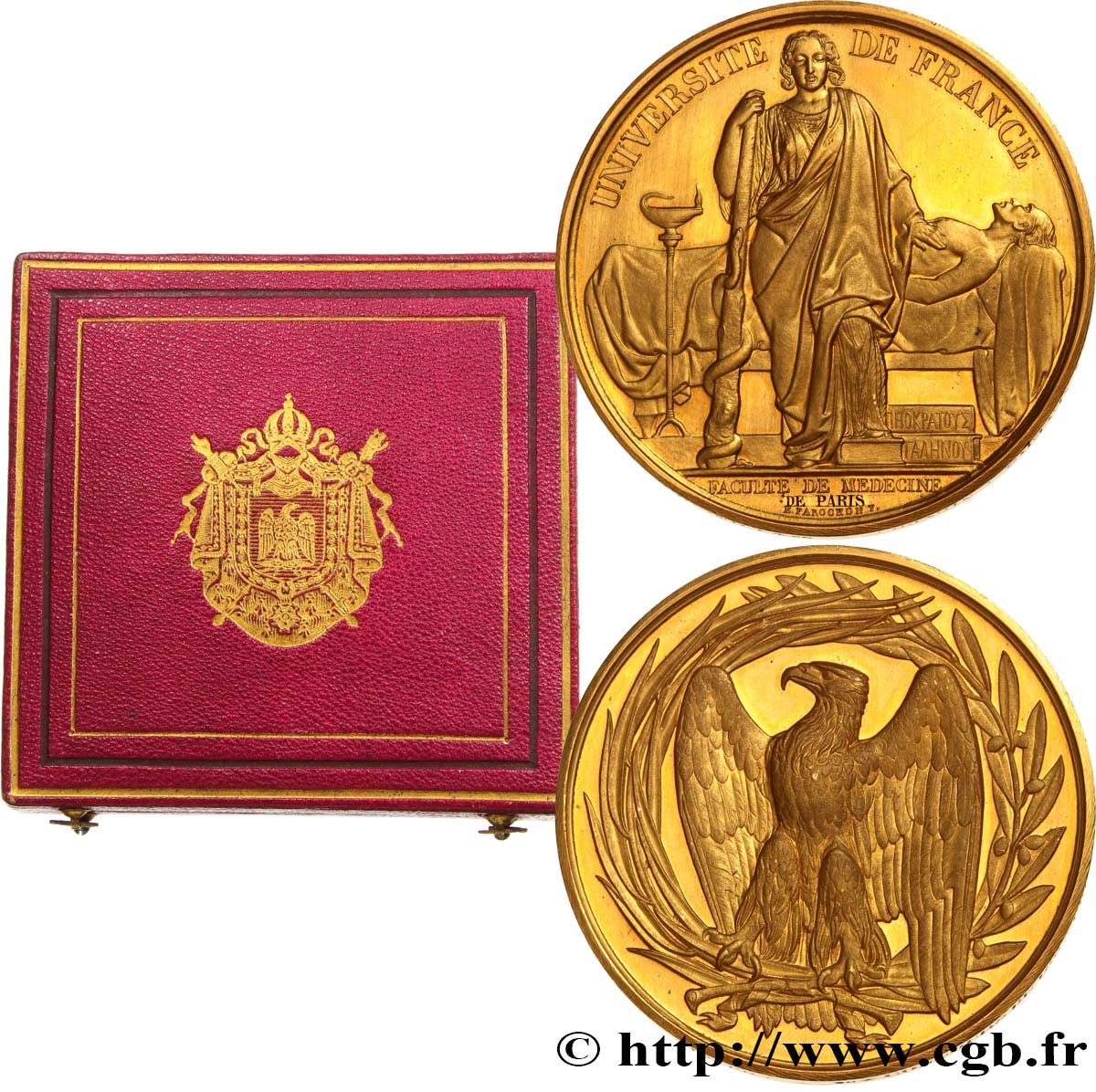
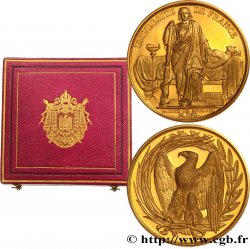
Type : Médaille de concours, Prix Corvisart
Date: 1867
Metal : gold
Diameter : 50,5 mm
Orientation dies : 12 h.
Weight : 110 g.
Edge : inscrite : CONCOURS DE 1867. PRIX CORVISART. Mr MALASSEZ (LOUIS CHARLES) NE LE 21 SEPTEMBRE 1842 A NEVERS (NIÈVRE)
Puncheon : Abeille (1860 - 1880)
Coments on the condition:
Splendide exemplaire présentant quelques traces de manipulation
Obverse
Obverse legend : UNIVERSITE - DE FRANCE // À L’EXERGUE : FACULTE DE MEDECINE / DE PARIS.
Obverse description : Femme debout, vêtue à l’antique, tenant une massue sur laquelle glisse un serpent, le pied sur des ouvrages dont deux d’entre eux sont inscrits en grec. Lampe à gauche. Homme allongé à l’arrière plan sur un lit. Signé : E. FAROCHON F..
Reverse
Reverse legend : ANÉPIGRAPHE.
Reverse description : Aigle impérial sur une couronne de laurier et palme.
Commentary
Cet exemplaire est présenté dans son écrin d’origine rouge timbré au blason impérial. Il fut décerné à Louis-Charles Malassez (1842-1909) médecin et scientifique français né à Nevers dans la Nièvre. Il est connu pour ses travaux au laboratoire d'histologie du Collège de France. Il est crédité de l’invention de l’hémocytomètre, un outil utilisé pour mesurer le nombre de cellules sanguines. La médaille (fme_561499), prix reçu pour l’élaboration de la numération des globules rouges du sang, va de pair avec son invention de l’hémocytomètre.
Le prix Corvisart est un prix distribué par la Faculté de médecine de Paris. Ce prix a été institué en 1806 suite à la décision de Jean-Nicolas Corvisart. En effet, il décida d’utiliser les sommes correspondant à ses traitements de professeur pour fonder des prix destinés à récompenser les étudiants qui se feraient remarquer par leur assiduité aux cours et par la qualité de leurs travaux. Cela fut confié à la Société d’émulation. Les premières médailles (10 en argent, 1 en or) furent attribuées en 1810.
Nous n’avons pas trouvé d’informations sur l’année 1867 mais sur l’année scolaire 1871-1872, tous les élèves inscrits à l’une des cliniques, étaient admis à concourir pour le prix Corvisart qui consistait en une médaille d’or de 400 francs.
Notre exemplaire est plutôt une médaille d’or de 340 francs et nous n’avons pas trouvé d’informations plus précise à son sujet.
Des informations sur le concours de 1871-1872 sont visibles sur le site internet d’éducation Persée. (cf. https://education.persee.fr/doc/baip_1254-0714_1873_num_16_303_40504 ).
This example is presented in its original red case stamped with the imperial coat of arms.. It was awarded to Louis-Charles Malassez (1842-1909), a French doctor and scientist born in Nevers in the Nièvre. He is known for his work at the histology laboratory of the Collège de France. He is credited with the invention of the hemocytometer, a tool used to measure blood cell counts. The medal (fme_561499), a prize received for the development of the red blood cell count, goes hand in hand with his invention of the hemocytometer.
The Corvisart Prize is a prize awarded by the Faculty of Medicine of Paris. This prize was established in 1806 following the decision of Jean-Nicolas Corvisart. In fact, he decided to use the sums corresponding to his professorial salaries to found prizes intended to reward students who would stand out for their assiduity in classes and the quality of their work.. This was entrusted to the Emulation Society. The first medals (10 silver, 1 gold) were awarded in 1810.
We have not found any information on the year 1867 but for the school year 1871-1872, all students enrolled in one of the clinics were admitted to compete for the Corvisart prize which consisted of a gold medal of 400 francs..
Our example is rather a gold medal of 340 francs and we have not found more precise information about it..
Information on the 1871-1872 competition can be seen on the Persée education website. (cf. https://education. Perseus. fr/doc/baip_1254-0714_1873_num_16_303_40504)
Le prix Corvisart est un prix distribué par la Faculté de médecine de Paris. Ce prix a été institué en 1806 suite à la décision de Jean-Nicolas Corvisart. En effet, il décida d’utiliser les sommes correspondant à ses traitements de professeur pour fonder des prix destinés à récompenser les étudiants qui se feraient remarquer par leur assiduité aux cours et par la qualité de leurs travaux. Cela fut confié à la Société d’émulation. Les premières médailles (10 en argent, 1 en or) furent attribuées en 1810.
Nous n’avons pas trouvé d’informations sur l’année 1867 mais sur l’année scolaire 1871-1872, tous les élèves inscrits à l’une des cliniques, étaient admis à concourir pour le prix Corvisart qui consistait en une médaille d’or de 400 francs.
Notre exemplaire est plutôt une médaille d’or de 340 francs et nous n’avons pas trouvé d’informations plus précise à son sujet.
Des informations sur le concours de 1871-1872 sont visibles sur le site internet d’éducation Persée. (cf. https://education.persee.fr/doc/baip_1254-0714_1873_num_16_303_40504 ).
This example is presented in its original red case stamped with the imperial coat of arms.. It was awarded to Louis-Charles Malassez (1842-1909), a French doctor and scientist born in Nevers in the Nièvre. He is known for his work at the histology laboratory of the Collège de France. He is credited with the invention of the hemocytometer, a tool used to measure blood cell counts. The medal (fme_561499), a prize received for the development of the red blood cell count, goes hand in hand with his invention of the hemocytometer.
The Corvisart Prize is a prize awarded by the Faculty of Medicine of Paris. This prize was established in 1806 following the decision of Jean-Nicolas Corvisart. In fact, he decided to use the sums corresponding to his professorial salaries to found prizes intended to reward students who would stand out for their assiduity in classes and the quality of their work.. This was entrusted to the Emulation Society. The first medals (10 silver, 1 gold) were awarded in 1810.
We have not found any information on the year 1867 but for the school year 1871-1872, all students enrolled in one of the clinics were admitted to compete for the Corvisart prize which consisted of a gold medal of 400 francs..
Our example is rather a gold medal of 340 francs and we have not found more precise information about it..
Information on the 1871-1872 competition can be seen on the Persée education website. (cf. https://education. Perseus. fr/doc/baip_1254-0714_1873_num_16_303_40504)
Historical background
FACULTÉ DE MÉDECINE DE PARIS
The Faculty of Medicine of Paris is one of the four components of the University of Paris, with the Faculty of Theology, the Faculty of Law and the Faculty of Arts and Letters. In 1789, it consisted of one hundred and fifty-two doctors, seven of whom were appointed to teach materia medica, physiology, pathology, pharmacy, childbirth, French surgery and Latin surgery. It was headed by a dean, who was also responsible for forming the University tribunal with the deans of Theology and Law, and the four prosecutors of the Faculty of Arts..
 Report a mistake
 Print the page
 Share my selection
 Ask a question
 Consign / sell
Related articles

 Full data


Your Recently Viewed Items

HENRI III - COIN WEIGHT Poids monétaire pour le teston XF
35.00 €

BRITTANY (STATES OF...) États de Rennes XF
17.00 €
5 francs Hercule, dite “Camélinat” 1871 Paris F.334/3 VF
500.00 €
FACULTÉ DE MÉDECINE DE PARIS Médaille de concours, Prix Corvisart MS
10000.00 €

III REPUBLIC Médaille, FERIAM SIDERA, Rallye aérien AU
110.00 €
LATVIA 1 Lats emblème / ramoneur 2008 Rahapaja Oy MS
6.00 €
cgbfr.com numismatists


