


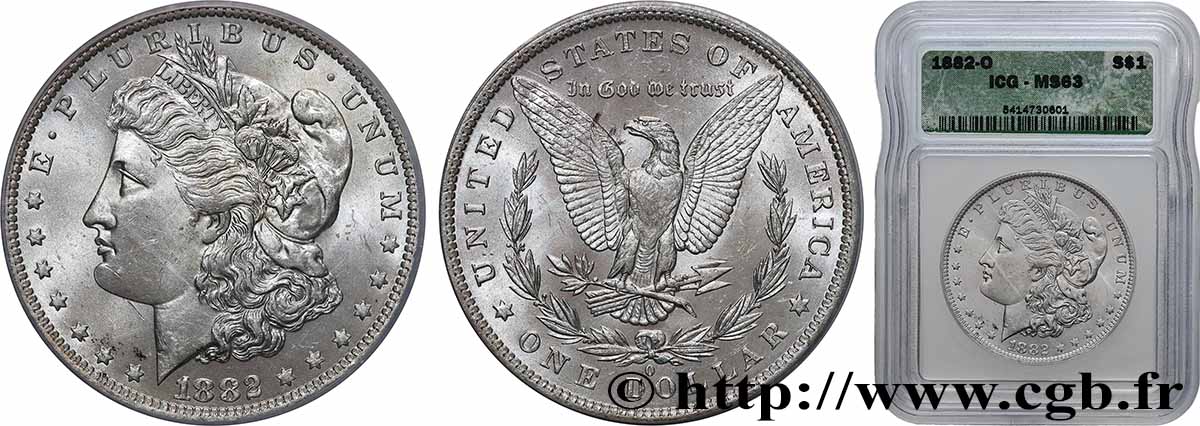
Live auction - fwo_1063924 - UNITED STATES OF AMERICA 1 Dollar Morgan 1882 Nouvelle-Orléans
You must signin and be an approved bidder to bid, LOGIN TO BID. Accounts are subject to approval and the approval process takes place within 48 hours. Do not wait until the day a sale closes to register. Clicking on "BID" constitutes acceptance of the terms of use of cgb.fr private live auctions.
Bids must be placed in whole Euro amounts only. The sale will start closing at the time stated on the item description; any bids received at the site after the closing time will not be executed. Transmission times may vary and bids could be rejected if you wait until the last second. For further information check the Live auction FAQ
All winning bids are subject to a 18% buyer’s fee.
All winning bids are subject to a 18% buyer’s fee.
| Estimate : | 130 € |
| Price : | 78 € |
| Maximum bid : | 80 € |
| End of the sale : | 21 October 2025 18:50:46 |
| bidders : | 3 bidders |
Type : 1 Dollar Morgan
Date: 1882
Mint name / Town : Nouvelle-Orléans
Quantity minted : 6090000
Metal : silver
Millesimal fineness : 900 ‰
Diameter : 38,10 mm
Orientation dies : 6 h.
Weight : 26,73 g.
Edge : cannelée
Slab
autre : MS63
Coments on the condition:
Exemplaire sous coque ICG MS63
Obverse
Obverse legend : E . PLURIBUS . UNUM // (DATE).
Obverse description : tête à gauche de femme symbolisant la Liberté.
Reverse
Reverse legend : UNITED - STATES OF - AMERICA // * ONE DOLLAR *.
Reverse description : aigle aux ailles déployées tenant une branche d’olivier et deux flèches ; couronne de laurier et motto “In God we trust”.
Commentary
En 1873, le « Fourth Coinage act » met fin au bimétallisme et les monnaies en argent sont démonétisées. Cependant dès 1876, de nombreux projets de lois sont proposés afin de réintroduire des dollars en argent. En 1878, Rutherford B. Hayes tente en vain de faire véto au «Bland-Allison Act » au Congrès. Dans cette optique, dès 1876, Henry Linderman, directeur de l'US Mint demande alors à C.W. Fremantle, deputy master de la Royal Mint de Londres, de lui trouver un graveur de coin de premier rang. Ce sera Georges T. Morgan (1845-1925) qui devient assistant graveur auprès du graveur en chef William Barber. Dès 1877, Morgan travaille sur des essais monétaires et prépare son projet de dollar argent. Ainsi en 1878, seulement une semaine après le passage de la loi, l'atelier de Philadelphie frappe des dollars dits « Morgan ». Georges T. Morgan Morgan succèdera à Charles E. Barber (fils de William Barber) en 1917.
In 1873, the Fourth Coinage Act ended bimetallism, and silver coins were demonetized. However, as early as 1876, numerous bills were proposed to reintroduce silver dollars. In 1878, Rutherford B. Hayes unsuccessfully attempted to veto the Bland-Allison Act in Congress. With this in mind, Henry Linderman, director of the U.S. Mint, asked C.W. Fremantle, deputy master of the Royal Mint in London, to find him a top-tier coin engraver. This turned out to be George T. Morgan (1845–1925), who became assistant engraver to chief engraver William Barber. Starting in 1877, Morgan worked on coin trials and prepared his design for a silver dollar. Thus, in 1878, just one week after the passage of the Act, the Philadelphia Mint struck dollars known as \\\"Morgan dollars.\\\" Georges T. Morgan Morgan succeeded Charles E. Barber (son of William Barber) in 1917
In 1873, the Fourth Coinage Act ended bimetallism, and silver coins were demonetized. However, as early as 1876, numerous bills were proposed to reintroduce silver dollars. In 1878, Rutherford B. Hayes unsuccessfully attempted to veto the Bland-Allison Act in Congress. With this in mind, Henry Linderman, director of the U.S. Mint, asked C.W. Fremantle, deputy master of the Royal Mint in London, to find him a top-tier coin engraver. This turned out to be George T. Morgan (1845–1925), who became assistant engraver to chief engraver William Barber. Starting in 1877, Morgan worked on coin trials and prepared his design for a silver dollar. Thus, in 1878, just one week after the passage of the Act, the Philadelphia Mint struck dollars known as \\\"Morgan dollars.\\\" Georges T. Morgan Morgan succeeded Charles E. Barber (son of William Barber) in 1917
Historical background
UNITED STATES OF AMERICA
 Report a mistake
 Print the page
 Share my selection
 Ask a question
 Consign / sell
Related articles
 Full data


Your Recently Viewed Items

GALLIA - AULERCI EBUROVICES (Area of Évreux) Hémistatère aux sangliers en él
1250.00 €

5 francs Louis XVIII, buste habillé 1814 Nantes F.308/12 XF40
4669.00 €

III REPUBLIC Médaille, Manette et Minette, Les deux âges de la vie, n°22 AU
2100.00 €
cgbfr.com numismatists


