


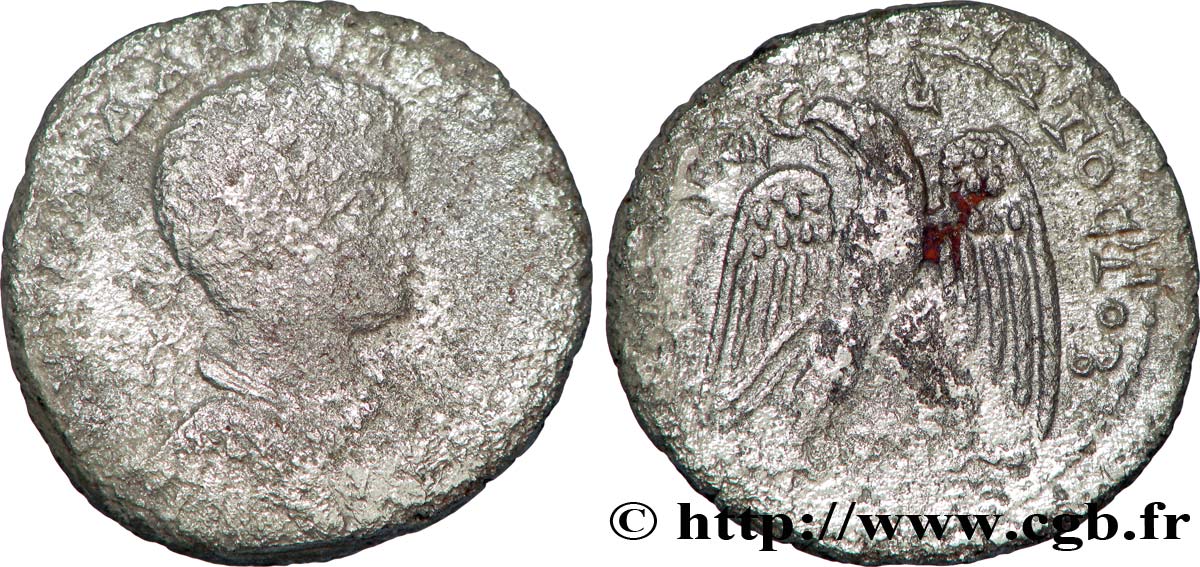
E-auction 95-49566 - bpv_305566 - ELAGABALUS Tétradrachme syro-phénicien
You must signin and be an approved bidder to bid, LOGIN TO BID. Accounts are subject to approval and the approval process takes place within 48 hours. Do not wait until the day a sale closes to register. Clicking on « bid » constitutes acceptance of the terms of use of cgb.fr private e-auctions.
Bids must be placed in whole Euro amounts only. The sale will start closing at the time stated on the item description; any bids received at the site after the closing time will not be executed. Transmission times may vary and bids could be rejected if you wait until the last second. For further information ckeck the E-auctions F.A.Q.
NO BUYER'S FEE.
NO BUYER'S FEE.
| Estimate : | 45 € |
| Price : | 13 € |
| Maximum bid : | 13 € |
| End of the sale : | 09 February 2015 16:13:00 |
| bidders : | 4 bidders |
Type : Tétradrachme syro-phénicien
Date: 218-220
Mint name / Town : Antioche, Syrie, Séleucie et Piérie
Metal : billon
Diameter : 26,00 mm
Orientation dies : 12 h.
Weight : 11,10 g.
Rarity : R1
Coments on the condition:
Pas d’usure au sens strict mais une violente corrosion
Catalogue references :
Predigree :
Cet exemplaire est le 0251_015 de la base TSP
Obverse
Obverse description : Buste cuirassé (ptéryges et épaulette cloutée bien visibles) et drapé d’Elagabal lauré à droite, vu de trois-quarts de face, les rubans de la couronne de lauriers flottant derrière la tête.
Obverse legend : AUT K M A ... ANTwNEINOS SEB
Obverse translation : Empereur César Marc Aurèle Antonin Auguste.
Reverse
Reverse description : Aigle au style d’Émèse debout à droite sur une ligne de terre, les ailes déployées, la tête et queue à gauche, tenant une couronne perlée de laurier dans son bec, une étoile à huit branches entre les pattes.
Reverse legend : DHMARC EX UPATOSTOB / .D. - .E.
Reverse translation : (Puissance tribunitienne, consul pour la deuxième fois).
Commentary
Ce buste cuirassé avec un empereur au visage imberbe et presque poupin (il a quatorze ans) s’inscrit très bien dans l’idée d’une frappe à Emèse, concomitante à la bataille contre Macrin.
Bien que classé par commodité à Antioche, ce type a été attribué au graveur d’Emèse, voire à l’atelier d’Emèse, pour trois raisons. Ce style de revers est celui de l’émission à l’Adventus (Prieur 253), unique par sa représentation et par la couronne radiée. Il semble logique que la bataille décisive ayant été livrée devant Emèse, la frappe y ait été initiée pour payer les troupes : où mieux qu’à Emèse ? Au final, le style du graveur est proche des Caracalla pour Emèse. Accessoirement, le métal de ces séries (Prieur 249/253) semble bien meilleur que la moyenne des autres frappes ; les frappes d’Elagabal se terminant en cuivre légèrement billoné, on peut supposer que les meilleurs alliages se placent au début du règne.
Les émissions d’Elagabal se classent par référence à leur graveur de revers, quand celui-ci peut être rapproché d’une émission précédente identifiée pour une ville, par le style plus généralement quand ce n’est pas le cas. On trouve une trentaine de graveurs de revers et moins d’une dizaine de graveurs de droit.
La question de savoir si les ateliers de Caracalla, encore en production sous Macrin, furent conservés ou si tous les graveurs furent regroupés à Antioche n’est pas tranchée, faute d’une analyse des liaisons de coins. On pense néanmoins que ce fut le cas, ne serait-ce que par la présence systématique du Delta Eta dans le champ du revers.
Tous les tétradrachmes officiels d’Elagabal portent la date du deuxième consulat, le hiatus entre Caracalla et le nouvel empereur étant considéré comme le premier consulat de celui-ci. À en juger par certaines émissions, les frappes se terminent certainement, dans une dégénerescence complète de l’aloi et du style, vers 220, en tous cas avant le troisième consulat.
On note que les sigma sont gravés en C.
Dans la base TSP maintenue par Michel Prieur, trente-quatre exemplaires sont maintenant répertoriés dont en musées ANS (3), Paris, British Museum et Yale.
This armored bust with an emperor with a beardless and almost baby-like face (he is fourteen years old) fits very well with the idea of a strike at Emesa, concomitant with the battle against Macrinus.
Although conveniently classified in Antioch, this type has been attributed to the engraver of Emesa, or even to the workshop of Emesa, for three reasons. This style of reverse is that of the Adventus issue (Prieur 253), unique in its representation and in the radiate crown. It seems logical that since the decisive battle was fought in front of Emesa, the minting was initiated there to pay the troops: where better than in Emesa? In the end, the engraver's style is close to that of Caracalla for Emesa. Incidentally, the metal of these series (Prieur 249/253) seems much better than the average of the other strikes; the strikes of Elagabal ending in slightly billonated copper, we can assume that the best alloys are placed at the beginning of the reign.
The issues of Elagabalus are classified by reference to their reverse engraver, when this can be compared to a previous issue identified for a city, and by style more generally when this is not the case.. There are around thirty reverse engravers and less than ten obverse engravers..
The question of whether the Caracalla workshops, still in production under Macrinus, were preserved or whether all the engravers were grouped together in Antioch is not settled, due to the lack of an analysis of the die bonds.. It is nevertheless believed that this was the case, if only because of the systematic presence of Delta Eta in the field of the reverse.
All official tetradrachms of Elagabalus bear the date of the second consulship, the hiatus between Caracalla and the new emperor being considered the latter's first consulship. Judging by some issues, the minting certainly ended, in a complete degeneration of alloy and style, around 220, in any case before the third consulate..
Note that the sigmas are engraved in C.
In the TSP database maintained by Michel Prieur, thirty-four examples are now listed, including in ANS museums (3), Paris, British Museum and Yale
Bien que classé par commodité à Antioche, ce type a été attribué au graveur d’Emèse, voire à l’atelier d’Emèse, pour trois raisons. Ce style de revers est celui de l’émission à l’Adventus (Prieur 253), unique par sa représentation et par la couronne radiée. Il semble logique que la bataille décisive ayant été livrée devant Emèse, la frappe y ait été initiée pour payer les troupes : où mieux qu’à Emèse ? Au final, le style du graveur est proche des Caracalla pour Emèse. Accessoirement, le métal de ces séries (Prieur 249/253) semble bien meilleur que la moyenne des autres frappes ; les frappes d’Elagabal se terminant en cuivre légèrement billoné, on peut supposer que les meilleurs alliages se placent au début du règne.
Les émissions d’Elagabal se classent par référence à leur graveur de revers, quand celui-ci peut être rapproché d’une émission précédente identifiée pour une ville, par le style plus généralement quand ce n’est pas le cas. On trouve une trentaine de graveurs de revers et moins d’une dizaine de graveurs de droit.
La question de savoir si les ateliers de Caracalla, encore en production sous Macrin, furent conservés ou si tous les graveurs furent regroupés à Antioche n’est pas tranchée, faute d’une analyse des liaisons de coins. On pense néanmoins que ce fut le cas, ne serait-ce que par la présence systématique du Delta Eta dans le champ du revers.
Tous les tétradrachmes officiels d’Elagabal portent la date du deuxième consulat, le hiatus entre Caracalla et le nouvel empereur étant considéré comme le premier consulat de celui-ci. À en juger par certaines émissions, les frappes se terminent certainement, dans une dégénerescence complète de l’aloi et du style, vers 220, en tous cas avant le troisième consulat.
On note que les sigma sont gravés en C.
Dans la base TSP maintenue par Michel Prieur, trente-quatre exemplaires sont maintenant répertoriés dont en musées ANS (3), Paris, British Museum et Yale.
This armored bust with an emperor with a beardless and almost baby-like face (he is fourteen years old) fits very well with the idea of a strike at Emesa, concomitant with the battle against Macrinus.
Although conveniently classified in Antioch, this type has been attributed to the engraver of Emesa, or even to the workshop of Emesa, for three reasons. This style of reverse is that of the Adventus issue (Prieur 253), unique in its representation and in the radiate crown. It seems logical that since the decisive battle was fought in front of Emesa, the minting was initiated there to pay the troops: where better than in Emesa? In the end, the engraver's style is close to that of Caracalla for Emesa. Incidentally, the metal of these series (Prieur 249/253) seems much better than the average of the other strikes; the strikes of Elagabal ending in slightly billonated copper, we can assume that the best alloys are placed at the beginning of the reign.
The issues of Elagabalus are classified by reference to their reverse engraver, when this can be compared to a previous issue identified for a city, and by style more generally when this is not the case.. There are around thirty reverse engravers and less than ten obverse engravers..
The question of whether the Caracalla workshops, still in production under Macrinus, were preserved or whether all the engravers were grouped together in Antioch is not settled, due to the lack of an analysis of the die bonds.. It is nevertheless believed that this was the case, if only because of the systematic presence of Delta Eta in the field of the reverse.
All official tetradrachms of Elagabalus bear the date of the second consulship, the hiatus between Caracalla and the new emperor being considered the latter's first consulship. Judging by some issues, the minting certainly ended, in a complete degeneration of alloy and style, around 220, in any case before the third consulate..
Note that the sigmas are engraved in C.
In the TSP database maintained by Michel Prieur, thirty-four examples are now listed, including in ANS museums (3), Paris, British Museum and Yale
Historical background
ELAGABALUS
(16/05/218-12/03/222)
Proclaimed emperor on May 16, 218, Elagabalus, sole august until the end of June or the beginning of July, left Syria to join Rome. Elagabalus stops at Nicomedia. He spent the whole winter there and fell ill. It was therefore in this city that he took up his second consulship. Elagabal will not arrive in Rome until July or September 219, bringing the black stone of his cult to install him in his capital. He will never return to Syria, quickly assassinated after an unequaled reign of turpitude and disorder.
 Report a mistake
 Print the page
 Share my selection
 Ask a question
 Consign / sell
 Full data


Your Recently Viewed Items
1 Pound SOUTH AFRICA 1957 P.092d UNC-
62.00 €

MASSALIA - MARSEILLE Petit bronze à l’aigle VF/XF
80.00 €

MAXIMIANUS HERCULIUS Follis ou nummus AU/XF
180.00 €
LICINIUS I Follis ou nummus AU
60.00 €
10 centimes Daniel-Dupuis 1915 F.136/25 MS60
65.00 €
JUSTIN II and SOPHIA Follis AU
145.00 €
cgbfr.com numismatists


