


brm_575359 - DIOCLETIAN Follis ou nummus

Not available.
Item sold on our e-shop (2021)
Price : 150.00 €
Item sold on our e-shop (2021)
Price : 150.00 €
Type : Follis ou nummus
Date: 295
Mint name / Town : Boulogne
Metal : copper
Millesimal fineness : 50 ‰
Diameter : 28 mm
Orientation dies : 6 h.
Weight : 9,54 g.
Rarity : R3
Coments on the condition:
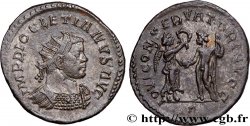
Exemplaire sur un flan large bien centré. Belle tête de Dioclétien. Frappe un peu faible au revers. Patine gris foncé avec des reflets métalliques
Catalogue references :
Obverse
Obverse legend : IMP C DIOCLETIANVS P F AVG.
Obverse description : Tête laurée de Dioclétien à droite (O*).
Obverse translation : “Imperator Cæsar Diocletianus Pius Felix Augustus”, (L’empereur césar Dioclétien pieux heureux auguste).
Reverse
Reverse legend : GENIO POPV-LI ROMANI.
Reverse description : Genius (le Génie) debout à gauche, le manteau sur l'épaule gauche, tenant une patère de la main droite et une corne d'abondance de la main gauche.
Reverse translation : “Genio Populi Romani”, (Le Génie du Peuple romain).
Commentary
Avec une grande partie de son argenture superficielle. Petite effigie. Rubans de type 3. Portrait particulier. Exemplaire de la plus grande rareté. La titulature et le portrait sont très proches des folles lyonnais des trois premières émissions (294-295) et seraient donc frappés à Boulogne. Le follis n’est pas de Lyon et n’a pas eu la marque d’exergue arasée ou n’est pas mal frappé, la marque mal venue. Il s’agit d’un scalptor lyonnais comme l’a démontré le Docteur Pierre Bastien qui suit le “comitatus” de Constance Chlore qui s’apprête à passer en Bretagne afin d’affronter Allectus. Quatrel exemplaires répertoriés dans le corpus du Docteur Bastien en 1976 (B. 6b, pl. LXIX avec la césure POPV-LI contre un avec la césures POP-VLI).
With a large part of its surface silvering. Small effigy. Type 3 ribbons. Particular portrait. An extremely rare example. The title and the portrait are very close to the folies lyonnais of the first three issues (294-295) and would therefore have been struck in Boulogne. The follis is not from Lyon and did not have the exergue mark leveled or is not badly struck, the mark badly placed. It is a scalptor lyonnais as demonstrated by Doctor Pierre Bastien who follows the “comitatus” of Constance Chlore who is preparing to go to Brittany to confront Allectus. Four examples listed in Doctor Bastien's corpus in 1976 (B. 6b, pl. LXIX with the POPV-LI caesura against one with the POP-VLI caesura)
With a large part of its surface silvering. Small effigy. Type 3 ribbons. Particular portrait. An extremely rare example. The title and the portrait are very close to the folies lyonnais of the first three issues (294-295) and would therefore have been struck in Boulogne. The follis is not from Lyon and did not have the exergue mark leveled or is not badly struck, the mark badly placed. It is a scalptor lyonnais as demonstrated by Doctor Pierre Bastien who follows the “comitatus” of Constance Chlore who is preparing to go to Brittany to confront Allectus. Four examples listed in Doctor Bastien's corpus in 1976 (B. 6b, pl. LXIX with the POPV-LI caesura against one with the POP-VLI caesura)
Historical background
DIOCLETIAN
(20/11/284-1/05/305)
Augustus
Diocletian, born in 245 in Dalmatia (Split), is an Illyrian emperor. After having eliminated Aper, prefect of the praetorium, also father-in-law and assassin of Numérien, he put on the purple on November 20, 284. Fighting first against Carin, last son of Carus, he was beaten at Margus the following year. But Carin is assassinated and Diocletian alone remains august. He raised Maximian, a compatriot, to the rank of Caesar in November 285, then Augustus on April 1, 286. Diocletian had just created a new political regime, the dyarchy. Two emperors shared military and political power there, but Maximian remained subordinate to Diocletian. Diocletian places himself under the Jovian protection (of Jupiter) while Maximian is of Herculean essence (of Hercules). Diocletian spent the first ten years of his reign fighting in the East, while Maximian remained in the West. Diocletian is the first emperor of the Lower Empire, according to the expression of Gibbons, and the founder of the dominion.
 Report a mistake
 Print the page
 Share my selection
 Ask a question
 Consign / sell
 Full data


Your Recently Viewed Items
1000 Gourdes HAITI 2007 P.278c UNC-
32.00 €

GERMANY - HESSE 6 Kreuzer 1833 XF
13.00 €
cgbfr.com numismatists


