


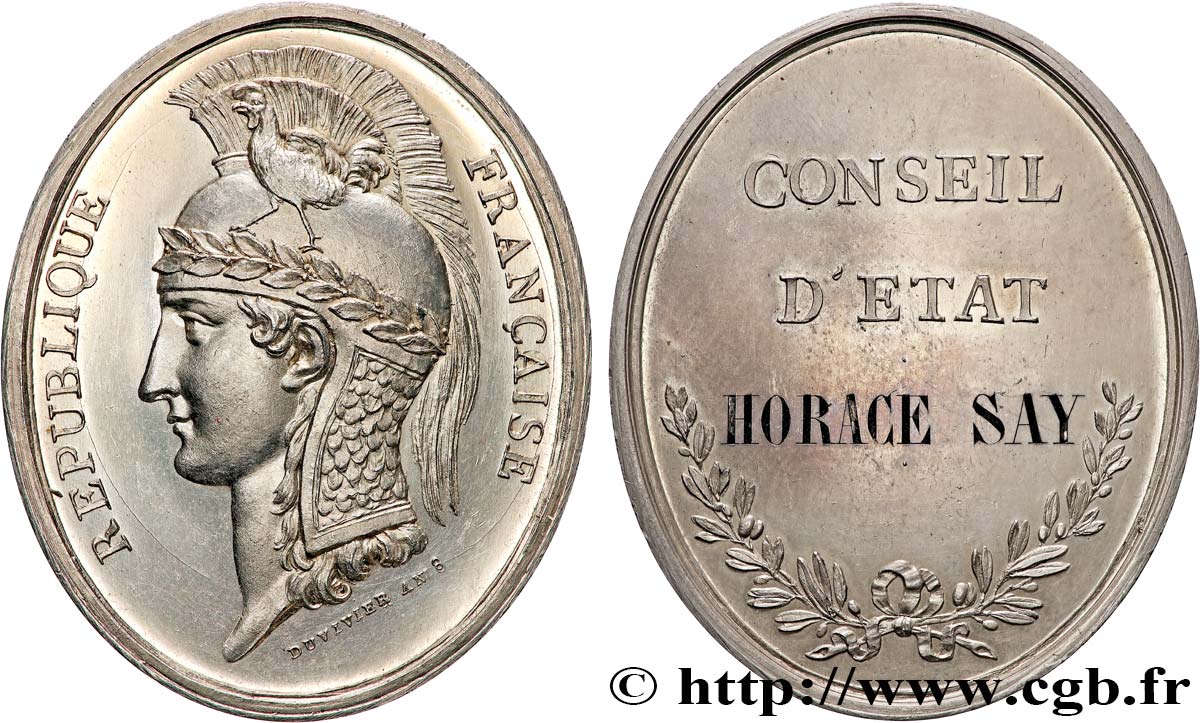
Live auction - fme_895987 - SECOND REPUBLIC Médaille, Conseil d’État, Horace Émile Say
You must signin and be an approved bidder to bid, LOGIN TO BID. Accounts are subject to approval and the approval process takes place within 48 hours. Do not wait until the day a sale closes to register. Clicking on "BID" constitutes acceptance of the terms of use of cgb.fr private live auctions.
Bids must be placed in whole Euro amounts only. The sale will start closing at the time stated on the item description; any bids received at the site after the closing time will not be executed. Transmission times may vary and bids could be rejected if you wait until the last second. For further information check the Live auction FAQ
All winning bids are subject to a 18% buyer’s fee.
All winning bids are subject to a 18% buyer’s fee.
| Estimate : | 400 € |
| Price : | 410 € |
| Maximum bid : | 410 € |
| End of the sale : | 13 February 2024 17:26:45 |
| bidders : | 4 bidders |
Type : Médaille, Conseil d’État, Horace Émile Say
Date: (1849-1851)
Metal : silver
Diameter : 46,5 mm
Orientation dies : 12 h.
Engraver DUVIVIER Benjamin (1730-1819)
Weight : 37,12 g.
Edge : lisse + main ARGENT
Puncheon : main indicatrice (1845-1860) et ARGENT
Coments on the condition:
Patine grise hétérogène, présentant des taches d’oxydation, notamment au revers. Présence de quelques rayures
Catalogue references :
Obverse
Obverse legend : REPUBLIQUE - FRANCAISE.
Obverse description : Tête féminine de profil à gauche, coiffée d’un casque lauré et sommé d’un coq. Signé : DUVIVIER AN 8.
Reverse
Reverse legend : CONSEIL / D’ETAT / HORACE SAY.
Reverse description : Légende en 3 lignes, branches d’olivier en sautoir à l’exergue.
Commentary
Médaille décernée à Horace Émile Say (1794-1860) économiste français appartenant à la famille protestante Say.
Il fait ses études à Genève et entre en apprentissage chez un parent négociant. Il est subrécargue aux États-Unis en 1813, puis au Brésil en 1815, où il reste dix ans. En 1818, il fonde à Paris une maison pour le commerce d'exportation.
Il est nommé juge au tribunal de commerce de la Seine en 1831, membre de la chambre de commerce en 1834, membre du conseil municipal et du conseil général de la Seine en 1837. Il est professeur d'économie industrielle au Conservatoire national des arts et métiers de Paris et professeur d'économie politique au Collège de France. Il est conseiller d'État de 1849 à 1851.
Cf. Wikipedia.
Medal awarded to Horace Émile Say (1794-1860), a French economist belonging to the Protestant Say family. He studied in Geneva and was apprenticed to a relative who was a merchant. He was a supercargo merchant in the United States in 1813, then in Brazil in 1815, where he stayed for ten years. In 1818, he founded an export trading firm in Paris. He was appointed judge at the Commercial Court of the Seine in 1831, a member of the Chamber of Commerce in 1834, and a member of the municipal council and the general council of the Seine in 1837. He was a professor of industrial economics at the Conservatoire national des arts et métiers in Paris and a professor of political economy at the Collège de France. He was a State Councilor from 1849 to 1851. See Wikipedia
Il fait ses études à Genève et entre en apprentissage chez un parent négociant. Il est subrécargue aux États-Unis en 1813, puis au Brésil en 1815, où il reste dix ans. En 1818, il fonde à Paris une maison pour le commerce d'exportation.
Il est nommé juge au tribunal de commerce de la Seine en 1831, membre de la chambre de commerce en 1834, membre du conseil municipal et du conseil général de la Seine en 1837. Il est professeur d'économie industrielle au Conservatoire national des arts et métiers de Paris et professeur d'économie politique au Collège de France. Il est conseiller d'État de 1849 à 1851.
Cf. Wikipedia.
Medal awarded to Horace Émile Say (1794-1860), a French economist belonging to the Protestant Say family. He studied in Geneva and was apprenticed to a relative who was a merchant. He was a supercargo merchant in the United States in 1813, then in Brazil in 1815, where he stayed for ten years. In 1818, he founded an export trading firm in Paris. He was appointed judge at the Commercial Court of the Seine in 1831, a member of the Chamber of Commerce in 1834, and a member of the municipal council and the general council of the Seine in 1837. He was a professor of industrial economics at the Conservatoire national des arts et métiers in Paris and a professor of political economy at the Collège de France. He was a State Councilor from 1849 to 1851. See Wikipedia
Historical background
SECOND REPUBLIC
(02/24/1848-12/2/1852)
Louis-Napoleon was elected on December 10, 1848 as the first President of the Second Republic. He did not have the right to run again in 1852. Louis-Napoleon decided to make a coup planned for December 2, 1851, the anniversary of the coronation of the Eagle and the commemoration of the Battle of Austerlitz. The coup is ratified by a plebiscite on December 21 with more than 7.5 million YES and only 640,000 NO. Victor Hugo went into exile on December 12. The following year, he will publish "Napoléon le Petit" which will earn Louis-Napoleon, who has become Napoleon III in the meantime, this famous sentence: "Napoleon le Petit by Victor le Grand".
 Report a mistake
 Print the page
 Share my selection
 Ask a question
 Consign / sell
Related articles

 Full data


Your Recently Viewed Items

GALLIA - AULERCI EBUROVICES (Area of Évreux) Bronze au cheval et au sanglier XF
75.00 €

LOUIS XIII Huitième d'écu de Béarn 1610 Morlaàs VF
150.00 €
50 Francs Guiraud 1958 Paris F.425/14 MS62 PCGS
180.00 €

Essai au module du quart de franc par Gengembre en laiton 1804 Paris Maz.621 a
265.00 €
50 centimes Cérès, IIIe République 1872 Paris F.189/3 MS65 PCGS
280.00 €

SECOND REPUBLIC Insigne de député, Assemblée constituante AU
210.00 €
cgbfr.com numismatists


