


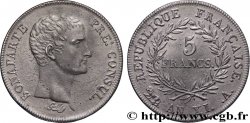
fmd_1054792 - Demi-franc Bonaparte Premier consul 1804 Strasbourg F.173/3

380.00 €(Approx. 440.80$ | 326.80£)
Quantity
Add to your cart

Type : Demi-franc Bonaparte Premier consul
Date: An 12 (1803-1804)
Mint name / Town : Strasbourg
Quantity minted : 2125
Metal : silver
Millesimal fineness : 900 ‰
Diameter : 18 mm
Orientation dies : 6 h.
Weight : 2,45 g.
Edge : pointée et barrée en creux
Rarity : R3
Coments on the condition:
Des traces de nettoyage
Catalogue references :
Obverse
Obverse legend : BONAPARTE - PREMIER CONSUL..
Obverse description : Tête nue de Bonaparte à droite ; signé Tiolier cursif au-dessous.
Reverse
Reverse legend : RÉPUBLIQUE FRANÇAISE./ DEMI/ FRANC./ .(MM). AN 12. .BB..
Reverse description : au centre dans une couronne formée de deux branches d'olivier.
Commentary
C’est seulement la troisième fois que nous proposons un exemplaire à la vente !.
This is only the third time we've offered a example for sale!
This is only the third time we've offered a example for sale!
Historical background
CONSULATE
(9-10/11/1799-18/05/1804)
Supported by supporters of a strong power, Napoleon Bonaparte, victorious general in the Italian and Egyptian campaigns, overthrew the Directory on 18 and 19 brumaire year VIII (9 and 10 November 1799). The Revolution is over, the destiny of France now rests in the hands of a strong executive. A new constitution, the Constitution of Year VIII, comes into force in December. It defines the powers and reinforces Bonaparte in his role as strong man of the country: First Consul, at the head of the executive, he appoints to the main public functions, holds a certain power of initiative in legislative matters, and retains his role military. The Senate, the Tribunate and the Legislative Body compose three assemblies which possess the other part of the legislative function.. On November 11, 1799, Bonaparte took an important decision: he appointed Gaudin Minister of Finance. This one will keep his post until April 1, 1814, and will find it again during the Hundred Days. Restoring the finances of the State is the number one priority of the First Consul. Thus, the Banque de France was created on February 18, 1800. With the help of the Sinking Fund, the budget of France is restored in 1802. And in 1803, as part of the great monetary reform, the Franc, a guarantee of stability, was reborn, under the name of Franc germinal. Bonaparte's second priority is the internal pacification of the country undermined by the divisions born of the Revolution. To reconcile the French, several measures were adopted: freedom of worship, end of the sale of national property, amnesty for emigrants. Only the West of France remains unsubdued. Insurgencies and robberies enliven this part of the territory and compromise the hopes of the First Consul, despite the signing of a truce with the Chouan chiefs in November 1799. However, with the support of the clergy, the Vendée was pacified during 1800. The religious framework is then definitively inscribed as the main element of the stabilization of society.. Negotiations with Pope Pius VII lead to the signing of the Concordat of 1801. Sixty bishops, appointed by Bonaparte, and invested by the Pope, then settled throughout the territory. Catholic priests, also named, are now civil servants. Many dissenters rallied, others continued to stir up trouble, mainly in Brittany and Normandy, where the Royalists, aided by England, awaited the arrival of Louis XVIII.. Outside, another challenge awaits Bonaparte: to restore peace. The Austrians were defeated at Marengo on June 14, 1800, then at Hohenlinden on December 3, 1800. The Peace of Lunéville was signed on February 9, 1801.. On March 25, 1802, the Peace of Amiens was signed with the English.. In 1802, the Consulate took a new direction, more authoritarian. The Jacobins are excluded from political life (the most virulent are arrested by Fouché, Prefect of Police), the press is controlled, and the Royalists hunted down. It is in this context that the Constitution of Year X was adopted: it considerably reduced the powers of the assemblies, and named Napoleon Bonaparte Consul for life.. The foundations of the first Empire are in place.
 Report a mistake
 Print the page
 Share my selection
 Ask a question
 Consign / sell
Related articles

 Full data

cgbfr.com numismatists


