


bga_959319 - DANUBIAN CELTS - IMITATIONS OF THE TETRADRACHMS OF PHILIP II AND HIS SUCCESSORS Tétradrachme

Not available.
Item sold on our e-shop (2025)
Price : 250.00 €
Item sold on our e-shop (2025)
Price : 250.00 €
Type : Tétradrachme
Date: (IIe-Ier siècles avant J.-C.)
Metal : silver
Diameter : 24 mm
Orientation dies : 2 h.
Weight : 12,58 g.
Rarity : R2
Coments on the condition:
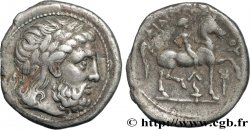
Monnaie idéalement centrée. Joli portrait de Zeus, bien venu à la frappe. Revers agréable. Patine grise
Catalogue references :
Obverse
Obverse legend : ANÉPIGRAPHE.
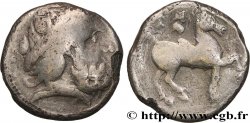
Obverse description : Tête laurée de Zeus à droite ; grènetis.
Reverse
Reverse description : Cavalier au pas à droite, tenant une palme de la main droite ; le cheval lève l'antérieur à droite ; entre les jambes du cheval, une torche.
Reverse legend : FILIP - POU
Commentary
Si le statère d’or de Philippe II de Macédoine a servi de prototype à de nombreuses imitations gauloises, le tétradrachme n’a pas été imité en Gaule, mais reste principal sujet d’inspiration des monnaies pour les Celtes du Danube (LT. 9697-9767, 9768-9832, 9618-9630, 9870-9886). Les premières imitations furent frappées dans le premier quart du IIIe siècle avant J.-C. La fabrication des copies serviles, puis des imitations, enfin des frappes celtiques continuèrent pendant plus de deux siècles.
Cet exemplaire est d’un très bon style, encore très proche du prototype.
If the gold stater of Philip II of Macedonia served as a prototype for numerous Gallic imitations, the tetradrachm was not imitated in Gaul, but remained the main subject of inspiration for the coins of the Danube Celts (LT. 9697 -9767, 9768-9832, 9618-9630, 9870-9886). The first imitations were struck in the first quarter of the 3rd century BC. The manufacture of servile copies, then imitations, and finally Celtic mintings continued for more than two centuries. This example is of a very good style, still very close to the prototype
Cet exemplaire est d’un très bon style, encore très proche du prototype.
If the gold stater of Philip II of Macedonia served as a prototype for numerous Gallic imitations, the tetradrachm was not imitated in Gaul, but remained the main subject of inspiration for the coins of the Danube Celts (LT. 9697 -9767, 9768-9832, 9618-9630, 9870-9886). The first imitations were struck in the first quarter of the 3rd century BC. The manufacture of servile copies, then imitations, and finally Celtic mintings continued for more than two centuries. This example is of a very good style, still very close to the prototype
Historical background
DANUBIAN CELTS - IMITATIONS OF THE TETRADRACHMS OF PHILIP II AND HIS SUCCESSORS
(3rd-1st century BC)
Under this title are generally grouped all the coinages that do not have a precise attribution. Sometimes the term "Eastern Celts" is offered. After the Celts plundered Delphi and spread through Greece and Asia Minor, they seized a significant amount of spoils, thanks to their plunder. The Hellenistic kings, Diadoques or Epigones, used them as mercenaries in their armies where the average salary was normally one stater of gold corresponding to five tetradrachms of Attic standard or twenty drachms. The prototypes which represented the head of Zeus with a horseman were widely copied and imitated throughout the Balkans, northern Macedonia and Thrace. The final phase of the coinage occurs at the end of the 2nd century or the beginning of the first century BC where there are no traces of the obverse and the reverse as well as legends more than a domed face of a coin. practically smooth on both sides.
 Report a mistake
 Print the page
 Share my selection
 Ask a question
 Consign / sell
Related articles

 Full data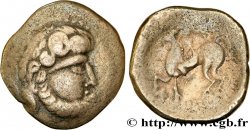


Your Recently Viewed Items

GALLIA - SOUTH WESTERN GAUL - CADURCI (Area of Cahors) Drachme “à la tête tr
140.00 €
cgbfr.com numismatists


