


bby_275435 - CONSTANTINE VIII Follis
Not available.
Item sold on our e-shop (2013)
Price : 75.00 €
Item sold on our e-shop (2013)
Price : 75.00 €
Type : Follis
Date: c. 976-1028
Mint name / Town : Constantinople
Metal : copper
Diameter : 27 mm
Orientation dies : 6 h.
Weight : 9,62 g.
Coments on the condition:
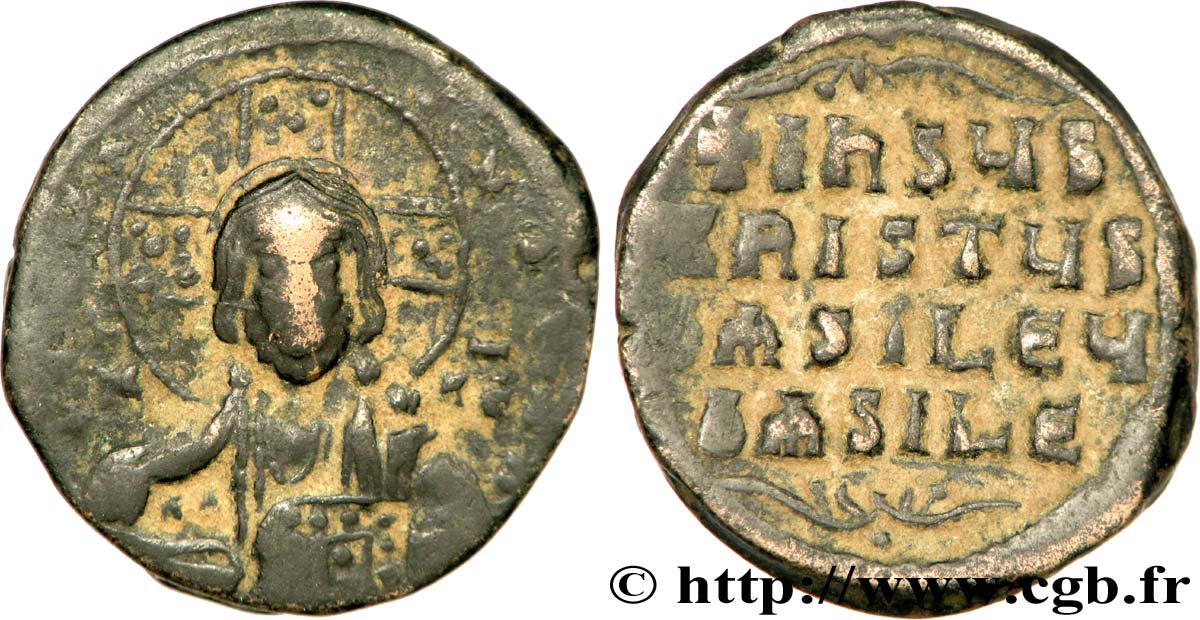
Exemplaire sur un petit flan, bien centré des deux côtés. Beau portrait du Christ à l’usure régulière. Joli revers. Patine marron foncé
Catalogue references :
Obverse
Obverse legend : + EMMA - NOVHA/ IC - XC.
Obverse description : Buste du Christ Antiphonetes debout de face, avec le globe crucigère, vêtu du pallium et du colobium, bénissant de la main droite et tenant les Évangiles de la gauche.
Obverse translation : (Dieu avec nous).
Reverse
Reverse legend : + IHSUS/ XRISTYS /BASILEU/ BASILE'.
Reverse description : en quatre lignes surmontées d'un ornement.
Reverse translation : (Jésus-Christ roi des rois).
Commentary
Poids lourd. Follis anonyme. Classe A3. Les Évangiles sont richement ornés. Le nimbe crucigère porte une carré formé de cinq globules pointé en cœ dans chaque bras de la croix. Motif floral à l’exergue du revers au-dessus et au-dessous de la légende. Ce type est attribué à Constantin VIII seul après 1025 et la mort de Basile II, mais Andreas Sommer l’attribue encore aux deux frères, malgré le poids et le diamètre.
Heavyweight. Anonymous Follis. Class A3. The Gospels are richly decorated. The cruciform nimbus bears a square formed by five globules pointed in a heart in each arm of the cross. Floral motif in the exergue of the reverse above and below the legend. This type is attributed to Constantine VIII alone after 1025 and the death of Basil II, but Andreas Sommer still attributes it to the two brothers, despite the weight and diameter
Heavyweight. Anonymous Follis. Class A3. The Gospels are richly decorated. The cruciform nimbus bears a square formed by five globules pointed in a heart in each arm of the cross. Floral motif in the exergue of the reverse above and below the legend. This type is attributed to Constantine VIII alone after 1025 and the death of Basil II, but Andreas Sommer still attributes it to the two brothers, despite the weight and diameter
Historical background
CONSTANTINE VIII
(15/12/1025-11/11/1028)
Constantin VIII, the second son of Roman II and Theophano was crowned in April 961. He is the brother of Basil II. He was associated with him throughout his reign. On the death of Basil II in December 1025, he succeeded him. His reign lasted only three years. His daughter Zoé married Romain, the Eparch of Constantinople. When Constantine VIII died on November 11, 1028, it was Roman III who ascended the throne..
 Report a mistake
 Print the page
 Share my selection
 Ask a question
 Consign / sell
Your Recently Viewed Items

2 Dollars SINGAPORE 1992 P.28 UNC
15.00 €
1 Franc SENEGAL 1917 P.02c AU
140.00 €
1 Franc SENEGAL 1917 P.02c XF
120.00 €

JUSTINIAN I Silique 1er type AU
280.00 €
GALLIA - BITURIGES CUBI (Area of Bourges) Bronze VANDIINOS XF/AU
290.00 €

MAXENTIUS Follis ou nummus AU/AU
110.00 €
cgbfr.com numismatists


