


brm_274777 - CONSTANTINE I THE GREAT Follis ou nummus
Not available.
Item sold on our e-shop (2012)
Price : 145.00 €
Item sold on our e-shop (2012)
Price : 145.00 €
Type : Follis ou nummus
Date: été
Date: 307
Mint name / Town : Lyon
Metal : copper
Diameter : 28 mm
Orientation dies : 6 h.
Weight : 6,75 g.
Coments on the condition:
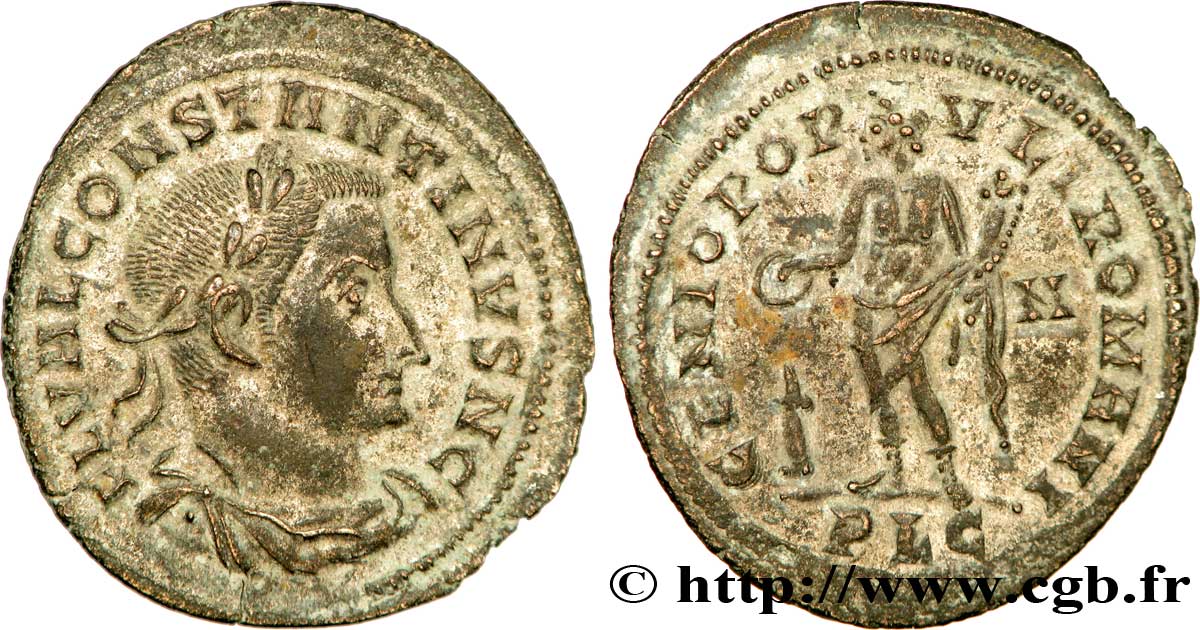
Exemplaire sur un flan mince, très large, ovale, bien centré des deux côtés avec les grènetis visibles. Beau portrait de Constantin Ier. Joli revers de style fin. Patine gris vert avec des reflets métalliques
Catalogue references :
Predigree :
Cet exemplaire provient du trésor de Marchais (Aisne), (J.-P. Callu, Inventaire des trésors de bronze constantiniens (313-348), p. 29, n° 9 et de la collection du baron L. Chaurand (Lyon)
Obverse
Obverse legend : FL VAL CONSTANTINVS N C.
Obverse description : Buste lauré, drapé et cuirassé de Constantin Ier césar à droite, vu de trois quarts en avant (A*).
Obverse translation : “Flavius Valerius Constantinus Nobilissimus Cæsar”, (Flavien Valère Constantin très noble césar).
Reverse
Reverse legend : GENIO POP-VLI ROMANI/ (AUTEL)|N// PLG.
Reverse description : Genius (Génie) debout à gauche, coiffé du modius, le Génie porte l’himation, tenant une patère de la main droite et une corne d'abondance de la main gauche.
Reverse translation : “Genio Populi Romani”, (Au Génie du Peuple romain).
Commentary
Avec son argenture superficielle. Poids léger. Rubans de type 3. Ptéryges invisibles sous le paludamentum. Un changement radical intervient dans la représentation du Génie au revers. Il est maintenant normalement revêtu de l’himation au lieu du manteau tombant sur l’épaule (paludamentum). Une autre innovation est l’apparition d’un N dans le champ à droite. Nous nous sommes interrogés sur la présence et la signification de ce N. Il pourrait tout simplement signifier “Nova”, (nouvelle) pour rappeler techniquement la réduction du follis du 1/32 L. au 1/40 L. Nous n’avons relevé aucune liaison de coin pertinente. Cet exemplaire est cité dans l’ouvrage de Pierre Bastien.
With its superficial silver plating. Light weight. Type 3 ribbons. Invisible pteryges under the paludamentum. A radical change occurs in the representation of the Genius on the reverse. He is now normally dressed in the himation instead of the mantle falling over the shoulder (paludamentum). Another innovation is the appearance of an N in the right field. We wondered about the presence and meaning of this N. It could simply mean “Nova”, (new) to technically recall the reduction of the follis from 1/32 L. to 1/40 L. We did not note any relevant die connection. This example is cited in the work of Pierre Bastien
With its superficial silver plating. Light weight. Type 3 ribbons. Invisible pteryges under the paludamentum. A radical change occurs in the representation of the Genius on the reverse. He is now normally dressed in the himation instead of the mantle falling over the shoulder (paludamentum). Another innovation is the appearance of an N in the right field. We wondered about the presence and meaning of this N. It could simply mean “Nova”, (new) to technically recall the reduction of the follis from 1/32 L. to 1/40 L. We did not note any relevant die connection. This example is cited in the work of Pierre Bastien
Historical background
CONSTANTINE I THE GREAT
(07/25/306-05/22/337)
Caesar
Constantine was proclaimed august on the death of his father in York in 306. In order not to offend Galerius and Severus, he contented himself with the title of Caesar recognized by Galerius, who had become "Senior Augustus". Constantine controls Gaul and Brittany. He resumed the title of august on December 25, 307 after having married Fausta, the daughter of Maximien Hercule.
 Report a mistake
 Print the page
 Share my selection
 Ask a question
 Consign / sell
Related articles

 Full data



Your Recently Viewed Items
GALLIA BELGICA - SUESSIONES (Area of Soissons) Potin au swastika AU
350.00 €

CHAMBERS OF COMMERCE / CHAMBRES DE COMMERCE Chambre de commerce de Bordeaux (Lou
36.00 €

10 centimes Daniel-Dupuis 1915 F.136/24 MS62
77.00 €

2 francs Jean Moulin 1993 F.273/2 MS63
2.00 €

III REPUBLIC Médaille, Monnaie de Paris AU
120.00 €
HONG KONG 2 Dollars Fleur de bauhinia 2013 MS
2.00 €
cgbfr.com numismatists


