


brm_1111600 - CONSTANTIUS I Follis ou nummus

120.00 €(Approx. 140.40$ | 103.20£)
Quantity
Add to your cart

Type : Follis ou nummus
Date: 295
Mint name / Town : Boulogne
Metal : copper
Millesimal fineness : 50 ‰
Diameter : 27 mm
Orientation dies : 12 h.
Weight : 8,91 g.
Rarity : R3
Coments on the condition:
Monnaie centrée. Joli portrait de Constance. Usure plus marquée au revers. Avec une partie de son argenture. Patine grise
Catalogue references :
Predigree :
Cette monnaie provient de la Collection Joulia
Obverse
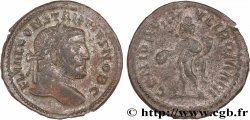
Obverse legend : FL VAL CONSTANTIVS NOB C.
Obverse description : Tête laurée de Constance Ier césar à droite (O*).
Obverse translation : “Flavius Valerius Constantius Nobilissimus Cæsar”, (Flavien Valère Constance très noble césar).
Reverse
Reverse legend : GENIO POPV-LI ROMANI.
Reverse description : Genius (le Génie) debout à gauche, le manteau sur l'épaule gauche, tenant une patère de la main droite et une corne d'abondance de la main gauche.
Reverse translation : “Genio Populi Romani”, (Le Génie du Peuple romain).
Commentary
Exemplaire de la plus grande rareté. La titulature et le portrait sont très proches des folles lyonnais des trois premières émissions (294-295) et seraient donc frappés à Boulogne. Le follis n’est pas de Lyon et n’a pas eu la marque d’exergue arasée ou n’est pas mal frappée, la marque mal venue. Il s’agit d’un scalptor lyonnais comme l’a démontré le Docteur Pierre Bastien qui suit le “comitatus” de Constance Chlore qui s’apprête à passer en Bretagne afin d’affronter Allectus. Un seul exemplaire répertorié dans le corpus du Docteur Bastien en 1976 (B. 4a, pl. LXIX avec la césure POPV-LI contre deux avec la césures POP-VLI). Ces exemplaires d’après V. Drost, RN 2014 pourraient constituer la première émission de l’atelier de Lyon sans marque.
An extremely rare example. The inscription and portrait are very similar to the Lyon folles of the first three issues (294-295) and would therefore have been struck in Boulogne. The follis is not from Lyon and does not have the exergue mark truncated or poorly struck. It is a Lyon scalptor, as demonstrated by Dr. Pierre Bastien, who followed the “comitatus” of Constantius Chlorus as he prepared to cross into Britain to confront Allectus. Only one example is recorded in Dr. Bastien's corpus in 1976 (B. 4a, pl. LXIX with the break POPV-LI, compared to two with the breaks POP-VLI). According to V. Drost, RN 2014, these examples could constitute the first issue from the Lyon mint without a mint mark.
An extremely rare example. The inscription and portrait are very similar to the Lyon folles of the first three issues (294-295) and would therefore have been struck in Boulogne. The follis is not from Lyon and does not have the exergue mark truncated or poorly struck. It is a Lyon scalptor, as demonstrated by Dr. Pierre Bastien, who followed the “comitatus” of Constantius Chlorus as he prepared to cross into Britain to confront Allectus. Only one example is recorded in Dr. Bastien's corpus in 1976 (B. 4a, pl. LXIX with the break POPV-LI, compared to two with the breaks POP-VLI). According to V. Drost, RN 2014, these examples could constitute the first issue from the Lyon mint without a mint mark.
Historical background
CONSTANTIUS I
(03/1/293-07/25/306)
Caesar
Constantius became Caesar on March 1, 293, at the same time as Galerius. He is the Caesar subordinate to Maximian while his colleague is to Diocletian. This is Tetrarchy. Constance is linked to Herculean parentage. He divorces Helen to marry Theodora, Maximian's daughter-in-law, while Galerius marries Galéria Valéria, daughter of Diocletian1/03/293-1/05/305.
 Report a mistake
 Print the page
 Share my selection
 Ask a question
 Consign / sell
Related articles

 Full data


cgbfr.com numismatists


