


fme_1161294 - V REPUBLIC Médaille, Reddition de Napoléon
75.00 €(Approx. 86.25$ | 64.50£)
Quantity
Add to your cart

Type : Médaille, Reddition de Napoléon
Date: 1969
Mint name / Town : 75 - Paris
Metal : bronze
Diameter : 41 mm
Orientation dies : 12 h.
Engraver BRENET Nicolas-Guy-Antoine (1773-1846) - MUDIE James (1779-1852)
Weight : 41 g.
Edge : lisse + 1969 + corne BRONZE
Puncheon : corne BRONZE
Coments on the condition:
Patine hétérogène avec des traces d’usure, rayures et taches d’oxydation
Obverse
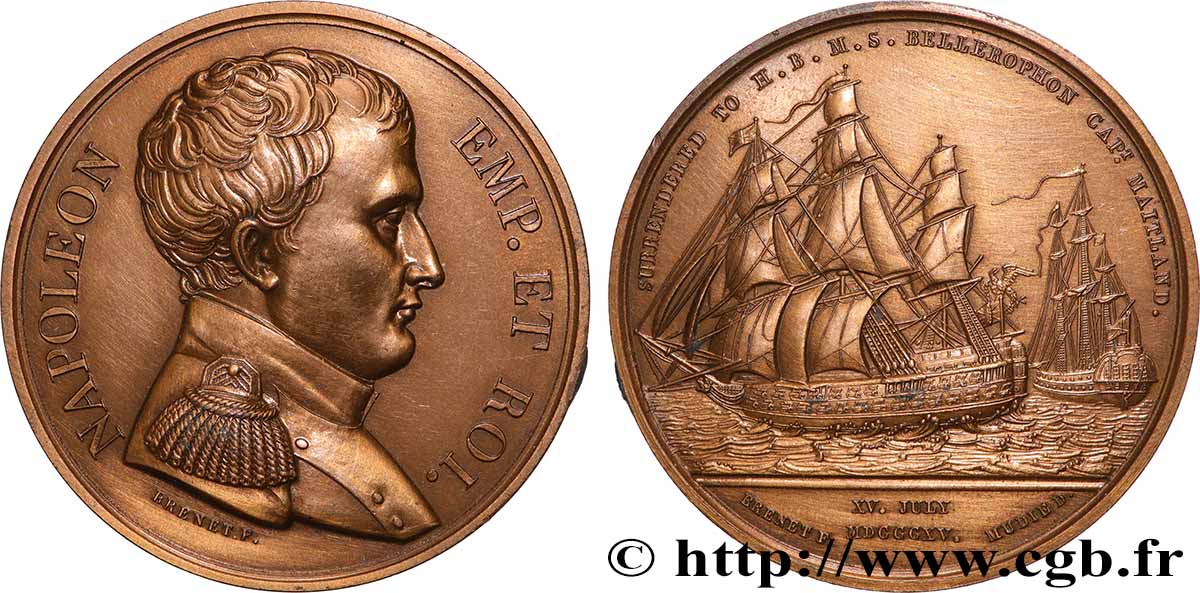
Obverse legend : NAPOLÉON EMP. ET ROI.
Obverse description : Buste de Napoléon à droite.
Reverse
Reverse legend : SURRENDERED TO H. B. M. S. BELLEROPHON CAPT MAITLAND. // XV. JULY / MDCCCXV.
Reverse description : Bataille navale mettant en scène le Bellerophon .
Commentary
Devant le rapprochement de Paris des armées de la septième Coalition, Napoléon quitte le palais le 25 juin pour le château de Malmaison puis le 29 il prend la route incognito en calèche isolée (habillé en bourgeois) pour Rochefort, puis Fouras, où l'attendent deux frégates la Saale et la Méduse, souhaitant rejoindre les États-Unis. Le 8 juillet, il embarque pour l'île d'Aix et monte à bord de la Saale. François Ponée, commandant de La Méduse offrit à l'empereur de combattre le Bellerophon, pendant que la Saale commandée par Pierre Philibert passerait. Mais Philibert refusa de jouer ce rôle qui lui était réservé. Joseph Fouché, président du gouvernement provisoire, alerte les Britanniques sur les risques de fuite de Napoléon. Plusieurs corvettes anglaises escortant le vaisseau le Bellerophon sont dépêchées dans le pertuis d'Antioche, contraignant Napoléon à négocier.
Demandant l'asile au « plus constant de ses ennemis », l'Angleterre, il est d'abord pris en charge par le Bellerophon, puis transféré le 7 août 1815 sur le Northumberland qui le déposera à Sainte-Hélène. On ne lui donne pas l'occasion de poser le pied en Angleterre, les ministres britanniques voulant absolument éviter que Napoléon puisse demander le droit d'asile en invoquant l'Habeas Corpus.
C'est le dernier service en mer du Bellerophon qui est décommissioné et transformé en ponton d'emprisonnement en 1815, puis rebaptisé HMS Captivity en 1824 afin de libérer le nom pour un autre navire. Déplacé à Plymouth en 1826, il est en service jusqu'en 1834, lorsque les derniers détenus le quittent. L'Amirauté le vend en 1836 et il est démoli..
Faced with the approach of the armies of the Seventh Coalition to Paris, Napoleon left the palace on June 25 for the Château de Malmaison, then on the 29th he took the road incognito in an isolated carriage (dressed as a bourgeois) to Rochefort, then Fouras, where two frigates, the Saale and the Méduse, were waiting for him, wishing to reach the United States.. On July 8, he embarked for the island of Aix and boarded the Saale. François Ponée, commander of La Méduse, offered to fight the Bellerophon to the emperor, while the Saale commanded by Pierre Philibert would pass. But Philibert refused to play this role which was reserved for him.. Joseph Fouché, president of the provisional government, alerts the British to the risks of Napoleon's escape. Several English corvettes escorting the ship Bellerophon were dispatched to the Antioch Strait, forcing Napoleon to negotiate..
Requesting asylum from \\\"his most constant enemy\\\", England, he was first taken in by the Bellerophon, then transferred on August 7, 1815 to the Northumberland which dropped him off at Saint Helena.. He was not given the opportunity to set foot in England, as British ministers were determined to prevent Napoleon from requesting the right of asylum by invoking Habeas Corpus..
This was Bellerophon's last seagoing service, and she was decommissioned and converted into a prison hulk in 1815, then renamed HMS Captivity in 1824 to free up the name for another ship.. Moved to Plymouth in 1826, it was in service until 1834, when the last prisoners left.. The Admiralty sold it in 1836 and it was broken up..
Demandant l'asile au « plus constant de ses ennemis », l'Angleterre, il est d'abord pris en charge par le Bellerophon, puis transféré le 7 août 1815 sur le Northumberland qui le déposera à Sainte-Hélène. On ne lui donne pas l'occasion de poser le pied en Angleterre, les ministres britanniques voulant absolument éviter que Napoléon puisse demander le droit d'asile en invoquant l'Habeas Corpus.
C'est le dernier service en mer du Bellerophon qui est décommissioné et transformé en ponton d'emprisonnement en 1815, puis rebaptisé HMS Captivity en 1824 afin de libérer le nom pour un autre navire. Déplacé à Plymouth en 1826, il est en service jusqu'en 1834, lorsque les derniers détenus le quittent. L'Amirauté le vend en 1836 et il est démoli..
Faced with the approach of the armies of the Seventh Coalition to Paris, Napoleon left the palace on June 25 for the Château de Malmaison, then on the 29th he took the road incognito in an isolated carriage (dressed as a bourgeois) to Rochefort, then Fouras, where two frigates, the Saale and the Méduse, were waiting for him, wishing to reach the United States.. On July 8, he embarked for the island of Aix and boarded the Saale. François Ponée, commander of La Méduse, offered to fight the Bellerophon to the emperor, while the Saale commanded by Pierre Philibert would pass. But Philibert refused to play this role which was reserved for him.. Joseph Fouché, president of the provisional government, alerts the British to the risks of Napoleon's escape. Several English corvettes escorting the ship Bellerophon were dispatched to the Antioch Strait, forcing Napoleon to negotiate..
Requesting asylum from \\\"his most constant enemy\\\", England, he was first taken in by the Bellerophon, then transferred on August 7, 1815 to the Northumberland which dropped him off at Saint Helena.. He was not given the opportunity to set foot in England, as British ministers were determined to prevent Napoleon from requesting the right of asylum by invoking Habeas Corpus..
This was Bellerophon's last seagoing service, and she was decommissioned and converted into a prison hulk in 1815, then renamed HMS Captivity in 1824 to free up the name for another ship.. Moved to Plymouth in 1826, it was in service until 1834, when the last prisoners left.. The Admiralty sold it in 1836 and it was broken up..
Historical background
V REPUBLIC
(since 08/01/1959)
The Fifth Republic, whose constitution was approved by referendum on September 28, 1958 by more than 79% of French people, only officially began with the installation of General de Gaulle as president on January 8, 1959. The constitution was amended on January 28, 1958. October 1962 by referendum where a majority of 62% of votes approves the election of the President of the Republic by direct universal suffrage. The various presidents of the Fifth Republic are Charles de Gaulle (8/01/1959 - 27/04/1969, retirement and Alain Poher becomes interim president), Georges Pompidou (15/06/1969 - 2/04/1974, deceased , Alain Poher becomes interim president), Valéry Giscard d'Estaing (19/05/1974 - 21/05/1981), François Mitterrand (21/05/1981 - 7/05/1995), Jacques Chirac (7/05 /1995 - 05/16/2007), Nicolas Sarkozy (05/16/2007 - 05/15/2012), François Hollande (05/15/2012 - 05/14/2017) and Emmanuel Macron (05/14/2017 - ).
 Report a mistake
 Print the page
 Share my selection
 Ask a question
 Consign / sell
 Full data


cgbfr.com numismatists


