


E-auction 514-427251 - bga_503390 - GALLIA - CARNUTES (Beauce area) Potin à la tête diabolique et au loup
You must signin and be an approved bidder to bid, LOGIN TO BID. Accounts are subject to approval and the approval process takes place within 48 hours. Do not wait until the day a sale closes to register. Clicking on « bid » constitutes acceptance of the terms of use of cgb.fr private e-auctions.
Bids must be placed in whole Euro amounts only. The sale will start closing at the time stated on the item description; any bids received at the site after the closing time will not be executed. Transmission times may vary and bids could be rejected if you wait until the last second. For further information ckeck the E-auctions F.A.Q.
NO BUYER'S FEE.
NO BUYER'S FEE.
| Estimate : | 150 € |
| Price : | 40 € |
| Maximum bid : | 56 € |
| End of the sale : | 20 February 2023 14:15:00 |
| bidders : | 5 bidders |
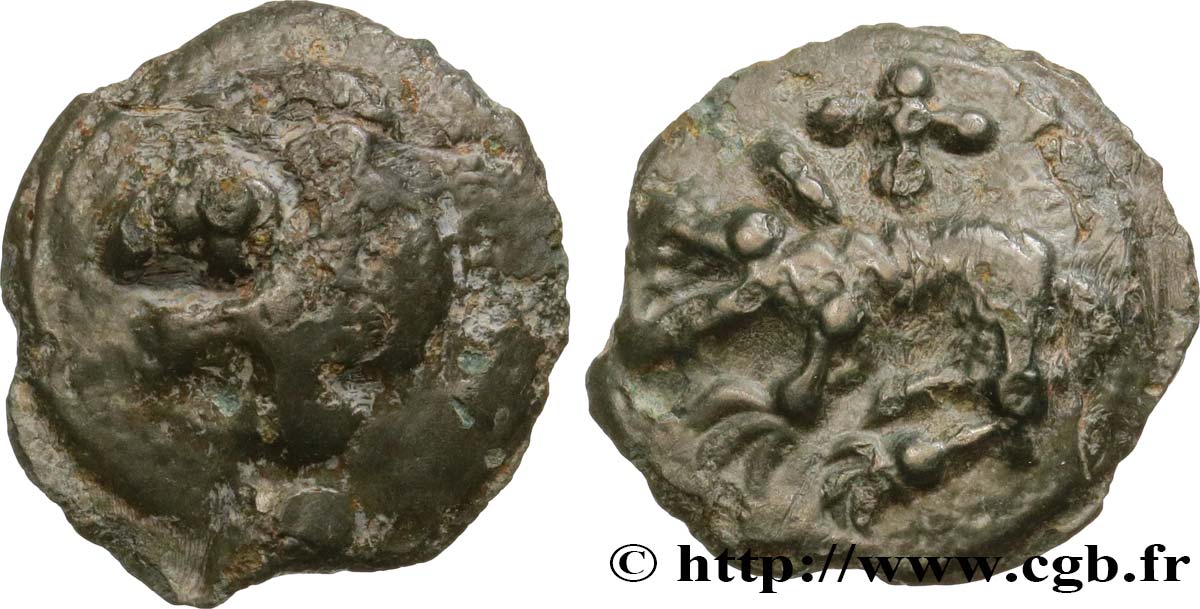
Type : Potin à la tête diabolique et au loup
Date: Ier siècle avant J.-C.
Mint name / Town : Chartres (28)
Metal : potin
Diameter : 18 mm
Orientation dies : 9 h.
Weight : 4,02 g.
Rarity : R3
Coments on the condition:
Usure régulière avec un beau revers. Patine grise
Catalogue references :
Obverse
Obverse legend : ANÉPIGRAPHE.
Obverse description : Tête chevelue à gauche, un globule en forme de goutte dans la bouche.
Reverse
Reverse legend : ANÉPIGRAPHE.
Reverse description : Loup stylisé et sexué à gauche, la queue entre les pattes et une croisette au-dessus du dos.
Commentary
Ce type de potin est nettement plus rare que les traditionnels potins à la tête diabolique. Il s'en distingue par le globule en forme de goutte au droit et par le loup au lieu du taureau au revers.
Sur cet exemplaire, le revers est si net que l’on distingue les cotes de l’animal !
La croisette du revers serait-elle le vestige de celle qui orne le petit potin turon à la tête bouclée et à la croisette ? A moins que ce ne soit l’inverse et que le revers de ce rare potin ait servi de prototype au potin turon ?.
This type of potin is significantly rarer than the traditional potin with the devil's head. It is distinguished by the drop-shaped globule on the obverse and by the wolf instead of the bull on the reverse. On this example, the reverse is so clear that the ribs of the animal can be seen! Could the cross on the reverse be a remnant of the one that adorns the small potin turon with the curly head and the cross? Or could it be the other way around and the reverse of this rare potin served as a prototype for the potin turon?
Sur cet exemplaire, le revers est si net que l’on distingue les cotes de l’animal !
La croisette du revers serait-elle le vestige de celle qui orne le petit potin turon à la tête bouclée et à la croisette ? A moins que ce ne soit l’inverse et que le revers de ce rare potin ait servi de prototype au potin turon ?.
This type of potin is significantly rarer than the traditional potin with the devil's head. It is distinguished by the drop-shaped globule on the obverse and by the wolf instead of the bull on the reverse. On this example, the reverse is so clear that the ribs of the animal can be seen! Could the cross on the reverse be a remnant of the one that adorns the small potin turon with the curly head and the cross? Or could it be the other way around and the reverse of this rare potin served as a prototype for the potin turon?
Historical background
GALLIA - CARNUTES (Beauce area)
(2nd - 1st century BC)
The Carnutes were one of the most important and powerful peoples of independent Gaul. Their territory stretched between the Loire and the Seine over the Orléanais, the Blésois and the Chartrain country as far as Mantes, that is to say the greater part of the current departments of Loiret, Loir-et-Cher and Eure-et-Loir and part of Yvelines. Their economic center was located in Genabum (Orléans), but their main oppidum seems to have been Autricum (Chartres). They would have participated in the legendary Bellovèse expedition to Italy. They formed the geographical center of Gaul and, long before the start of the Gallic Wars, Roman merchants knew the way to Genabum (Orléans), then a major commercial center. The Carnutes were also famous for their forest where the annual meeting of the Druids was held.. At the start of the War, Caesar had wintered with the Carnutes in 57 BC.. -VS. and had imposed on them as king Tasgetios, who was assassinated in 54 BC. -VS. The following year, they submit but at the beginning of 52 BC. -VS. , they are perhaps at the origin of the revolt which will raise the whole of Gaul. It is possible that the conspirators met during a druidic assembly. The Carnutes massacred the Roman settlers and merchants of Genabum (Orleans) under the leadership of Cotuatos and Conconnétodumnos. Caesar came to besiege the city which he took, pillaged and burned, marking the beginning of hostilities. The Carnutes then provided a contingent of twelve thousand men to the relief army in order to clear Alesia. After the fall of Vercingetorix, the following year, the Romans carried out a new campaign of pacification and Caesar punished the assassins of the previous year. Caesar (BG. II. 35; V, 25, 29, 56; VI, 2-4, 13, 44; VII. 2, 3, 11, 75; VIII. 4, 5, 31, 38, 46). Strabo (G. IV, 2, 3); Livy (HR. V, 34). Ptolemy (G. II, 8). Kruta: 68, 187, 334.
 Report a mistake
 Print the page
 Share my selection
 Ask a question
 Consign / sell
Related articles


GALLIA - CARNUTES (Beauce area) Bronze ou potin (?) à l’aigle et au sanglier VF/AU
350.00 €
 Full data
GALLIA - CARNUTES (Beauce area) Potin à l’aigle de face et à la tête casquée VF/XF
130.00 €
Full data


Your Recently Viewed Items
GALLIA - SOUTH-WESTERN GAUL - TOLOSATES (Area of Vieille-Toulouse) Drachme “à
63.00 €
cgbfr.com numismatists


