


bpv_173665 - CARACALLA Tétradrachme syro-phénicien
Not available.
Item sold on our e-shop (2016)
Price : 180.00 €
Item sold on our e-shop (2016)
Price : 180.00 €
Type : Tétradrachme syro-phénicien
Date: 215-217
Mint name / Town : Beroea, Syrie, Cyrrhestica
Metal : billon
Diameter : 28 mm
Orientation dies : 6 h.
Weight : 13,81 g.
Rarity : R2
Coments on the condition:
Faible usure mais centrage imparfait à droite
Catalogue references :
Obverse
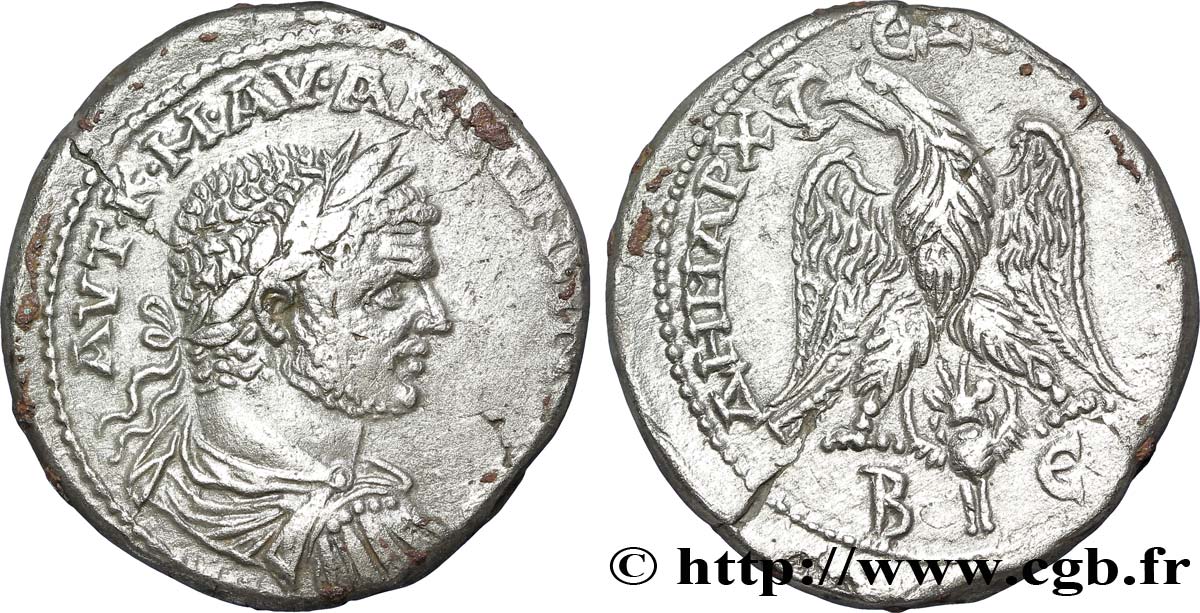
Obverse description : Buste lauré, drapé et cuirassé de Caracalla à droite, vu de trois-quarts en arrière. Les deux rubans de la couronne laurée descendent derrière la tête (A*2).
Obverse legend : AUT. K.M. AU .ANTWNEINOS .SEB (Autokrator Kaisar Markos Aurhlios Antwneinos Sebastos)
Obverse translation : (L’empereur césar Marc Aurèle Antonin auguste).
Reverse
Reverse description : Aigle debout à droite, les ailes déployées, la tête et la queue tournées à gauche, tenant dans son bec une couronne feuillée ; un griffon ailé de face entre les pattes, B - E dans le champ sous les pattes de l’aigle.
Reverse legend : DHMARC. EX. UPATOS TO. D., (Dhmarcikhs Ex Ousias Upatos D)
Reverse translation : (Revêtu de la puissance tribunitienne consul pour la quatrième fois).
Commentary
Ce graveur de revers est particulièrement rare pour le type qui est de loin le type le plus courant pour Caracalla dans cette série.
Si l’attribution de cette série à Beroea, l’antique Alep ou Halab, est certaine par les initiales BE dans le champ du revers, l’interprétation du symbole ne l’est pas, ni même sa lecture. Pour Henri Seyrig dans Antiquités Syriennes 84, le symbole représenterait un lion cornu et ailé vu de face mais les commentateurs le décrivent plutôt comme un griffon vu de face. Nous suivons cette interprétation car tous les lions symboliques sur les tétradrachmes syro-phéniciens sont représentés de profil et aisément identifiables. La statue cultuelle représentée ici devait être très particulière pour ne présenter que deux pattes. Les deux courbes sur la tête en plus des cornes et des ailes ne rappellent rien de particulier. On ne connaît pas encore de frappe de présentation pour la série, avec le revers complètement consacré au symbole, sans aigle, et il est probable que la découverte d’un exemplaire permettra une interprétation plus pertinente.
La série comporte un seul graveur pour les droits (sauf une seule pièce) mais au moins quatre pour les revers.
On note que les sigma sont gravés en C.
Dans la base TSP maintenue par Michel Prieur, vingt-sept exemplaires sont maintenant répertoriés. Notre exemplaire est le 0884_004.
This reverse engraver is particularly rare for the type which is by far the most common type for Caracalla in this series.
If the attribution of this series to Beroea, ancient Aleppo or Halab, is certain by the initials BE in the field of the reverse, the interpretation of the symbol is not, nor even its reading. According to Henri Seyrig in Antiquités Syriennes 84, the symbol would represent a horned and winged lion seen from the front, but commentators describe it rather as a griffin seen from the front.. We follow this interpretation because all the symbolic lions on the Syro-Phoenician tetradrachms are represented in profile and easily identifiable.. The cult statue represented here must have been very unusual to have only two legs.. The two curves on the head in addition to the horns and wings do not recall anything in particular. There is no known presentation strike for the series, with the reverse completely devoted to the symbol, without the eagle, and it is likely that the discovery of a example will allow a more relevant interpretation..
The series has a single engraver for the obverses (except for one piece) but at least four for the reverses.
Note that the sigmas are engraved in C.
In the TSP database maintained by Michel Prieur, twenty-seven examples are now listed. Our example is 0884_004
Si l’attribution de cette série à Beroea, l’antique Alep ou Halab, est certaine par les initiales BE dans le champ du revers, l’interprétation du symbole ne l’est pas, ni même sa lecture. Pour Henri Seyrig dans Antiquités Syriennes 84, le symbole représenterait un lion cornu et ailé vu de face mais les commentateurs le décrivent plutôt comme un griffon vu de face. Nous suivons cette interprétation car tous les lions symboliques sur les tétradrachmes syro-phéniciens sont représentés de profil et aisément identifiables. La statue cultuelle représentée ici devait être très particulière pour ne présenter que deux pattes. Les deux courbes sur la tête en plus des cornes et des ailes ne rappellent rien de particulier. On ne connaît pas encore de frappe de présentation pour la série, avec le revers complètement consacré au symbole, sans aigle, et il est probable que la découverte d’un exemplaire permettra une interprétation plus pertinente.
La série comporte un seul graveur pour les droits (sauf une seule pièce) mais au moins quatre pour les revers.
On note que les sigma sont gravés en C.
Dans la base TSP maintenue par Michel Prieur, vingt-sept exemplaires sont maintenant répertoriés. Notre exemplaire est le 0884_004.
This reverse engraver is particularly rare for the type which is by far the most common type for Caracalla in this series.
If the attribution of this series to Beroea, ancient Aleppo or Halab, is certain by the initials BE in the field of the reverse, the interpretation of the symbol is not, nor even its reading. According to Henri Seyrig in Antiquités Syriennes 84, the symbol would represent a horned and winged lion seen from the front, but commentators describe it rather as a griffin seen from the front.. We follow this interpretation because all the symbolic lions on the Syro-Phoenician tetradrachms are represented in profile and easily identifiable.. The cult statue represented here must have been very unusual to have only two legs.. The two curves on the head in addition to the horns and wings do not recall anything in particular. There is no known presentation strike for the series, with the reverse completely devoted to the symbol, without the eagle, and it is likely that the discovery of a example will allow a more relevant interpretation..
The series has a single engraver for the obverses (except for one piece) but at least four for the reverses.
Note that the sigmas are engraved in C.
In the TSP database maintained by Michel Prieur, twenty-seven examples are now listed. Our example is 0884_004
Historical background
CARACALLA
(05/27/196-04/8/217)
Augustus
After Geta's assassination, Caracalla decreed the "damnatio memoriæ" of his brother. The "Constitution Antoniniana" was promulgated in 212. All the inhabitants of the Empire became Roman citizens. The following year he undertook a campaign in Germania and won numerous victories over the Germans, Iapyges and Goths. He received the title of "Germanicus". The end of the reign was marked in 215 by the Monetary Reform and the creation of the Antoninianus. Caracalla begins a final campaign against the Parthians. He is assassinated after having celebrated his vicennalia.
 Report a mistake
 Print the page
 Share my selection
 Ask a question
 Consign / sell
Related articles

 Full data



Your Recently Viewed Items

5 Dollars UNITED STATES OF AMERICA Hagerstown 1856 G
40.00 €
ELAGABALUS Tétradrachme syro-phénicien AU
280.00 €

ATTICA - ATHENS Tétradrachme stéphanophore XF
266.79 €
cgbfr.com numismatists


