


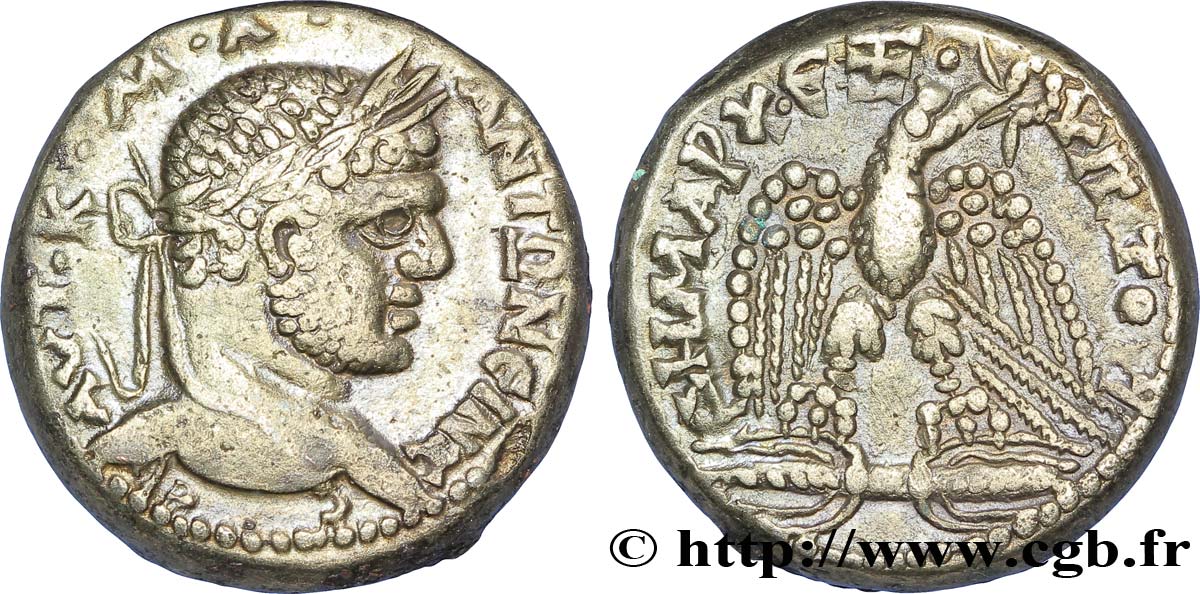
bpv_173765 - CARACALLA Tétradrachme syro-phénicien
Not available.
Item sold on our e-shop (2017)
Price : 240.00 €
Item sold on our e-shop (2017)
Price : 240.00 €
Type : Tétradrachme syro-phénicien
Date: 215-217
Mint name / Town : Séleucie, Syrie, Séleucie et Pierie
Metal : billon
Diameter : 24 mm
Orientation dies : 12 h.
Weight : 16,89 g.
Coments on the condition:
Petits coins et flan, bon centrage, usure moyenne
Catalogue references :
Obverse
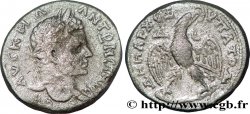
Obverse description : Tête laurée de Caracalla à droite, l’un des deux rubans de la couronne laurée descendant sur l’épaule (O*).
Obverse legend : AUT K. M. A..AN...TWNEINOS .SEB. (Autokrator Kaisar Markos Aurhlios Antwneinos Sebastos)
Obverse translation : (L’empereur césar Marc Aurèle Antonin auguste).
Reverse
Reverse description : Aigle debout à gauche, les ailes déployées, la tête et la queue tournées à droite, couronne perlée dans le bec ; l'aigle a les serres posées sur le foudre de Zeus Kasios.
Reverse legend : DHMARC. EX. UPATOD. (Dhmarcikhs Exousias Upato D)
Reverse translation : (Puissance tribunitienne, consul pour la quatrième fois).
Commentary
Cet exemplaire est particulier à deux titres : le coin de droit montre une récupération hasardeuse de la fin de légende sous le buste et le poids est exceptionnel. En effet, mêle si le tétradrachme est une monnaie fiduciaire dont le contenu métallique ne couvre plus la totalité de la valeur de compte, les poids sont quand même dans des limites raisonnables, pour cette période autour de 12,5 grammes. 16,89 grammes est tout à fait exceptionnel.
L’atelier de Seleucia fait preuve d’une indigence rare, presque unique, avec un seul type. Peut-être d’autres représentations sont-elles encore à découvrir ?
L’attribution de ces séries au foudre est pratiquement certaine car le foudre de Séleucie est bien particulier (particulièrement avec le corps torsadé et la position des filets, c’est manifestement la représentation d’un objet réel).
Le style de portraits est bien particulier, avec deux graveurs spécifiques répertoriés.
On note que les sigma sont gravés en C.
Dans la base TSP maintenue par Michel Prieur, soixante et un exemplaires sont maintenant répertoriés. Notre exemplaire, qui provient de la trouvaille dite de Syrie 1930, est le 1188_054.
This example is special for two reasons: the obverse corner shows a haphazard recovery of the end of the legend under the bust and the weight is exceptional. Indeed, even if the tetradrachm is a fiduciary coin whose metallic content no longer covers the entire value of the account, the weights are still within reasonable limits, for this period around 12.5 grams. 16.89 grams is quite exceptional. The Seleucia workshop shows a rare, almost unique poverty, with a single type. Perhaps other representations are still to be discovered? The attribution of these series to the thunderbolt is practically certain because the Seleucia thunderbolt is very particular (particularly with the twisted body and the position of the threads, it is clearly the representation of a real object). The style of portraits is very particular, with two specific engravers listed. It is noted that the sigmas are engraved in C. In the TSP database maintained by Michel Prieur, sixty-one examples are now listed. Our example, which comes from the so-called Syria 1930 find, is 1188_054
L’atelier de Seleucia fait preuve d’une indigence rare, presque unique, avec un seul type. Peut-être d’autres représentations sont-elles encore à découvrir ?
L’attribution de ces séries au foudre est pratiquement certaine car le foudre de Séleucie est bien particulier (particulièrement avec le corps torsadé et la position des filets, c’est manifestement la représentation d’un objet réel).
Le style de portraits est bien particulier, avec deux graveurs spécifiques répertoriés.
On note que les sigma sont gravés en C.
Dans la base TSP maintenue par Michel Prieur, soixante et un exemplaires sont maintenant répertoriés. Notre exemplaire, qui provient de la trouvaille dite de Syrie 1930, est le 1188_054.
This example is special for two reasons: the obverse corner shows a haphazard recovery of the end of the legend under the bust and the weight is exceptional. Indeed, even if the tetradrachm is a fiduciary coin whose metallic content no longer covers the entire value of the account, the weights are still within reasonable limits, for this period around 12.5 grams. 16.89 grams is quite exceptional. The Seleucia workshop shows a rare, almost unique poverty, with a single type. Perhaps other representations are still to be discovered? The attribution of these series to the thunderbolt is practically certain because the Seleucia thunderbolt is very particular (particularly with the twisted body and the position of the threads, it is clearly the representation of a real object). The style of portraits is very particular, with two specific engravers listed. It is noted that the sigmas are engraved in C. In the TSP database maintained by Michel Prieur, sixty-one examples are now listed. Our example, which comes from the so-called Syria 1930 find, is 1188_054
Historical background
CARACALLA
(05/27/196-04/8/217)
Augustus
After Geta's assassination, Caracalla decreed the "damnatio memoriæ" of his brother. The "Constitution Antoniniana" was promulgated in 212. All the inhabitants of the Empire became Roman citizens. The following year he undertook a campaign in Germania and won numerous victories over the Germans, Iapyges and Goths. He received the title of "Germanicus". The end of the reign was marked in 215 by the Monetary Reform and the creation of the Antoninianus. Caracalla begins a final campaign against the Parthians. He is assassinated after having celebrated his vicennalia.
 Report a mistake
 Print the page
 Share my selection
 Ask a question
 Consign / sell
Related articles

 Full data



Your Recently Viewed Items

CARACALLA Tétradrachme syro-phénicien VF
16.00 €

PHILIPPUS Tétradrachme syro-phénicien XF
101.00 €
HERENNIUS ETRUSCUS Tétradrachme syro-phénicien VF
55.00 €
CARACALLA Tétradrachme syro-phénicien VF
21.00 €
cgbfr.com numismatists


