


E-auction 166-102490 - bpv_173691 - CARACALLA Tétradrachme syro-phénicien
You must signin and be an approved bidder to bid, LOGIN TO BID. Accounts are subject to approval and the approval process takes place within 48 hours. Do not wait until the day a sale closes to register. Clicking on « bid » constitutes acceptance of the terms of use of cgb.fr private e-auctions.
Bids must be placed in whole Euro amounts only. The sale will start closing at the time stated on the item description; any bids received at the site after the closing time will not be executed. Transmission times may vary and bids could be rejected if you wait until the last second. For further information ckeck the E-auctions F.A.Q.
NO BUYER'S FEE.
NO BUYER'S FEE.
| Estimate : | 180 € |
| Price : | 46 € |
| Maximum bid : | 51 € |
| End of the sale : | 20 June 2016 15:16:00 |
| bidders : | 5 bidders |
Type : Tétradrachme syro-phénicien
Date: 215-217
Mint name / Town : Émèse, Syrie, Séleucie et Pierie
Metal : billon
Diameter : 26 mm
Orientation dies : 1 h.
Weight : 09,51 g.
Rarity : R2
Coments on the condition:
Faible usure mais métal de mauvais aloi, très cuivreux, centrage imparfait
Catalogue references :
Obverse
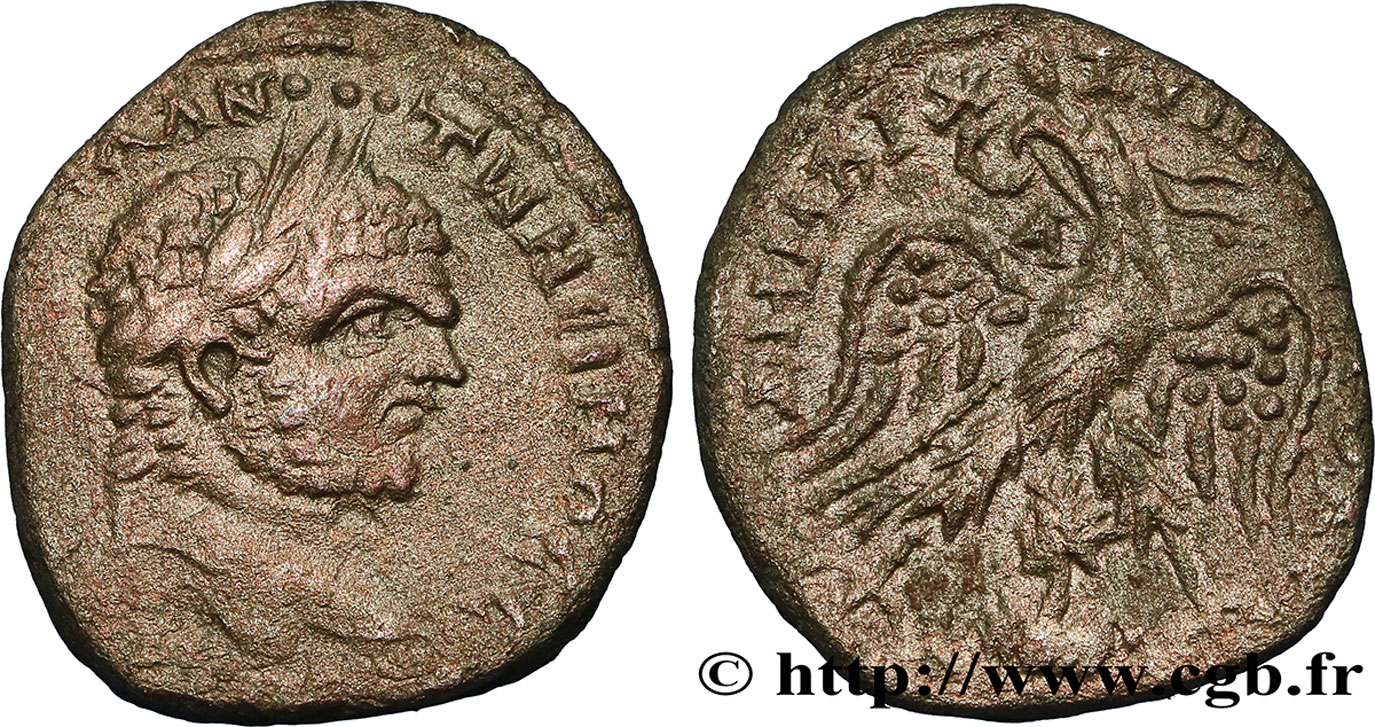
Obverse description : Tête laurée de Caracalla à droite, vue de trois-quarts arrière, l’un des deux rubans de la couronne laurée descendant sur l’épaule (O*).
Obverse legend : AUT. K.M. A .ANTwNEINOS .SEB (Autokrator Kaisar Markos Aurhlios Antwneinos Sebastos)
Obverse translation : (L’empereur césar Marc Aurèle Antonin auguste).
Reverse
Reverse description : Aigle debout à droite, les ailes déployées, la tête et la queue tournées à gauche, tenant une couronne feuillée dans son bec, A dans le champ à gauche sous la couronne ; buste radié, drapé et cuirassé de Shamash à gauche entre les pattes de l’aigle.
Reverse legend : DHMARC EX UPATOS TOD
Reverse translation : (Revêtu de la puissance tribunitienne consul pour la quatrième fois).
Commentary
Faux pour servir. Officine A. Le poids et l’aloi apparent laissent de prime abord penser à un faux d’époque, pour servir. Pourtant, ces deux critères ne sont pas suffisants car le tétradrachme, étant une monnaie fiduciaire dont le contenu métallique ne couvre pas la valeur de compte, a des poids très irréguliers. Un nettoyage mal conduit peut aussi donner une apparence cuivrée au billon. La décision est à trouver dans le fait que le coin d’avers de notre exemplaire est une copie remarquable d’exactitude du coin qui a frappé tous les Prieur 956 : faut-il y voir une preuve du faux pour servir ? Probablement car ce n’est pas la même main de graveur, le style manque de souplesse, alors que les moindres petits détails et tics de graveur ont été méticuleusement reproduits. Le coin de revers est également un plagiat de coins existants mais nous n’avons pu en retrouver une autre utilisation, ni surtout une utilisation sur une pièce de bon aloi et bon poids.
Les faux pour servir sont très rares avant la période d’Elagabal, où la distinction entre émissions officielles de la fin du règne et faux pour servir est difficile. C’est le seul exemplaire que nous connaissions de celui-ci.
On note que les sigma sont gravés en C.
Dans la base TSP maintenue par Michel Prieur, neuf exemplaires sont maintenant répertoriés, ce faux pour servir compris, aucun exemplaire répertorié en musée. Notre exemplaire est le 0956_009.
Fake to serve. Pharmacy A. The weight and apparent alloy suggest at first glance that it is a period fake, to serve. However, these two criteria are not sufficient because the tetradrachm, being a fiat coin whose metallic content does not cover the account value, has very irregular weights.. Poorly conducted cleaning can also give the ridge a coppery appearance.. The decision is to be found in the fact that the obverse die of our example is a remarkably accurate example of the die that struck all the Prieur 956: should we see this as proof of the fake to serve? Probably because it is not the same engraver's hand, the style lacks flexibility, while the smallest details and engraver's tics have been meticulously reproduced. The reverse die is also a plagiarism of existing dies but we have not been able to find another use for it, nor especially a use on a coin of good alloy and good weight..
Forgeries for use are very rare before the period of Elagabalus, where the distinction between official issues from the end of the reign and forgeries for use is difficult.. This is the only example we know of..
Note that the sigmas are engraved in C.
In the TSP database maintained by Michel Prieur, nine examples are now listed, including this fake for use, no examples listed in a museum. Our example is 0956_009
Les faux pour servir sont très rares avant la période d’Elagabal, où la distinction entre émissions officielles de la fin du règne et faux pour servir est difficile. C’est le seul exemplaire que nous connaissions de celui-ci.
On note que les sigma sont gravés en C.
Dans la base TSP maintenue par Michel Prieur, neuf exemplaires sont maintenant répertoriés, ce faux pour servir compris, aucun exemplaire répertorié en musée. Notre exemplaire est le 0956_009.
Fake to serve. Pharmacy A. The weight and apparent alloy suggest at first glance that it is a period fake, to serve. However, these two criteria are not sufficient because the tetradrachm, being a fiat coin whose metallic content does not cover the account value, has very irregular weights.. Poorly conducted cleaning can also give the ridge a coppery appearance.. The decision is to be found in the fact that the obverse die of our example is a remarkably accurate example of the die that struck all the Prieur 956: should we see this as proof of the fake to serve? Probably because it is not the same engraver's hand, the style lacks flexibility, while the smallest details and engraver's tics have been meticulously reproduced. The reverse die is also a plagiarism of existing dies but we have not been able to find another use for it, nor especially a use on a coin of good alloy and good weight..
Forgeries for use are very rare before the period of Elagabalus, where the distinction between official issues from the end of the reign and forgeries for use is difficult.. This is the only example we know of..
Note that the sigmas are engraved in C.
In the TSP database maintained by Michel Prieur, nine examples are now listed, including this fake for use, no examples listed in a museum. Our example is 0956_009
Historical background
CARACALLA
(05/27/196-04/8/217)
Augustus
After Geta's assassination, Caracalla decreed the "damnatio memoriæ" of his brother. The "Constitution Antoniniana" was promulgated in 212. All the inhabitants of the Empire became Roman citizens. The following year he undertook a campaign in Germania and won numerous victories over the Germans, Iapyges and Goths. He received the title of "Germanicus". The end of the reign was marked in 215 by the Monetary Reform and the creation of the Antoninianus. Caracalla begins a final campaign against the Parthians. He is assassinated after having celebrated his vicennalia.
 Report a mistake
 Print the page
 Share my selection
 Ask a question
 Consign / sell
Related articles

 Full data



Your Recently Viewed Items

1/4 franc Louis-Philippe 1835 Paris F.166/49 MS60
120.00 €

NEMAUSUS - NÎMES Dupondius COL NEM (as) VF
115.00 €
cgbfr.com numismatists


