


bpv_158443 - CARACALLA Tétradrachme syro-phénicien
Not available.
Item sold on our e-shop (2017)
Price : 380.00 €
Item sold on our e-shop (2017)
Price : 380.00 €
Type : Tétradrachme syro-phénicien
Date: 215-217
Mint name / Town : Zeugma, Syrie, Commagène
Metal : billon
Diameter : 27 mm
Orientation dies : 12 h.
Weight : 12,98 g.
Rarity : R2
Coments on the condition:
Centrage correct, surface très légèrement piquée, très faible usure
Catalogue references :
Predigree :
Cet exemplaire, qui provient de la trouvaille Julia Hoard, est le 0819_006 de la base TSP
Obverse
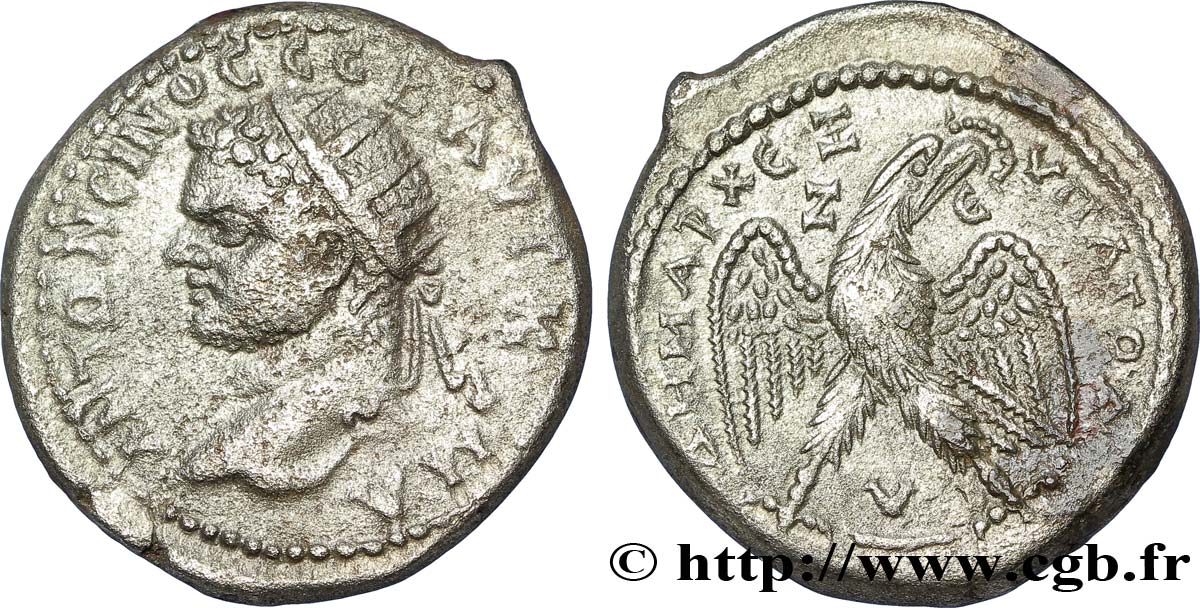
Obverse description : Tête nue de Caracalla à gauche, vu de trois quarts en arrière (O11).
Obverse legend : AUT K. M. A.- .ANTWNEINO-S. S-E-B. (Autokratoros Kaisar Markos Aurhlios Antwneinos Sebastos)
Obverse translation : (L’empereur césar Marc Aurèle Antonin auguste).
Reverse
Reverse description : Aigle debout de face sur une ligne de terre, les ailes déployées, la tête et queue à droite, tenant dans son bec une couronne perlée, les trois lettres initiales du nom de la ville dans le champ, le Z au-dessus de l’épaule gauche, le E au-dessus de l’épaule droite et le V entre les pattes.
Reverse legend : DHMARC. E.X. UPATO. D., (Dhmarcikhs Ex Ousias Upatos D)/ Z-E/u
Reverse translation : (Revêtu de la puissance tribunitienne consul pour la quatrième fois - Zeugma).
Commentary
Zeugma est l’un des ateliers à utiliser apparemment sans distinction les couronnes radiées et les couronnes laurées, sans, rappelons-le, que cette différence influe sur la valeur faciale, contrairement à ce qui se passe pour les antoniniens et deniers de l’atelier de Rome. Les couronnes radiées sont néanmoins plus rares et particulièrement avec un buste à gauche toujours rare, sans que l’on puisse savoir pourquoi, dans la plus grande partie des ateliers de la période.
Définitivement romaine depuis le règne de Vespasien, Zeugma, fondée par Séleucus Ier était une halte pour les caravanes venant d’Orient, située sur la rive opposée d’Apamée de l’Euphrate. La quatrième Légion Scythica y était cantonnée. Elle est aujourd’hui noyée sous les eaux par un barrage hydro-électrique.
Les émissions de Zeugma sont les seules qui ne posent aucune difficulté d’attribution puisque ce sont les seules qui portent, même si ce ne sont que par les trois lettres initiales, le nom de la ville. Il n’est pas connu de frappe inaugurale pour cette série, avec un motif propre à la ville occupant tout le revers à la place de l’aigle et nous restons donc sans information sur la divinité tutélaire qu’auraient pu invoquer les habitants de Zeugma.
Le problème que posent ces émissions est plutôt à chercher dans l’absence de frappes attribuées à la ville d’Apamée, bien plus riche et puissante, de l’autre côté du fleuve Euphrate par rapport à Zeugma. Quelque soit le motif que nous décidions de choisir pour expliquer l’ouverture d’une trentaine d’ateliers pendant la grande guerre parthique de Caracalla, tous auraient dû mener à des frappes d’Apamée si Zeugma a frappé.
Taxe pour le trésor militaire, exaltation politique des fiertés municipales et religieuses locales, aucune raison de ne pas voir de frappes à Apamée (comme d’ailleurs à Samosate, autre grande voisine).
Mauvaise attribution d’une série connue qu’il faudrait rendre à cette ville ou règlement de la taxe pour le Trésor militaire en lingots et non en monnaies frappées localement, les deux hypothèses sont valables.
On note que les sigma sont gravés en C.
Dans la base TSP maintenue par Michel Prieur, onze exemplaires sont maintenant répertoriés, dont quatre en musée, British Museum, Yale/Doura (2), le dernier au Israel State Museum.
Zeugma is one of the workshops that apparently uses radiate crowns and laureate crowns without distinction, without, let us recall, this difference influencing the face value, unlike what happens for the antoninians and denarii of the Rome workshop.. Radiate crowns are nevertheless rarer and particularly with a bust on the left, always rare, without it being possible to know why, in the majority of workshops of the period..
Definitively Roman since the reign of Vespasian, Zeugma, founded by Seleucus I, was a stopping place for caravans coming from the East, located on the opposite bank of the Euphrates from Apamea.. The Fourth Scythica Legion was stationed there. Today it is submerged under water by a hydroelectric dam..
The Zeugma emissions are the only ones that do not pose any difficulty in attribution since they are the only ones that bear, even if only by the three initial letters, the name of the city.. There is no known inaugural strike for this series, with a motif specific to the city occupying the entire reverse instead of the eagle, and we therefore remain without information on the tutelary deity that the inhabitants of Zeugma could have invoked..
The problem with these emissions is rather to be found in the absence of strikes attributed to the city of Apamea, much richer and more powerful, on the other side of the Euphrates River from Zeugma.. Whatever motive we decide to choose to explain the opening of some thirty workshops during Caracalla's great Parthian war, all of them should have led to strikes from Apamea if Zeugma struck..
Tax for the military treasury, political exaltation of local municipal and religious pride, no reason not to see strikes in Apamea (as indeed in Samosata, another large neighbor).
Wrong attribution of a known series that should be returned to this city or payment of the tax for the military treasury in ingots and not in locally minted coins, both hypotheses are valid.
Note that the sigmas are engraved in C.
In the TSP database maintained by Michel Prieur, eleven examples are now listed, including four in museums, British Museum, Yale/Doura (2), the last one at the Israel State Museum
Définitivement romaine depuis le règne de Vespasien, Zeugma, fondée par Séleucus Ier était une halte pour les caravanes venant d’Orient, située sur la rive opposée d’Apamée de l’Euphrate. La quatrième Légion Scythica y était cantonnée. Elle est aujourd’hui noyée sous les eaux par un barrage hydro-électrique.
Les émissions de Zeugma sont les seules qui ne posent aucune difficulté d’attribution puisque ce sont les seules qui portent, même si ce ne sont que par les trois lettres initiales, le nom de la ville. Il n’est pas connu de frappe inaugurale pour cette série, avec un motif propre à la ville occupant tout le revers à la place de l’aigle et nous restons donc sans information sur la divinité tutélaire qu’auraient pu invoquer les habitants de Zeugma.
Le problème que posent ces émissions est plutôt à chercher dans l’absence de frappes attribuées à la ville d’Apamée, bien plus riche et puissante, de l’autre côté du fleuve Euphrate par rapport à Zeugma. Quelque soit le motif que nous décidions de choisir pour expliquer l’ouverture d’une trentaine d’ateliers pendant la grande guerre parthique de Caracalla, tous auraient dû mener à des frappes d’Apamée si Zeugma a frappé.
Taxe pour le trésor militaire, exaltation politique des fiertés municipales et religieuses locales, aucune raison de ne pas voir de frappes à Apamée (comme d’ailleurs à Samosate, autre grande voisine).
Mauvaise attribution d’une série connue qu’il faudrait rendre à cette ville ou règlement de la taxe pour le Trésor militaire en lingots et non en monnaies frappées localement, les deux hypothèses sont valables.
On note que les sigma sont gravés en C.
Dans la base TSP maintenue par Michel Prieur, onze exemplaires sont maintenant répertoriés, dont quatre en musée, British Museum, Yale/Doura (2), le dernier au Israel State Museum.
Zeugma is one of the workshops that apparently uses radiate crowns and laureate crowns without distinction, without, let us recall, this difference influencing the face value, unlike what happens for the antoninians and denarii of the Rome workshop.. Radiate crowns are nevertheless rarer and particularly with a bust on the left, always rare, without it being possible to know why, in the majority of workshops of the period..
Definitively Roman since the reign of Vespasian, Zeugma, founded by Seleucus I, was a stopping place for caravans coming from the East, located on the opposite bank of the Euphrates from Apamea.. The Fourth Scythica Legion was stationed there. Today it is submerged under water by a hydroelectric dam..
The Zeugma emissions are the only ones that do not pose any difficulty in attribution since they are the only ones that bear, even if only by the three initial letters, the name of the city.. There is no known inaugural strike for this series, with a motif specific to the city occupying the entire reverse instead of the eagle, and we therefore remain without information on the tutelary deity that the inhabitants of Zeugma could have invoked..
The problem with these emissions is rather to be found in the absence of strikes attributed to the city of Apamea, much richer and more powerful, on the other side of the Euphrates River from Zeugma.. Whatever motive we decide to choose to explain the opening of some thirty workshops during Caracalla's great Parthian war, all of them should have led to strikes from Apamea if Zeugma struck..
Tax for the military treasury, political exaltation of local municipal and religious pride, no reason not to see strikes in Apamea (as indeed in Samosata, another large neighbor).
Wrong attribution of a known series that should be returned to this city or payment of the tax for the military treasury in ingots and not in locally minted coins, both hypotheses are valid.
Note that the sigmas are engraved in C.
In the TSP database maintained by Michel Prieur, eleven examples are now listed, including four in museums, British Museum, Yale/Doura (2), the last one at the Israel State Museum
Historical background
CARACALLA
(05/27/196-04/8/217)
Augustus
After Geta's assassination, Caracalla decreed the "damnatio memoriæ" of his brother. The "Constitution Antoniniana" was promulgated in 212. All the inhabitants of the Empire became Roman citizens. The following year he undertook a campaign in Germania and won numerous victories over the Germans, Iapyges and Goths. He received the title of "Germanicus". The end of the reign was marked in 215 by the Monetary Reform and the creation of the Antoninianus. Caracalla begins a final campaign against the Parthians. He is assassinated after having celebrated his vicennalia.
 Report a mistake
 Print the page
 Share my selection
 Ask a question
 Consign / sell
Related articles

 Full data



Your Recently Viewed Items

CARACALLA Tétradrachme syro-phénicien XF
350.00 €

PHILIPPUS Tétradrachme syro-phénicien XF
280.00 €

RUSSIA - ALEXANDER III 5 roubles or 1893 Saint-Pétersbourg XF
170.00 €
cgbfr.com numismatists


