


MONNAIES 59 (2013)
Starting price : 650.00 €
Estimate : 950.00 €
Realised price : 650.00 €
Starting price : 650.00 €
Estimate : 950.00 €
Realised price : 650.00 €
Type : Demi-shekel
Date: c. 216-211 AC.
Mint name / Town : Capoue, Campanie
Metal : silver
Diameter : 19 mm
Orientation dies : 1 h.
Weight : 3,89 g.
Rarity : R2
Coments on the condition:
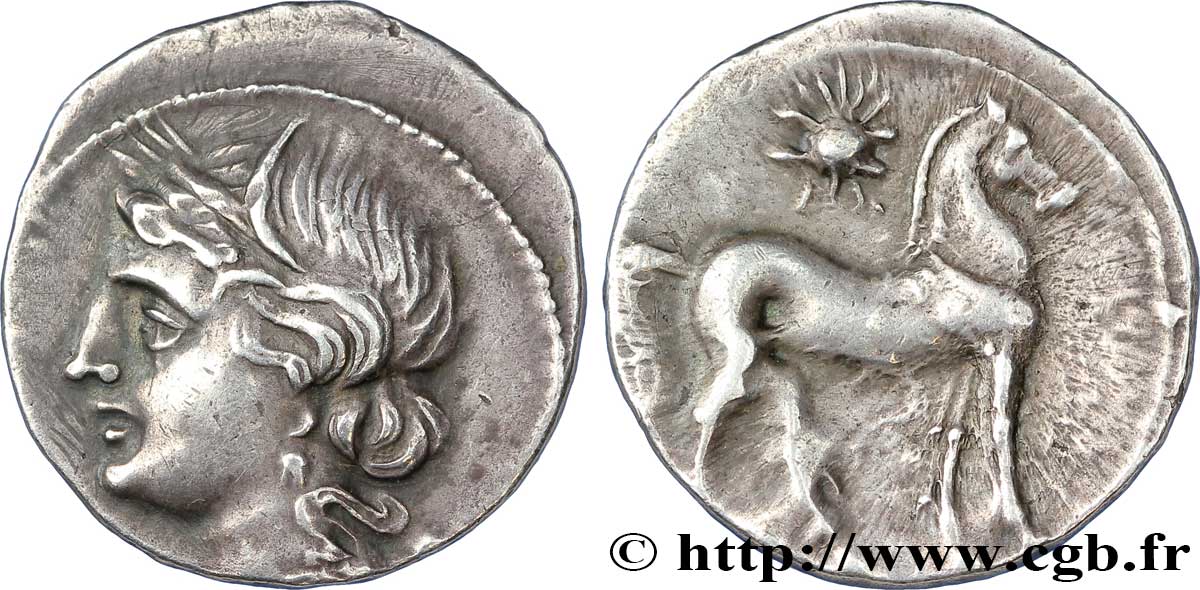
Exemplaire sur un flan large et ovale, parfaitement centré des deux côtés avec les grènetis visibles. Belle tête élégante et fine de Tanit. Cheval bien venu à la frappe, mais de frappe un peu molle. Belle patine de collection ancienne avec des reflets dorés
Catalogue references :
Predigree :
Cet exemplaire provient du stock de Jean Vinchon (Paris) en 2000 et de la collection du docteur Thierry de Craeker
Obverse
Obverse legend : ANÉPIGRAPHE.
Obverse description : Tête de Tanit à gauche, couronnée d’épis avec collier et pendants d’oreilles.
Reverse
Reverse legend : ANÉPIGRAPHE.
Reverse description : Cheval au pas à droite surmonté d’un disque solaire radié.
Commentary
Style de la tête de Tanit fantastique. La fabrication de ce type semble bien carthaginoise, mais frappée en Italie. Il se rencontre dans les trésors d’Italie du Sud. Le style est purement “grec”, fin et équilibré en particulier pour le cheval au revers. Nous n’avons pas relevé de liaison de coin pertinente. Normalement les espèces frappées à Carthage ont les coins alignés à 12 heures alors que pour les espèces frappées en Sicile, les coins ne le sont pas.
Fantastic style of the Tanit head. The manufacture of this type seems to be Carthaginian, but struck in Italy. It is found in the treasures of southern Italy. The style is purely “Greek”, fine and balanced, especially for the horse on the reverse. We have not noted any relevant die bond. Normally, coins struck in Carthage have the dies aligned at 12 o’clock, while for coins struck in Sicily, the dies are not aligned.
Fantastic style of the Tanit head. The manufacture of this type seems to be Carthaginian, but struck in Italy. It is found in the treasures of southern Italy. The style is purely “Greek”, fine and balanced, especially for the horse on the reverse. We have not noted any relevant die bond. Normally, coins struck in Carthage have the dies aligned at 12 o’clock, while for coins struck in Sicily, the dies are not aligned.
Historical background
CAMPANIA - CAPUA
(216-211 BC)
Carthaginian occupation - Hannibal
The Samnites seized Capua in the 5th century BC They formed a community with the Etruscans and the Oscans. The term Campanian was first applied to the inhabitants of the city before becoming a generic term to designate the region according to Diodorus of Sicily (XII, 31, 1). The city entered the area of Roman influence in 338 BC. Coinage only began during the Second Punic War when Capua joined the Carthaginian camp after the Roman defeat at Cannae (216 BC). Hannibal resided there for five years falling on the charms of "the delights of Capua" doomed to inaction, without being able to seize Rome. Finally the city was taken by the Romans in 211 BC and was harshly punished for its betrayal. Colony in 83 BC, it obtained the right of city in 58 BC.
 Report a mistake
 Print the page
 Share my selection
 Ask a question
 Consign / sell
Your Recently Viewed Items
1000 Pesos PHILIPPINES 2023 P.241 UNC
60.00 €

CONSTANS II, CONSTANTINE IV, HERACLIUS and TIBERIUS Solidus MS
560.00 €
BOOKS - NUMISMATIC BIBLIOPHILIA AU
450.00 €

BRUTTIUM - VIBO VALENTIA (HIPPONION) Triens VF
80.00 €
ANTONINUS PIUS Sesterce VF/VF
100.00 €
POSTUMUS Antoninien AU/XF
11.00 €
cgbfr.com numismatists


