


E-auction 689-738779 - GALLIA - BITURIGES CUBI (Area of Bourges) Bronze au cheval et aux trois annelets

You must signin and be an approved bidder to bid, LOGIN TO BID. Accounts are subject to approval and the approval process takes place within 48 hours. Do not wait until the day a sale closes to register. Clicking on « bid » constitutes acceptance of the terms of use of cgb.fr private e-auctions.
Bids must be placed in whole Euro amounts only. The sale will start closing at the time stated on the item description; any bids received at the site after the closing time will not be executed. Transmission times may vary and bids could be rejected if you wait until the last second. For further information ckeck the E-auctions F.A.Q.
NO BUYER'S FEE.
NO BUYER'S FEE.
Type : Bronze au cheval et aux trois annelets
Date: c. 60-50 AC.
Mint name / Town : Bourges (18)
Metal : bronze
Diameter : 18 mm
Orientation dies : 9 h.
Weight : 4,90 g.
Rarity : R3
Coments on the condition:
Flan épais et centré. Usure très importante. Patine vert foncé
Obverse
Obverse legend : ANÉPIGRAPHE.
Obverse description : Tête stylisée à droite, la chevelure en trois grosses mèches.
Reverse
Reverse legend : ANÉPIGRAPHE.
Reverse description : Cheval sexué, à gauche ; au-dessus, A renversé ; au-dessous, trois annelets posés un et deux sur une double ligne d’exergue rainurée.
Commentary
Le motif constitué de trois annelets se retrouve fréquemment sur les monnaies gauloises, particulièrement chez les Bituriges (cf. LA TOUR II 4143-4196, pl. 24).
The motif consisting of three ringlets is frequently found on Gallic coins, particularly among the Bituriges (cf. LA TOUR II 4143-4196, pl. 24)
The motif consisting of three ringlets is frequently found on Gallic coins, particularly among the Bituriges (cf. LA TOUR II 4143-4196, pl. 24)
Historical background
GALLIA - BITURIGES CUBI (Area of Bourges)
(2nd - 1st century BC)
The Bituriges Cubes were one of the most powerful peoples of the Celtic. Their territory extended over part of Bourbonnais, Touraine and Berry, the current departments of Cher, Indre and part of Allier. Their capital was the oppidum of Avaricum (Bourges). The Loire separated them from the Aedui and the Carnutes. They also had for neighbors the Pictons, the Lémovices and the Arvernes. According to the account of Livy, the king of Bituriges, Ambigat would have reigned over the whole of unified Gaul in the 6th century BC.. -VS. and would have sent his two nephews, Bellovèse and Sigovèse, one to Italy, the other to the East, to found the Gallic Empire which, a century later, extended over Great Britain, central Europe (except Switzerland), northern Italy and most of the Danube. Before the Gallic Wars, the Bituriges would have been the clients of the Aedui and a contingent of Boii would have been installed on their territory.. Their main wealth came from animal husbandry and iron mining which had brought them wealth and prosperity.. In 52 BC. -VS. , they supported Vercingetorix. They were defeated at Genabum (Orleans) by Caesar. Vercingetorix encouraged them to practice the scorched earth technique. They thus destroyed more than twenty oppida, but refused the same fate to their capital, Avaricum (Bourges). Caesar came to besiege the oppidum, defended by thirty thousand Bituriges and ten thousand allies. The city was taken and burned, only eight hundred soldiers were able to escape, while the garrison and the population were massacred.. Caesar found there abundant reserves which enabled him to spend the winter and prepare the campaign for the following spring.. Nevertheless, the Bituriges would still have provided a contingent of twelve thousand men to the relief army of the Gallic coalition, during the siege of Alésia. At the beginning of 51 BC. -VS. , Caesar led a new campaign among the Bituriges who submitted very quickly. A few weeks later, they intervened with Caesar to fight against the Carnutes. Caesar (BG. I, 18; VII, 5, 8, 9, 11-13, 15, 21, 29, 75, 90, VIII, 2, 3, 4, 11). Strabo (G. IV, 2). Livy (HR. V, 34, 35). Pliny (HN. , IV. 109). Ptolemy (G. II, 7). Kruta: 68-70, 145, 186-187, 212-213, 240, 334, 344, 360.
 Report a mistake
 Print the page
 Share my selection
 Ask a question
 Consign / sell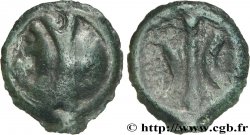
 Full data



Your Recently Viewed Items
100 Francs DELACROIX imprimé en continu FRANCE 1990 F.69bis.01bB UNC
350.00 €
20 Francs DEBUSSY Spécimen FRANCE 1980 F.66.01Spn1 UNC-
410.00 €
20 Francs DEBUSSY Petit numéro FRANCE 1980 F.66.01A1 UNC
230.00 €

5 NF sur 500 Francs Victor HUGO FRANCE 1959 F.52.02 F
92.00 €

500 Francs PIERRE ET MARIE CURIE Sans STRAP Fauté FRANCE 1995 F.76f4.02 UNC-
250.00 €

NABATEA - NABATAEAN KINGDOM - ARETAS IV Unité VF/VF
40.00 €
cgbfr.com numismatists


