


E-auction 454-366596 - fme_412077 - BELGIUM Médaille, Exposition Internationale d'Anvers
You must signin and be an approved bidder to bid, LOGIN TO BID. Accounts are subject to approval and the approval process takes place within 48 hours. Do not wait until the day a sale closes to register. Clicking on « bid » constitutes acceptance of the terms of use of cgb.fr private e-auctions.
Bids must be placed in whole Euro amounts only. The sale will start closing at the time stated on the item description; any bids received at the site after the closing time will not be executed. Transmission times may vary and bids could be rejected if you wait until the last second. For further information ckeck the E-auctions F.A.Q.
NO BUYER'S FEE.
NO BUYER'S FEE.
| Estimate : | 100 € |
| Price : | 68 € |
| Maximum bid : | 88 € |
| End of the sale : | 27 December 2021 18:22:30 |
| bidders : | 5 bidders |
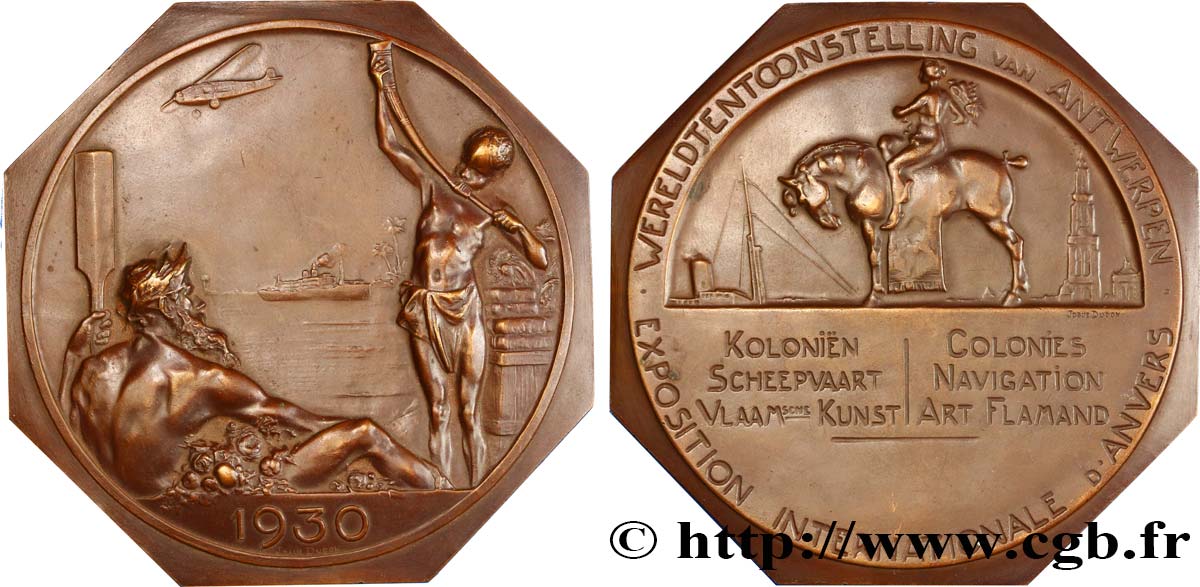
Type : Médaille, Exposition Internationale d'Anvers
Date: 1930
Mint name / Town : Belgique, Anvers
Metal : bronze
Diameter : 80 mm
Orientation dies : 12 h.
Engraver DUPON Josué (1864-1935)
Weight : 170 g.
Edge : lisse + J. FONSON
Coments on the condition:
Magnifique médaille avec une très agréable patine brune, lisse et brillante
Obverse
Obverse legend : À L’EXERGUE : 1930.
Obverse description : Le dieu du fleuve Escaut assis à gauche, un gouvernail à la main, et un jeune enfant congolais debout, vêtu d'un pagne et jouant d'un instrument traditionnel, devant le fleuve où navique un bateau, un avion traversant le ciel.
Reverse
Reverse legend : .WERELDTENTOONSTELLING VAN ANTWERPEN. // EXPOSITION INTERNATIONALE D'ANVERS. // KOLONIËN - COLONIES / SCHEEPVAART - NAVIGATION / VLAAMSCHE - ART FLAMAND. .
Reverse description : Dans un médaillon, une femme nue chevauche un cheval à l'arrêt en amazone, à gauche, devant le port d'Anvers.
Commentary
Médaille signée Josué DUPON sous la date au droit et J.FONSON (sur la tranche).
Josue Dupon (1864-1935) était un sculpteur flamand et graveur. Il a reçu son éducation par le biais des cours du soir à l'Académie de Roeselare et Anvers (1884) et plus tard à l'Institut National Supérieur des Beaux-Arts (1887). Après ses études, il a d'abord travaillé dans l'atelier du sculpteur Clément Carbon à Roeselare. Il était ami avec le sculpteur Jules Lagae. En 1891, il a remporté une médaille d'or avec le groupe de sculpture monumentale Samson tue le lion, et il a terminé deuxième dans le Prix de Rome de sculpture. De 1905 à 1934, il enseigne la sculpture à l'Académie d'Anvers.
L'Exposition internationale de 1930 s'est tenue à Liège en Belgique à l'occasion du centenaire de l'indépendance belge. À cette occasion une deuxième Exposition internationale est organisée à Anvers.
Celle d'Anvers se spécialise dans les domaines maritime et colonial. Liège est avant tout une exposition de la grande industrie et des sciences, le but étant de rendre compte des innovations depuis 1830, date de l'indépendance du pays.
Ces deux Expositions ne sont pas considérées comme étant des Expositions universelles car elles se spécialisent chacune dans des domaines particuliers. Le nom officiel de la manifestation liégeoise est : Exposition internationale de la grande industrie, sciences et applications, art wallon ancien.
L'anniversaire du centenaire de l'indépendance n'est pas le seul motif de l'Exposition liégeoise, en effet, après l'Exposition universelle de 1905, le gouvernement a promis à la ville de terminer les travaux d'endiguements pour protéger la ville des inondations qui la touche régulièrement. Toutefois, la première guerre mondiale l'empêche d'accomplir sa tâche. Après la guerre, les dirigeants liégeois, le bourgmestre Émile Digneffe en tête, rappellent au gouvernement sa promesse.
Ce dernier s'accomplit et débloque les moyens rapidement, surtout après les graves inondations de 1926, pour protéger la ville. Le Pont-barrage de Monsin est construit en aval du fleuve afin de remplacer plusieurs écluses et de stabiliser le cours de la Meuse. Les travaux permettent également de construire le port de Liège qui est relié neuf ans plus tard au port d'Anvers par le canal Albert.
Pour attirer la grande foule, les directeurs de l'Exposition mettent également sur pied une exposition d'art wallon présentant une rétrospective sur les œuvres antérieures à 1830; une exposition agricole, ainsi qu'un parc d'attractions..
Medal signed Josué DUPON under the date on the right and J. FONSON (on the edge).
Josue Dupon (1864-1935) was a Flemish sculptor and engraver. He received his education through evening classes at the Academy of Roeselare and Antwerp (1884) and later at the National Institute of Fine Arts (1887). After his studies, he first worked in the studio of the sculptor Clément Carbon in Roeselare.. He was friends with the sculptor Jules Lagae. In 1891 he won a gold medal with the monumental sculpture group Samson Kills the Lion, and he finished second in the Prix de Rome for sculpture.. From 1905 to 1934, he taught sculpture at the Antwerp Academy..
The 1930 International Exhibition was held in Liège, Belgium, to mark the centenary of Belgian independence.. On this occasion a second International Exhibition is organized in Antwerp.
The one in Antwerp specializes in maritime and colonial fields.. Liège is above all an exhibition of large-scale industry and science, the aim being to report on innovations since 1830, the date of the country's independence..
These two Expositions are not considered to be World's Fairs because they each specialize in particular areas.. The official name of the Liège event is: International Exhibition of Large-Scale Industry, Science and Applications, Ancient Walloon Art.
The centenary of independence is not the only reason for the Liège Exhibition. After the 1905 World's Fair, the government promised the city that it would complete the dike work to protect it from the floods that regularly affect it.. However, the First World War prevented him from accomplishing his task.. After the war, the leaders of Liège, led by Mayor Émile Digneffe, reminded the government of its promise.
The latter was accomplished and resources were released quickly, especially after the serious floods of 1926, to protect the city.. The Monsin Dam Bridge was built downstream of the river to replace several locks and stabilize the course of the Meuse. The work also enabled the construction of the port of Liège, which was connected nine years later to the port of Antwerp by the Albert Canal..
To attract large crowds, the directors of the Exposition also set up an exhibition of Walloon art presenting a retrospective of works prior to 1830; an agricultural exhibition, as well as an amusement park..
Josue Dupon (1864-1935) était un sculpteur flamand et graveur. Il a reçu son éducation par le biais des cours du soir à l'Académie de Roeselare et Anvers (1884) et plus tard à l'Institut National Supérieur des Beaux-Arts (1887). Après ses études, il a d'abord travaillé dans l'atelier du sculpteur Clément Carbon à Roeselare. Il était ami avec le sculpteur Jules Lagae. En 1891, il a remporté une médaille d'or avec le groupe de sculpture monumentale Samson tue le lion, et il a terminé deuxième dans le Prix de Rome de sculpture. De 1905 à 1934, il enseigne la sculpture à l'Académie d'Anvers.
L'Exposition internationale de 1930 s'est tenue à Liège en Belgique à l'occasion du centenaire de l'indépendance belge. À cette occasion une deuxième Exposition internationale est organisée à Anvers.
Celle d'Anvers se spécialise dans les domaines maritime et colonial. Liège est avant tout une exposition de la grande industrie et des sciences, le but étant de rendre compte des innovations depuis 1830, date de l'indépendance du pays.
Ces deux Expositions ne sont pas considérées comme étant des Expositions universelles car elles se spécialisent chacune dans des domaines particuliers. Le nom officiel de la manifestation liégeoise est : Exposition internationale de la grande industrie, sciences et applications, art wallon ancien.
L'anniversaire du centenaire de l'indépendance n'est pas le seul motif de l'Exposition liégeoise, en effet, après l'Exposition universelle de 1905, le gouvernement a promis à la ville de terminer les travaux d'endiguements pour protéger la ville des inondations qui la touche régulièrement. Toutefois, la première guerre mondiale l'empêche d'accomplir sa tâche. Après la guerre, les dirigeants liégeois, le bourgmestre Émile Digneffe en tête, rappellent au gouvernement sa promesse.
Ce dernier s'accomplit et débloque les moyens rapidement, surtout après les graves inondations de 1926, pour protéger la ville. Le Pont-barrage de Monsin est construit en aval du fleuve afin de remplacer plusieurs écluses et de stabiliser le cours de la Meuse. Les travaux permettent également de construire le port de Liège qui est relié neuf ans plus tard au port d'Anvers par le canal Albert.
Pour attirer la grande foule, les directeurs de l'Exposition mettent également sur pied une exposition d'art wallon présentant une rétrospective sur les œuvres antérieures à 1830; une exposition agricole, ainsi qu'un parc d'attractions..
Medal signed Josué DUPON under the date on the right and J. FONSON (on the edge).
Josue Dupon (1864-1935) was a Flemish sculptor and engraver. He received his education through evening classes at the Academy of Roeselare and Antwerp (1884) and later at the National Institute of Fine Arts (1887). After his studies, he first worked in the studio of the sculptor Clément Carbon in Roeselare.. He was friends with the sculptor Jules Lagae. In 1891 he won a gold medal with the monumental sculpture group Samson Kills the Lion, and he finished second in the Prix de Rome for sculpture.. From 1905 to 1934, he taught sculpture at the Antwerp Academy..
The 1930 International Exhibition was held in Liège, Belgium, to mark the centenary of Belgian independence.. On this occasion a second International Exhibition is organized in Antwerp.
The one in Antwerp specializes in maritime and colonial fields.. Liège is above all an exhibition of large-scale industry and science, the aim being to report on innovations since 1830, the date of the country's independence..
These two Expositions are not considered to be World's Fairs because they each specialize in particular areas.. The official name of the Liège event is: International Exhibition of Large-Scale Industry, Science and Applications, Ancient Walloon Art.
The centenary of independence is not the only reason for the Liège Exhibition. After the 1905 World's Fair, the government promised the city that it would complete the dike work to protect it from the floods that regularly affect it.. However, the First World War prevented him from accomplishing his task.. After the war, the leaders of Liège, led by Mayor Émile Digneffe, reminded the government of its promise.
The latter was accomplished and resources were released quickly, especially after the serious floods of 1926, to protect the city.. The Monsin Dam Bridge was built downstream of the river to replace several locks and stabilize the course of the Meuse. The work also enabled the construction of the port of Liège, which was connected nine years later to the port of Antwerp by the Albert Canal..
To attract large crowds, the directors of the Exposition also set up an exhibition of Walloon art presenting a retrospective of works prior to 1830; an agricultural exhibition, as well as an amusement park..
Historical background
BELGIUM
 Report a mistake
 Print the page
 Share my selection
 Ask a question
 Consign / sell
Related articles
 Full data


Your Recently Viewed Items

1 Som KYRGYZSTAN 1999 P.15 UNC
4.00 €
1000 Yen JAPAN 1963 P.096d AU
15.00 €

5000 Francs WEST AFRICAN STATES 2001 P.113Ak AU
16.00 €

GIBRALTAR 2 Quartos lion tenant une clé 1820 XF
50.00 €

ALBANIA 2 Leke 1989 MS
10.00 €
cgbfr.com numismatists


