


Live auction - bmv_1143162 - UNSPECIFIED MINT Denier
You must signin and be an approved bidder to bid, LOGIN TO BID. Accounts are subject to approval and the approval process takes place within 48 hours. Do not wait until the day a sale closes to register. Clicking on "BID" constitutes acceptance of the terms of use of cgb.fr private live auctions.
Bids must be placed in whole Euro amounts only. The sale will start closing at the time stated on the item description; any bids received at the site after the closing time will not be executed. Transmission times may vary and bids could be rejected if you wait until the last second. For further information check the Live auction FAQ
All winning bids are subject to a 18% buyer’s fee.
All winning bids are subject to a 18% buyer’s fee.
| Estimate : | 400 € |
| Price : | 210 € |
| Maximum bid : | 210 € |
| End of the sale : | 30 June 2026 15:43:28 |
| bidders : | 2 bidders |
Type : Denier
Date: c. 695-740
Date: s.m.
Mint name / Town : Atelier indéterminé
Metal : silver
Diameter : 12 mm
Orientation dies : 10 h.
Weight : 0,72 g.
Rarity : R2
Coments on the condition:
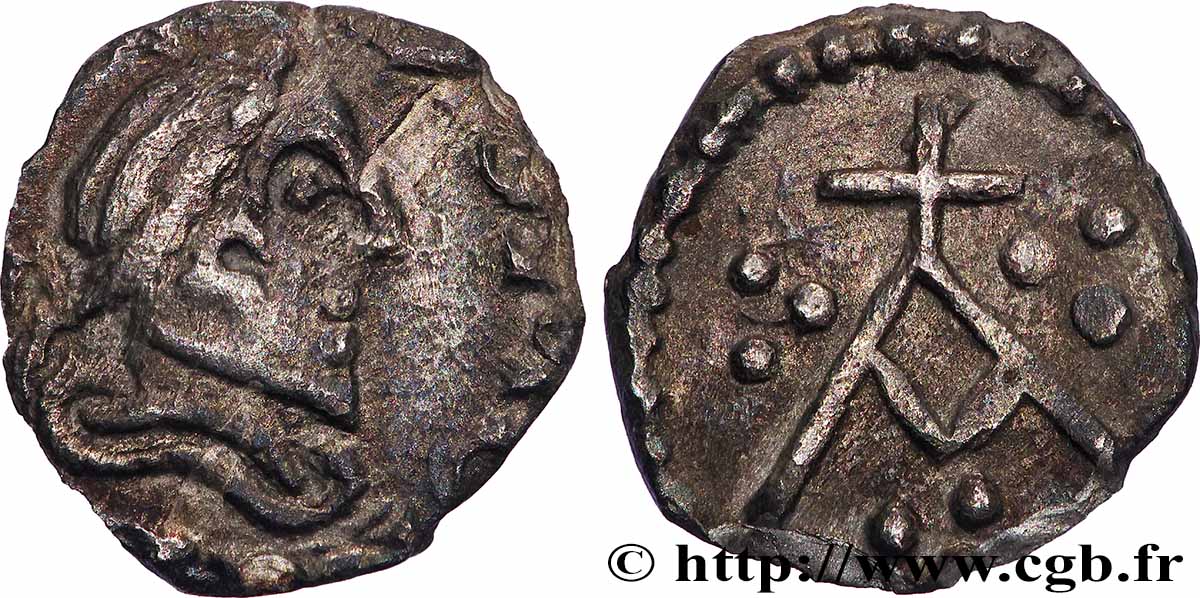
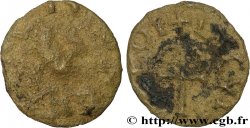
Ce denier est frappé sur un flan irrégulier. Patine grise. Monnaie fragile, cristallisée, avec d’infimes détachement de métal
Obverse
Obverse legend : VS[...]SX.
Obverse description : Buste à droite.
Reverse
Reverse legend : ANÉPIGRAPHE.
Reverse description : A croiseté dans un grènetis ; trois globules posés en triangle de part et d’autre du A et trois autres au-dessous.
Commentary
Si ce type de revers est assez classique dans le monnayage mérovingien en argent, il est plus inhabituel de le voir associé à ce type de portrait ! La série au A croiseté est en fait mal connue et les attributions varient entre le Poitou et l’Aube (ce qui semble confirmé par les provenances). D’autres exemplaires avec un A au droit et au revers sont classé à Paris, pour le palais. Il serait dangereux de faire l’amalgame à partir d’une similitude de revers ; ce type au A croiseté regroupe probablement plusieurs séries aux aires de circulation distinctes. Les seuls deniers au A croiseté avec un portrait semblent être les monnaies au nom de TROBADVS pour Poitiers (B. 6356, 431 et 3526). En l’état actuel des connaissances, cet exemplaire, avec une partie des légendes hors flan, ne peut pas être rapproché d’un atelier déterminé.
While this type of reverse is fairly common in Merovingian silver coinage, it is more unusual to see it associated with this type of portrait! The series with the crossed A is actually poorly understood, and attributions vary between Poitou and Aube (which seems to be confirmed by the provenances). Other examples with an A on both the obverse and reverse are classified as belonging to Paris, for the palace. It would be dangerous to make a generalization based on a similarity of reverse; this type with the crossed A probably encompasses several series with distinct circulation areas. The only deniers with the crossed A and a portrait appear to be the coins in the name of TROBADVS for Poitiers (B. 6356, 431, and 3526). Based on current knowledge, this example, with some of the legends off-flan, cannot be assigned to a specific mint.
While this type of reverse is fairly common in Merovingian silver coinage, it is more unusual to see it associated with this type of portrait! The series with the crossed A is actually poorly understood, and attributions vary between Poitou and Aube (which seems to be confirmed by the provenances). Other examples with an A on both the obverse and reverse are classified as belonging to Paris, for the palace. It would be dangerous to make a generalization based on a similarity of reverse; this type with the crossed A probably encompasses several series with distinct circulation areas. The only deniers with the crossed A and a portrait appear to be the coins in the name of TROBADVS for Poitiers (B. 6356, 431, and 3526). Based on current knowledge, this example, with some of the legends off-flan, cannot be assigned to a specific mint.
Historical background
UNSPECIFIED MINT
(6th - 8th centuries)
Many Merovingian coins, badly minted, with very poor or inexplicit epigraphy, cannot be attributed to a particular mint. Too rare coins unfortunately have the same problem. The attributions being based on often old works, a coin unknown at the time will often have difficulty in being attributed, unless it is possible to read the mint or find the name of the mint and compare with its production in the workshops where he minted coins....
 Report a mistake
 Print the page
 Share my selection
 Ask a question
 Consign / sell
Related articles
 Full data


Your Recently Viewed Items

TRÉSOR ROYAL XF
14.00 €
cgbfr.com numismatists


