


Live auction - bmv_1116209 - UNSPECIFIED MINT Denier ou sceat à la tête casquée et aux croisettes

You must signin and be an approved bidder to bid, LOGIN TO BID. Accounts are subject to approval and the approval process takes place within 48 hours. Do not wait until the day a sale closes to register. Clicking on "BID" constitutes acceptance of the terms of use of cgb.fr private live auctions.
Bids must be placed in whole Euro amounts only. The sale will start closing at the time stated on the item description; any bids received at the site after the closing time will not be executed. Transmission times may vary and bids could be rejected if you wait until the last second. For further information check the Live auction FAQ
All winning bids are subject to a 18% buyer’s fee.
All winning bids are subject to a 18% buyer’s fee.
| Estimate : | 700 € |
| Price : | 410 € |
| Maximum bid : | 410 € |
| End of the sale : | 09 June 2026 15:26:15 |
| bidders : | 2 bidders |
Type : Denier ou sceat à la tête casquée et aux croisettes
Date: c. 695-740
Date: s.m.
Mint name / Town : Atelier indéterminé
Metal : silver
Diameter : 11,5 mm
Weight : 1,14 g.
Rarity : R2
Coments on the condition:
Agréable monnaie frappée sur un flan large et régulier. Frappe centrée avec de petites faiblesses de frappe, surtout au revers. Patine grise, plus claire par endroits
Catalogue references :
Obverse
Obverse legend : ANÉPIGRAPHE.
Obverse description : Tête stylisée et casquée à droite ; un brin devant le visage ; un annelet derrière la tête.
Reverse
Reverse legend : ANÉPIGRAPHE.
Reverse description : Petite croix à six bras dans un grènetis intérieur ; quatre croix et quatre groupes de trois globules posées en triangle alternés et entourés d’un grènetis extérieur.
Commentary
Ce denier est du même type que le n° 1277 du Belfort où il est associé au monnayage de Chalon-sur-Saône, avec la croix à six bras si typique. Le type de droit n’a cependant rien à voir et notre denier est anépigraphe des deux côtés. Connu dès 1839, avec l’article de Cartier qui le reproduit pl. XVII, n° 8 de la RN 1839, ce type monétaires est représenté au Musée de Chalon-sur-Saône (trouvé à Buxy) et repris par Ponton d’Amécourt, tome III, p. 301. G. Depeyrot recense 21 denier de ce type, ce qui en fait une monnaie assez courante. Il doute de l’attribution à Chalon, en mentionnant la possibilité qu’il s’agisse d’une imitation (cf. Moneta p. 98). Selon l’étude de P. Crinon, ce denier appartiendrait au monnayage remois ; cet exemplaire est le n° 54 pour sa série de “Deniers anonymes au buste casqué”. Selon ce dernier, “ce monnayage semble très abondant, comme l’indique les nombreux exemplaires de coins variés”.
This denier is of the same type as Belfort no. 1277, where it is associated with the coinage of Chalon-sur-Saône, with the very typical six-armed cross. However, the obverse design is completely different, and our denier is uninscribed on both sides. Known since 1839, thanks to Cartier's article which reproduces it (pl. XVII, no. 8 of the RN 1839), this type of coin is represented in the Chalon-sur-Saône Museum (found at Buxy) and discussed by Ponton d'Amécourt, volume III, p. 301. G. Depeyrot lists 21 deniers of this type, making it a fairly common coin. He doubts the attribution to Chalon, mentioning the possibility that it is an imitation (cf. Moneta p. 98). According to P. Crinon's study, this denier would belong to the Reims coinage; This example is number 54 in his series of “Anonymous Deniers with Helmeted Busts.” According to him, “this coinage appears to be very abundant, as indicated by the numerous examples from various dies.”
This denier is of the same type as Belfort no. 1277, where it is associated with the coinage of Chalon-sur-Saône, with the very typical six-armed cross. However, the obverse design is completely different, and our denier is uninscribed on both sides. Known since 1839, thanks to Cartier's article which reproduces it (pl. XVII, no. 8 of the RN 1839), this type of coin is represented in the Chalon-sur-Saône Museum (found at Buxy) and discussed by Ponton d'Amécourt, volume III, p. 301. G. Depeyrot lists 21 deniers of this type, making it a fairly common coin. He doubts the attribution to Chalon, mentioning the possibility that it is an imitation (cf. Moneta p. 98). According to P. Crinon's study, this denier would belong to the Reims coinage; This example is number 54 in his series of “Anonymous Deniers with Helmeted Busts.” According to him, “this coinage appears to be very abundant, as indicated by the numerous examples from various dies.”
Historical background
UNSPECIFIED MINT
(6th - 8th centuries)
Many Merovingian coins, badly minted, with very poor or inexplicit epigraphy, cannot be attributed to a particular mint. Too rare coins unfortunately have the same problem. The attributions being based on often old works, a coin unknown at the time will often have difficulty in being attributed, unless it is possible to read the mint or find the name of the mint and compare with its production in the workshops where he minted coins....
 Report a mistake
 Print the page
 Share my selection
 Ask a question
 Consign / sell
Related articles

 Full data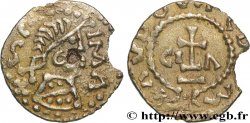

Your Recently Viewed Items

EDUENS, ÆDUI (BIBRACTE, Area of the Mont-Beuvray) Denier ATPILI F/ORCITIRIX AU
300.00 €

FRENCH INDOCHINA 1 Taël d'argent (1 Lang ou 1 Bya) (1944) Hanoï AU
1050.00 €

1 franc Louis XVIII 1824 Limoges F.206/60 AU50
350.00 €

FRENCH CONSTITUTION - NATIONAL ASSEMBLY Médaille du député, Marquis de Lafaye
600.00 €

V REPUBLIC Médaille, Reproduction d’un Cistophore d’Hadrien AU
16.00 €

FRENCH STATE Médaille, Débarquement du 6 juin 1944 AU
12.00 €
cgbfr.com numismatists


