


E-auction 256-179539 - fme_412393 - AQUITAINE - DUCHY OF AQUITAINE - LOUIS VII Médaille de la reine Aliénor
You must signin and be an approved bidder to bid, LOGIN TO BID. Accounts are subject to approval and the approval process takes place within 48 hours. Do not wait until the day a sale closes to register. Clicking on « bid » constitutes acceptance of the terms of use of cgb.fr private e-auctions.
Bids must be placed in whole Euro amounts only. The sale will start closing at the time stated on the item description; any bids received at the site after the closing time will not be executed. Transmission times may vary and bids could be rejected if you wait until the last second. For further information ckeck the E-auctions F.A.Q.
NO BUYER'S FEE.
NO BUYER'S FEE.
| Estimate : | 50 € |
| Price : | 32 € |
| Maximum bid : | 51 € |
| End of the sale : | 12 March 2018 18:56:00 |
| bidders : | 6 bidders |
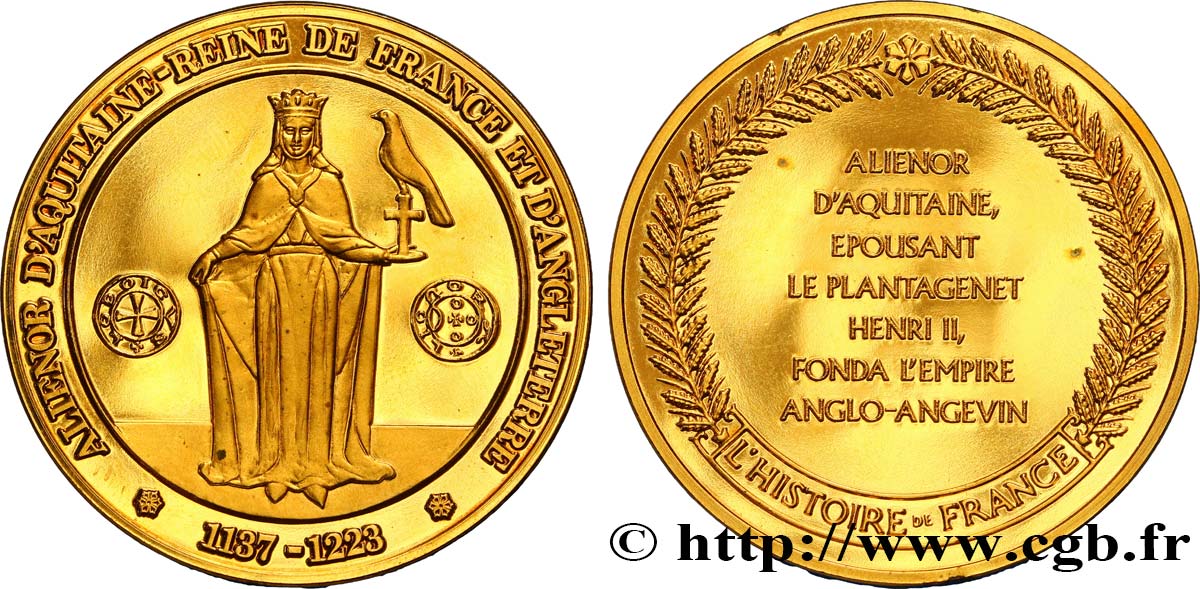
Type : Médaille de la reine Aliénor
Date: 1137-1223
Mint name / Town : France
Metal : gold plated silver
Diameter : 44 mm
Orientation dies : 12 h.
Weight : 39 g.
Edge : lisse + losange VERMEIL 78-P
Coments on the condition:
Médaille neuve avec un très bel éclat
Obverse
Obverse legend : ALIENOR D’AQUITAINE - REINE DE FRANCE ET D’ANGLETERRE // 1137-1223.
Obverse description : La reine Aliénor en pied, tenant un oiseau posé sur une croix de la main gauche ; deux monnaies médiévales de part et d’autre.
Reverse
Reverse legend : ALIENOR / D’AQUITAINE / EPOUSANT / LE PLANTAGENET / HENRI II, / FONDA L’EMPIRE / ANGLO-ANGEVIN // L’HISTOIRE DE FRANCE.
Reverse description : Légende en 7 lignes horizontales dans une couronne végétale partant d’un cartouche à l’exergue.
Commentary
Médaille de la série Histoire de France, sans graveur.
Aliénor d’Aquitaine, aussi connue sous le nom de Éléonore d'Aquitaine ou de Guyenne, née vers 1122 ou 1124, et morte le 31 mars ou le 1er avril 1204, à Poitiers et non à l'abbaye de Fontevraud, a été tour à tour reine des Francs, puis reine consort d'Angleterre.
Duchesse d’Aquitaine et comtesse de Poitiers, elle occupe une place centrale dans les relations au XIIe siècle entre les royaumes de France et d’Angleterre : elle épouse successivement le roi de France Louis VII (1137), puis Henri Plantagenêt (1152), futur roi d’Angleterre Henri II, renversant ainsi le rapport des forces en apportant ses terres à l’un puis à l’autre des deux souverains. À la cour fastueuse qu'elle tient en Aquitaine, elle favorise l'expression poétique des troubadours en langue d'oc. À compter de son premier mariage (pendant lequel elle a participé à la deuxième croisade), elle joue un rôle politique important dans l’Europe médiévale..
Medal from the History of France series, without engraver. Eleanor of Aquitaine, also known as Eleanor of Aquitaine or Guyenne, born around 1122 or 1124, and died on March 31 or April 1, 1204, in Poitiers and not at Fontevraud Abbey, was in turn Queen of the Franks, then Queen consort of England. Duchess of Aquitaine and Countess of Poitiers, she occupied a central place in the relations in the 12th century between the kingdoms of France and England: she married successively the King of France Louis VII (1137), then Henry Plantagenet (1152), future King of England Henry II, thus reversing the balance of power by bringing her lands to one then to the other of the two sovereigns. At the lavish court she held in Aquitaine, she encouraged the poetic expression of the troubadours in the langue d'oc. From her first marriage (during which she participated in the Second Crusade), she played an important political role in medieval Europe.
Aliénor d’Aquitaine, aussi connue sous le nom de Éléonore d'Aquitaine ou de Guyenne, née vers 1122 ou 1124, et morte le 31 mars ou le 1er avril 1204, à Poitiers et non à l'abbaye de Fontevraud, a été tour à tour reine des Francs, puis reine consort d'Angleterre.
Duchesse d’Aquitaine et comtesse de Poitiers, elle occupe une place centrale dans les relations au XIIe siècle entre les royaumes de France et d’Angleterre : elle épouse successivement le roi de France Louis VII (1137), puis Henri Plantagenêt (1152), futur roi d’Angleterre Henri II, renversant ainsi le rapport des forces en apportant ses terres à l’un puis à l’autre des deux souverains. À la cour fastueuse qu'elle tient en Aquitaine, elle favorise l'expression poétique des troubadours en langue d'oc. À compter de son premier mariage (pendant lequel elle a participé à la deuxième croisade), elle joue un rôle politique important dans l’Europe médiévale..
Medal from the History of France series, without engraver. Eleanor of Aquitaine, also known as Eleanor of Aquitaine or Guyenne, born around 1122 or 1124, and died on March 31 or April 1, 1204, in Poitiers and not at Fontevraud Abbey, was in turn Queen of the Franks, then Queen consort of England. Duchess of Aquitaine and Countess of Poitiers, she occupied a central place in the relations in the 12th century between the kingdoms of France and England: she married successively the King of France Louis VII (1137), then Henry Plantagenet (1152), future King of England Henry II, thus reversing the balance of power by bringing her lands to one then to the other of the two sovereigns. At the lavish court she held in Aquitaine, she encouraged the poetic expression of the troubadours in the langue d'oc. From her first marriage (during which she participated in the Second Crusade), she played an important political role in medieval Europe.
Historical background
AQUITAINE - DUCHY OF AQUITAINE - LOUIS VII
1137
Louis VII (1120-1180) married in 1137 Eleanor of Aquitaine (1122-1204), daughter of Guillaume X, last Duke of Aquitaine and Count of Poitou. The marriage was not happy. Louis divorced in 1152 on his return from the second crusade. Eleanor then married Henry II Plantagenet, who became King of England in 1154, the source of the first Hundred Years War (1154-1259). The coinage of Louis VII for Aquitaine is very rare.
 Report a mistake
 Print the page
 Share my selection
 Ask a question
 Consign / sell
Your Recently Viewed Items
GALLIA BELGICA - SEQUANI (Area of Besançon) Denier TOGIRIX, fourré VF/AU
19.00 €
GALLIA BELGICA - REMI (Area of Reims) Potin au bucrane VF
19.00 €

AMBIANI (Area of Amiens) Bronze à la tête de face rayonnante et au cheval VF
54.00 €
SENONES (Area of Sens) Potin à la tête “d’indien” XF/VF
26.00 €

GALLIA BELGICA - REMI (Area of Reims) Potin au guerrier courant VF
22.00 €
5 francs type Tiolier avec le I, tranche en creux 1831 Marseille F.315/23 XF
39.00 €
cgbfr.com numismatists


