


fme_540485 - ANIMALS Médaille animalière - Chèvre
Not available.
Item sold on our e-shop (2022)
Price : 50.00 €
Item sold on our e-shop (2022)
Price : 50.00 €
Type : Médaille animalière - Chèvre
Date: n.d.
Mint name / Town : France
Metal : bronze
Diameter : 49,5 mm
Orientation dies : 12 h.
Engraver AURICOSTE Emmanuel (1908-1995)
Weight : 44,35 g.
Edge : lisse + corne BRONZE
Puncheon : corne BRONZE
Coments on the condition:
Exemplaire nettoyé. Présence de coups et rayures
Obverse
Obverse legend : ANÉPIGRAPHE.
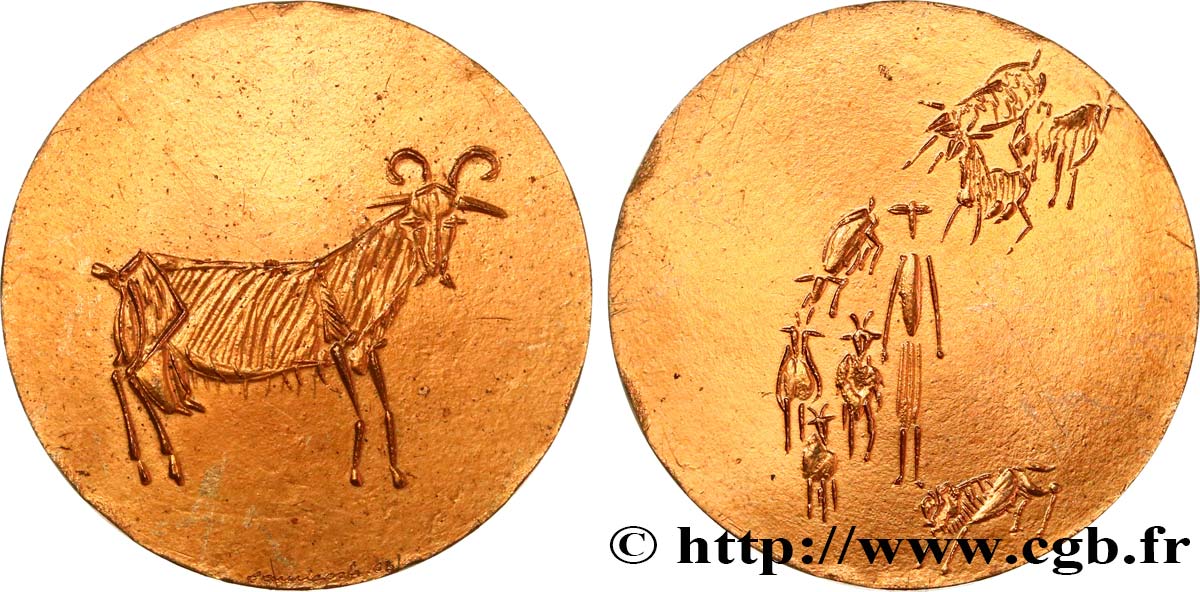
Obverse description : Chèvre à droite, signé : EAURICOSTE 631.
Reverse
Reverse legend : ANÉPIGRAPHE.
Reverse description : Troupeau de 9 chèvres très stylisées.
Commentary
Emmanuel Auricoste, né en 1908 à Paris, et mort le 15 août 1995 à Leucate, est un sculpteur et médailleur français. Emmanuel Auricoste suit l’enseignement d'Antoine Bourdelle et de Charles Despiau. Il reçoit le prix de l'Académie scandinave en 1934. Il devient professeur à l'École nationale supérieure des arts décoratifs à Paris. Son œuvre inclut un bas-relief au palais de Chaillot (1937), un Monument à Chateaubriand à Milan (1938), une porte de bronze du palais de la Société des Nations à Genève (1939), ou encore une statue de Fénelon en face de la cathédrale de Cambrai (1947). À Marvejols (Lozère), il a laissé un Vert galant (1956) et une Bête du Gévaudan (1958). A Paris, au cimetière du Père Lachaise, une plaque de bronze qu'il a réalisé d'après un dessin de Marc Chagall représente le couple Yvan et Claire Goll, sur leur sépulture (10ème division).
La Monnaie de Paris répertorie douze médailles dont il est l'auteur.
La chèvre domestique (Capra hircus Linnaeus, 1758 ou Capra aegagrus hircus) est une espèce ou une sous-espèce de mammifères herbivores ruminant, appartenant à la famille des bovidés, sous-famille des caprins. Elle a été domestiquée dès le début du Néolithique (environ -10000 ans), vraisemblablement d'abord pour son lait, puis pour sa laine, sa viande, sa peau et son cuir. La plupart du temps, les chèvres sont domestiquées, mais on les trouve aussi à l'état sauvage dans quelques contrées du Caucase, d'Iran, d'Afghanistan ou d'Irak..
Emmanuel Auricoste, born in 1908 in Paris, and died on August 15, 1995 in Leucate, is a French sculptor and medalist. Emmanuel Auricoste studied under Antoine Bourdelle and Charles Despiau. He received the Scandinavian Academy Prize in 1934.. He became a professor at the National School of Decorative Arts in Paris.. His work includes a bas-relief at the Palais de Chaillot (1937), a Monument to Chateaubriand in Milan (1938), a bronze door of the Palace of the League of Nations in Geneva (1939), and a statue of Fénelon in front of Cambrai Cathedral (1947).. In Marvejols (Lozère), he left a Vert galant (1956) and a Bête du Gévaudan (1958). In Paris, at the Père Lachaise cemetery, a bronze plaque that he created based on a drawing by Marc Chagall represents the couple Yvan and Claire Goll, on their grave (10th division).
The Paris Mint lists twelve medals of which he is the author.
The domestic goat (Capra hircus Linnaeus, 1758 or Capra aegagrus hircus) is a species or subspecies of ruminant herbivorous mammals, belonging to the family Bovidae, subfamily Caprines. It was domesticated from the beginning of the Neolithic period (around 10,000 years ago), probably first for its milk, then for its wool, meat, skin and leather.. Most of the time, goats are domesticated, but they are also found in the wild in some regions of the Caucasus, Iran, Afghanistan or Iraq..
La Monnaie de Paris répertorie douze médailles dont il est l'auteur.
La chèvre domestique (Capra hircus Linnaeus, 1758 ou Capra aegagrus hircus) est une espèce ou une sous-espèce de mammifères herbivores ruminant, appartenant à la famille des bovidés, sous-famille des caprins. Elle a été domestiquée dès le début du Néolithique (environ -10000 ans), vraisemblablement d'abord pour son lait, puis pour sa laine, sa viande, sa peau et son cuir. La plupart du temps, les chèvres sont domestiquées, mais on les trouve aussi à l'état sauvage dans quelques contrées du Caucase, d'Iran, d'Afghanistan ou d'Irak..
Emmanuel Auricoste, born in 1908 in Paris, and died on August 15, 1995 in Leucate, is a French sculptor and medalist. Emmanuel Auricoste studied under Antoine Bourdelle and Charles Despiau. He received the Scandinavian Academy Prize in 1934.. He became a professor at the National School of Decorative Arts in Paris.. His work includes a bas-relief at the Palais de Chaillot (1937), a Monument to Chateaubriand in Milan (1938), a bronze door of the Palace of the League of Nations in Geneva (1939), and a statue of Fénelon in front of Cambrai Cathedral (1947).. In Marvejols (Lozère), he left a Vert galant (1956) and a Bête du Gévaudan (1958). In Paris, at the Père Lachaise cemetery, a bronze plaque that he created based on a drawing by Marc Chagall represents the couple Yvan and Claire Goll, on their grave (10th division).
The Paris Mint lists twelve medals of which he is the author.
The domestic goat (Capra hircus Linnaeus, 1758 or Capra aegagrus hircus) is a species or subspecies of ruminant herbivorous mammals, belonging to the family Bovidae, subfamily Caprines. It was domesticated from the beginning of the Neolithic period (around 10,000 years ago), probably first for its milk, then for its wool, meat, skin and leather.. Most of the time, goats are domesticated, but they are also found in the wild in some regions of the Caucasus, Iran, Afghanistan or Iraq..
Historical background
ANIMALS
Animals (Animalia) (from the Latin animalis "animated, living, animal") are in biology, according to the classical classification, heterotrophic living beings (that is to say, which feed on organic substances) and possess collagen in their extracellular matrices. See Wikipedia.
 Report a mistake
 Print the page
 Share my selection
 Ask a question
 Consign / sell
Related articles
 Full data


Your Recently Viewed Items
5000 Francs type 1962 Modifié CHAD 1980 A.284a XF+
390.00 €
LYONNAIS - ARCHBISHOPRIC OF LYON - ANONYMOUS Denier AU
300.00 €
CLAUDIUS II GOTHICUS Antoninien XF
24.00 €
VALENTINIAN I Demi-maiorina, (PB, Æ 3) VF
14.00 €

CONSTANTINE I THE GREAT Follis ou nummus AU
30.00 €
1 centime Daniel-Dupuis 1900 F.105/4 XF
130.00 €
cgbfr.com numismatists


