


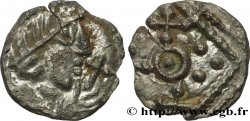
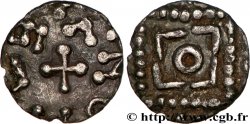
v43_1209 - ENGLAND - ANGLO-SAXONS Obole (ou demi-denier) au quatre-feuilles

MONNAIES 43 (2010)
Starting price : 180.00 €
Estimate : 300.00 €
Realised price : 180.00 €
Starting price : 180.00 €
Estimate : 300.00 €
Realised price : 180.00 €
Type : Obole (ou demi-denier) au quatre-feuilles
Date: c. 710-750
Mint name / Town : Frise, Maastricht
Metal : silver
Diameter : 12 mm
Weight : 0,56 g.
Rarity : R3
Coments on the condition:
Flan un peu court, mais avec les types de droit et de revers complets et de frappe vigoureuse. Aspect un peu granuleux avec une patine sombre, surtout dans les champs, et plus claire sur les reliefs
Catalogue references :
Obverse
Obverse legend : ANÉPIGRAPHE.
Obverse description : Buste diadémé à gauche, le cou perlé ; une croix latine devant le visage et trois globules posés en triangle derrière la nuque.
Reverse
Reverse legend : ANÉPIGRAPHE.
Reverse description : Quatre-feuilles cantonné de trois globules en triangles.
Commentary
Si les monnaies coupées sont bien attestées à l'époque romaine et à l'époque gauloise, tout le monde pensera aux as de Nîmes ou aux potins, ce phénomène est peu ou pas attesté à l'époque mérovingienne. Le monnayage est pourtant restreint et principalement connu par des triens en ou or des deniers en argent. Le monnayage de bronze est excessivement rare et l'étude des oboles semble n'être un phénomène que très récent. Dans ce contexte et face à la rareté des monnaies divisionnaires, il est presque logique que la population ou les marchands aient eu recours à la découpe des monnaies comme celle proposée ici.
Quatre deniers coupés en deux sont repris dans l’article de référence sur les oboles mérovingiennes, n° 1-4 p. 284 et 285 de la RN 2007. Un autre exemplaire a été vendu sous le n° 977 de MONNAIES 32.
Malgré les diverses attributions proposées, dans son Numéraire Mérovingien G. Depeyrot ne se prononce pas en mettant les monnaies de ce type dans une série typologique “entrelacs au revers” (cf. pl. 30). Il précise, page 175, que ces “deniers aux entrelacs seraient attribués à Poitiers par d’Amécourt (B. 5995). Pour J. Lafaurie (RN 1996) ces monnaies seraient à attribuer à Maastricht”. La précision selon laquelle pour d'Amécourt “le quatrefeuille doit être attribué à Auxerre et le trèfle à Poitiers” semble assez simpliste (cf. Belfort tome IV, page 281).
L’exemplaire n° 1693 de MONNAIES 38, dans un état inférieur, a été vendu 420€ sur un ordre de 456€.
If cut coins are well attested in the Roman and Gallic periods, everyone will think of the aces of Nîmes or gossip, this phenomenon is little or not attested in the Merovingian period. The coinage is however limited and mainly known by gold triens and silver denarii.. Bronze coinage is extremely rare and the study of obols seems to be a very recent phenomenon.. In this context and given the scarcity of fractional coins, it is almost logical that the population or merchants resorted to cutting coins like the one proposed here..
Four deniers cut in two are included in the reference article on Merovingian obols, no. 1-4 p.. 284 and 285 of the RN 2007. Another example was sold under number 977 of COINS 32.
Despite the various attributions proposed, in his Merovingian Numerary G. Depeyrot does not pronounce himself by placing coins of this type in a typological series “interlacing on the reverse” (cf.. pl. 30). He specifies, on page 175, that these “interlaced coins” would be attributed to Poitiers by d'Amécourt (B. 5995). For J. Lafaurie (RN 1996) these coins should be attributed to Maastricht”. The clarification that for d'Amécourt \\\"the quatrefoil should be attributed to Auxerre and the clover to Poitiers\\\" seems rather simplistic (cf.. Belfort volume IV, page 281).
example No. 1693 of MONNAIES 38, in inferior condition, was sold for €420 on an order of €456
Quatre deniers coupés en deux sont repris dans l’article de référence sur les oboles mérovingiennes, n° 1-4 p. 284 et 285 de la RN 2007. Un autre exemplaire a été vendu sous le n° 977 de MONNAIES 32.
Malgré les diverses attributions proposées, dans son Numéraire Mérovingien G. Depeyrot ne se prononce pas en mettant les monnaies de ce type dans une série typologique “entrelacs au revers” (cf. pl. 30). Il précise, page 175, que ces “deniers aux entrelacs seraient attribués à Poitiers par d’Amécourt (B. 5995). Pour J. Lafaurie (RN 1996) ces monnaies seraient à attribuer à Maastricht”. La précision selon laquelle pour d'Amécourt “le quatrefeuille doit être attribué à Auxerre et le trèfle à Poitiers” semble assez simpliste (cf. Belfort tome IV, page 281).
L’exemplaire n° 1693 de MONNAIES 38, dans un état inférieur, a été vendu 420€ sur un ordre de 456€.
If cut coins are well attested in the Roman and Gallic periods, everyone will think of the aces of Nîmes or gossip, this phenomenon is little or not attested in the Merovingian period. The coinage is however limited and mainly known by gold triens and silver denarii.. Bronze coinage is extremely rare and the study of obols seems to be a very recent phenomenon.. In this context and given the scarcity of fractional coins, it is almost logical that the population or merchants resorted to cutting coins like the one proposed here..
Four deniers cut in two are included in the reference article on Merovingian obols, no. 1-4 p.. 284 and 285 of the RN 2007. Another example was sold under number 977 of COINS 32.
Despite the various attributions proposed, in his Merovingian Numerary G. Depeyrot does not pronounce himself by placing coins of this type in a typological series “interlacing on the reverse” (cf.. pl. 30). He specifies, on page 175, that these “interlaced coins” would be attributed to Poitiers by d'Amécourt (B. 5995). For J. Lafaurie (RN 1996) these coins should be attributed to Maastricht”. The clarification that for d'Amécourt \\\"the quatrefoil should be attributed to Auxerre and the clover to Poitiers\\\" seems rather simplistic (cf.. Belfort volume IV, page 281).
example No. 1693 of MONNAIES 38, in inferior condition, was sold for €420 on an order of €456
Historical background
ENGLAND - ANGLO-SAXONS
(7th - 8th centuries)
If the minting of these coins is to be located at the beginning of the 8th century, in Great Britain, it is not exceptional to find them in Gaul. They are often confused with Merovingian silver coins (cf. MONNAIES XIX, n° 503, sceattas c. 680-710, classified in Merovingian denier of Laon). During the 8th century, the style of these pieces is more and more degenerated, they are often in ridge or filled. These coins disappeared from circulation in the second half of the 8th century.
 Report a mistake
 Print the page
 Share my selection
 Ask a question
 Consign / sell
Related articles

 Full data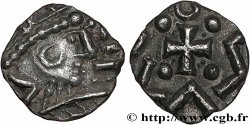


cgbfr.com numismatists


