


Not available.
Item sold on our e-shop (2021)
Price : 120.00 €
Item sold on our e-shop (2021)
Price : 120.00 €
Type : Médaille religieuse
Date: n.d.
Mint name / Town : Allemagne
Metal : copper
Diameter : 52 mm
Orientation dies : 12 h.
Weight : 35,55 g.
Edge : lisse
Puncheon : sans poinçon
Coments on the condition:
Beaux reliefs. Traces de coups et petites rayures dans les champs
Obverse
Obverse legend : IESVS - MARIA. IOSEPH.
Obverse description : Jésus enfant et ses parents marchant à droite, dans un paysage rural, surmontés d’un petit ange.
Reverse
Reverse legend : S. IGNAT. I. C. FVND..
Reverse description : Saint Ignace agenouillé à gauche devant un livre ouvert ; représentation du Christ portant une croix sortant d’une nuée.
Commentary
Médaille réligieuse d'origine polonaise ou allemande. Sa datation est difficile, mais la gravure semble de style ancien.
Les initiales I et H pourrait faire penser au graveur allemand Jan Hôhn, médailleur à Gdansk et Berlin au 17e siècle).
Ignace d'Antioche, Ignace le Théophore, est né vers 35 dans la province de Syrie, mort à Rome, en martyr, probablement en 107 ou 113. Il fut le troisième évêque d'Antioche, après saint Pierre et Evode, à qui il succéda vers 68. Probablement disciple direct des apôtres Pierre et Jean, il est surtout connu pour ses lettres apostoliques, associant le martyre pour la Foi aux grains de blé moulus pour devenir le pain de l'Eucharistie.
Ses lettres apostoliques développant une première théologie eucharistique le font ranger parmi les Pères apostoliques, première génération de Pères de l'Église..
Religious medal of Polish or German origin. Its dating is difficult, but the engraving seems to be in an old style. The initials I and H could be reminiscent of the German engraver Jan Hôhn, a medalist in Gdansk and Berlin in the 17th century. Ignatius of Antioch, Ignatius the Theophorus, was born around 35 in the province of Syria, died in Rome, a martyr, probably in 107 or 113. He was the third bishop of Antioch, after Saint Peter and Evode, whom he succeeded around 68. Probably a direct disciple of the apostles Peter and John, he is best known for his apostolic letters, associating martyrdom for the Faith with grains of wheat ground to become the bread of the Eucharist. His apostolic letters developing an early Eucharistic theology rank him among the Apostolic Fathers, the first generation of Fathers of the Church.
Les initiales I et H pourrait faire penser au graveur allemand Jan Hôhn, médailleur à Gdansk et Berlin au 17e siècle).
Ignace d'Antioche, Ignace le Théophore, est né vers 35 dans la province de Syrie, mort à Rome, en martyr, probablement en 107 ou 113. Il fut le troisième évêque d'Antioche, après saint Pierre et Evode, à qui il succéda vers 68. Probablement disciple direct des apôtres Pierre et Jean, il est surtout connu pour ses lettres apostoliques, associant le martyre pour la Foi aux grains de blé moulus pour devenir le pain de l'Eucharistie.
Ses lettres apostoliques développant une première théologie eucharistique le font ranger parmi les Pères apostoliques, première génération de Pères de l'Église..
Religious medal of Polish or German origin. Its dating is difficult, but the engraving seems to be in an old style. The initials I and H could be reminiscent of the German engraver Jan Hôhn, a medalist in Gdansk and Berlin in the 17th century. Ignatius of Antioch, Ignatius the Theophorus, was born around 35 in the province of Syria, died in Rome, a martyr, probably in 107 or 113. He was the third bishop of Antioch, after Saint Peter and Evode, whom he succeeded around 68. Probably a direct disciple of the apostles Peter and John, he is best known for his apostolic letters, associating martyrdom for the Faith with grains of wheat ground to become the bread of the Eucharist. His apostolic letters developing an early Eucharistic theology rank him among the Apostolic Fathers, the first generation of Fathers of the Church.
Historical background
GERMANY
 Report a mistake
 Print the page
 Share my selection
 Ask a question
 Consign / sell
Related articles

 Full data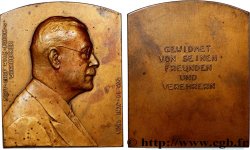


Your Recently Viewed Items
2,5 Angolares ANGOLA 1948 P.071 VG
64.00 €
PARTHIAN KINGDOM - MITHRADATES II Drachme MS
300.00 €

ROMA Centenionalis ou nummus AU
180.00 €

PLAUTILLA and CARACALLA Denier MS/AU
150.00 €
TETRICUS I Antoninien XF/VF
4.00 €
RUCHE NAZAIRIENNE 50 CENTIMES VF
15.00 €
cgbfr.com numismatists


