


brm_361206 - ACILIA Denier

Not available.
Item sold on our e-shop (2018)
Price : 225.00 €
Item sold on our e-shop (2018)
Price : 225.00 €
Type : Denier
Date: 49 AC.
Mint name / Town : Grèce ou Illyrie
Metal : silver
Millesimal fineness : 950 ‰
Diameter : 17,5 mm
Orientation dies : 6 h.
Weight : 3,79 g.
Rarity : R1
Slab

NGC :
Coments on the condition:
Exemplaire sur un flan ovale bien centré avec les grènetis visibles. Joli portrait de style fin. Revers de style fin Patine grise superficielle avec des reflets dorés
Catalogue references :
Obverse
Obverse legend : SALVTIS.
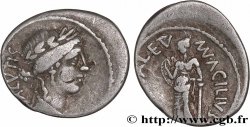
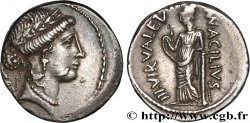
Obverse description : Tête de Salus (la Santé) laurée à droite.
Obverse translation : “Salutis”, (de la Santé).
Reverse
Reverse legend : (MN) ACILIVS/ III VIR VALE(TV).
Reverse description : Valetudo (la Santé) debout à gauche, appuyée sur une colonne de la main gauche et tenant un serpent de la main droite.
Reverse translation : “Manius Acilius Triumviri Valetudinis”, (Manius Acilius triumvir monétaire Valetudo).
Commentary
Si le poids est correct, la monnaie semble toute de même fourrée avec notamment une boursouflure de métal au revers. Pour ce type, M. Crawford a relevé une estimation de 651 coins de droit et de 723 coins de revers ce qui pourrait correspondre à une fabrication totale comprise entre un million et demi et trois millions de deniers. C’est l’un des types monétaires qui permit de financer le parti sénatorial au début de l’année 49 avant J.-C. quand ce dernier rejoignit Pompée qui avait quitté Rome. Les auteurs du Catàlogo ont différencié trois variétés dont la nôtre qui semble la plus rare avec le mot SALVTIS qui remonte vers le haut derrière la tête.
If the weight is correct, the coin still seems to be filled, notably with a metal bulge on the reverse. For this type, Mr. Crawford noted an estimate of 651 obverse dies and 723 reverse dies, which could correspond to a total production of between one and a half and three million denarii. This is one of the monetary types that allowed the financing of the senatorial party at the beginning of 49 BC when the latter joined Pompey who had left Rome. The authors of the Catàlogo differentiated three varieties, including ours, which seems the rarest, with the word SALVTIS rising upwards behind the head.
If the weight is correct, the coin still seems to be filled, notably with a metal bulge on the reverse. For this type, Mr. Crawford noted an estimate of 651 obverse dies and 723 reverse dies, which could correspond to a total production of between one and a half and three million denarii. This is one of the monetary types that allowed the financing of the senatorial party at the beginning of 49 BC when the latter joined Pompey who had left Rome. The authors of the Catàlogo differentiated three varieties, including ours, which seems the rarest, with the word SALVTIS rising upwards behind the head.
Historical background
ACILIA
(49 BC)
The gens Acilia is a plebeian family of Rome. Manius Acilius is the son of Manius Acilius Glabrio and Æmilia, the daughter of Metella and Marcus Æmilius Scaurus. Metella marries Sylla in second marriage. She died in 82 BC. Æmilia was chosen to become Pompey's wife, although she was already married to Glabrio. She died in 81 BC.
 Report a mistake
 Print the page
 Share my selection
 Ask a question
 Consign / sell
 Full data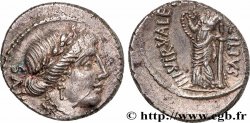


Your Recently Viewed Items

PISIDIA - SELGE Obole XF
120.00 €

ELAGABALUS Dupondius AU
31.00 €

MARCUS AURELIUS Assarion XF
16.00 €

DOMITIA Denier AU/XF
195.00 €

CARINUS Aurelianus AU/XF
175.00 €
PHILIP IV "THE FAIR" Double parisis n.d. VG
10.00 €
cgbfr.com numismatists


