


E-auction 321-238289 - fme_446707 - ACADEMIES AND LEARNED SOCIETIES Médaille de l’Académie de Besançon
You must signin and be an approved bidder to bid, LOGIN TO BID. Accounts are subject to approval and the approval process takes place within 48 hours. Do not wait until the day a sale closes to register. Clicking on « bid » constitutes acceptance of the terms of use of cgb.fr private e-auctions.
Bids must be placed in whole Euro amounts only. The sale will start closing at the time stated on the item description; any bids received at the site after the closing time will not be executed. Transmission times may vary and bids could be rejected if you wait until the last second. For further information ckeck the E-auctions F.A.Q.
NO BUYER'S FEE.
NO BUYER'S FEE.
| Estimate : | 75 € |
| Price : | 26 € |
| Maximum bid : | 51 € |
| End of the sale : | 10 June 2019 18:07:30 |
| bidders : | 5 bidders |
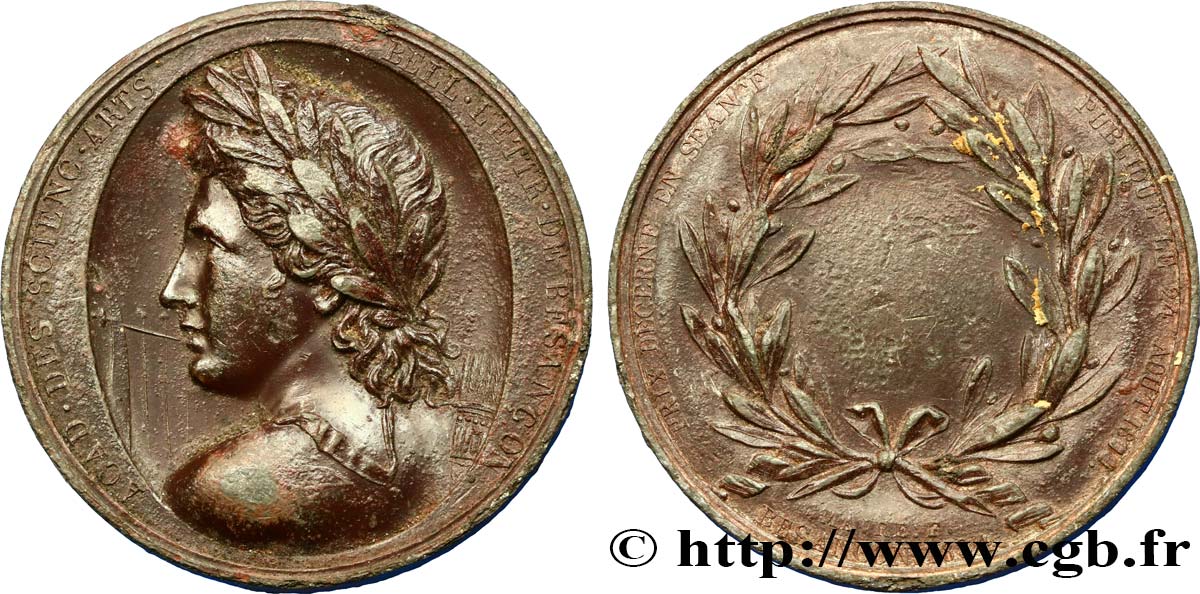
Type : Médaille de l’Académie de Besançon
Date: c.1834
Mint name / Town : 25 - Besançon
Metal : bronze
Diameter : 55,3 mm
Orientation dies : 12 h.
Weight : 70,2 g.
Edge : lisse
Slab

GENI :
Coments on the condition:
Aspect poreux. Présence de concrétions
Obverse
Obverse legend : ACAD. DES SCIENCES. ARTS. BELLES LETTRES. DE BESANÇON.
Obverse description : Buste lauré à gauche, traité à l’Antique, avec un lyre en second plan.
Reverse
Reverse legend : PRIX DÉCERNÉ EN SÉANCE - PUBLIQUE LE 24 AOUT 1800 // MAIRE. F. / BESANÇON 1834.
Reverse description : Couronne de lauriers.
Commentary
L'Académie des sciences, belles-lettres et arts de Besançon et de Franche-Comté est une société savante, fondée en 1752 à Besançon.
En juin 1752, les lettres patentes royales signées par Louis XV instaurent une « Académie des sciences, belles-lettres et arts en ville de Besançon » et accordent ainsi à la capitale comtoise une distinction analogue à ses voisines Nancy et Dijon.
L'éclat de cette Académie est marqué par le couronnement qu'elle accorde aux travaux de Antoine Parmentier en 1772.
L'Académie est supprimée en 1793, mais elle se reconstitue à partir de 1804 à l'initiative du préfet et du recteur en s'adaptant aux exigences nouvelles.
Elle décerna pendant longtemps une pension, issue d'un legs de Jean Baptiste Antoine Suard : Pierre-Joseph Proudhon en fut l'un des bénéficiaires..
The Academy of Sciences, Belles-Lettres and Arts of Besançon and Franche-Comté is a learned society, founded in 1752 in Besançon. In June 1752, the royal letters patent signed by Louis XV established an \\\"Academy of Sciences, Belles-Lettres and Arts in the city of Besançon\\\" and thus granted the capital of Franche-Comté a distinction similar to its neighbors Nancy and Dijon. The brilliance of this Academy is marked by the crowning achievement it bestowed on the work of Antoine Parmentier in 1772. The Academy was abolished in 1793, but it was reconstituted from 1804 on the initiative of the prefect and the rector, adapting to new requirements. For a long time, it awarded a pension, derived from a legacy of Jean Baptiste Antoine Suard: Pierre-Joseph Proudhon was one of the beneficiaries.
En juin 1752, les lettres patentes royales signées par Louis XV instaurent une « Académie des sciences, belles-lettres et arts en ville de Besançon » et accordent ainsi à la capitale comtoise une distinction analogue à ses voisines Nancy et Dijon.
L'éclat de cette Académie est marqué par le couronnement qu'elle accorde aux travaux de Antoine Parmentier en 1772.
L'Académie est supprimée en 1793, mais elle se reconstitue à partir de 1804 à l'initiative du préfet et du recteur en s'adaptant aux exigences nouvelles.
Elle décerna pendant longtemps une pension, issue d'un legs de Jean Baptiste Antoine Suard : Pierre-Joseph Proudhon en fut l'un des bénéficiaires..
The Academy of Sciences, Belles-Lettres and Arts of Besançon and Franche-Comté is a learned society, founded in 1752 in Besançon. In June 1752, the royal letters patent signed by Louis XV established an \\\"Academy of Sciences, Belles-Lettres and Arts in the city of Besançon\\\" and thus granted the capital of Franche-Comté a distinction similar to its neighbors Nancy and Dijon. The brilliance of this Academy is marked by the crowning achievement it bestowed on the work of Antoine Parmentier in 1772. The Academy was abolished in 1793, but it was reconstituted from 1804 on the initiative of the prefect and the rector, adapting to new requirements. For a long time, it awarded a pension, derived from a legacy of Jean Baptiste Antoine Suard: Pierre-Joseph Proudhon was one of the beneficiaries.
Historical background
ACADEMIES AND LEARNED SOCIETIES
In the 17th and 18th centuries, the academies and learned societies contributed to the influence of science, arts and literature throughout France and abroad.. They allow the dissemination of knowledge, then the ideas of the Enlightenment, and include in their ranks the most influential personalities in their field, responsible, among other things, for training future creators and scholars.. In the provinces, they constitute the essential elements of social and cultural life.. They bring together "great" and "beautiful" minds (men of letters, artists and scientists), and are endowed with official institutions (legal and material structures) which ensure their permanence, stability and legitimacy.. They are established by letters patent of the King, and most often placed under the protection of the latter.. Let us cite as an example the Academy of Sciences, Belles-Lettres and Arts of Rouen, created in June 1744 by letters patent of Louis XV. Previously, there were already meetings of botanic friends who formed an unofficial academy. Two men actively worked for the official recognition of this academy: Fontenelle, godfather of the Academy and Le Cornier de Cideville, classmate and friend of Voltaire.. Many members of this Academy are famous: Chardin, Pigalle, Parmentier, Necker, Victor Hugo or Abbé Cochet.. Reading tips: BARRIERE P. , "The Academy of Bordeaux, center of international culture in the 18th century (1712-1792)", Bordeaux, 1951; COUSIN J. , "The Academy of Sciences, Literature and Arts of Besançon" (1752-1952), Besançon, 1954; TAILLEFER M. , "An Academy Interprets Enlightenment. The Academy of Sciences, inscriptions and belles-lettres of Toulouse in the 18th century", Paris, 1984.
 Report a mistake
 Print the page
 Share my selection
 Ask a question
 Consign / sell
Related articles

 Full data


Your Recently Viewed Items

100 Francs DELACROIX modifié FRANCE 1979 F.69.02c UNC-
48.00 €

EXTRAORDINARY ITEMS FROM WARS EXTRAORDINAIRE DES GUERRES AU
20.00 €

100 francs or Napoléon III, tête laurée 1868 Paris F.551/10 AU
2200.00 €

CANALS AND WATERWAY TRANSPORT Médaille, Compagnie Universelle du Canal maritime
80.00 €
DENMARK - KINGDOM OF DENMARK - CHRISTIAN IX 25 Ore 1874 Copenhague AU58 PCGS
45.00 €
1000 Francs RICHELIEU FRANCE 1956 F.42.24 AU
100.00 €
cgbfr.com numismatists


