


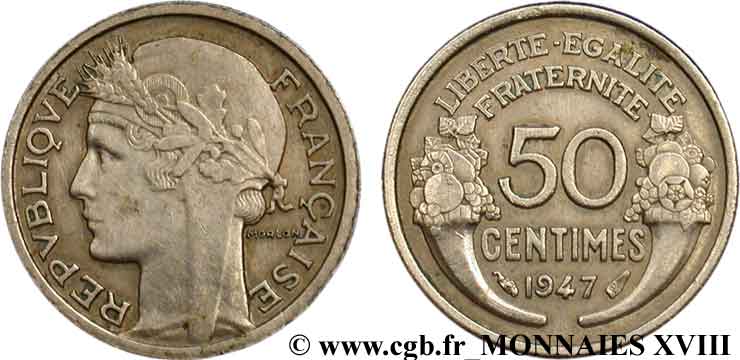
v18_2352 - 50 centimes Morlon, variété de métal ou essai indéterminé 1947 F.192/19 var.
MONNAIES 18 (2003)
Starting price : 180.00 €
Estimate : 400.00 €
Realised price : 415.00 €
Number of bids : 7
Maximum bid : 451.00 €
Starting price : 180.00 €
Estimate : 400.00 €
Realised price : 415.00 €
Number of bids : 7
Maximum bid : 451.00 €
Type : 50 centimes Morlon, variété de métal ou essai indéterminé
Date: 1947
Metal : nickel silver
Diameter : 18 mm
Orientation dies : 6 h.
Weight : 2,47 g.
Edge : lisse
Rarity : R3
Coments on the condition:
Exemplaire brossé de façon agressive, la surface d’origine n’est plus distincte
Catalogue references :
Obverse
Obverse legend : REPVBLIQVE - FRANÇAISE.
Obverse description : Buste de la République à gauche, coiffée du bonnet phrygien orné d’une cocarde sous couronne composite d’olivier, de chêne et de blé ; signé MORLON derrière.
Reverse
Reverse legend : LIBERTE - EGALITE / FRATERNITE.
Reverse description : 50 / CENTIMES / 1947 entre deux cornes d’abondance.
Commentary
Cet exemplaire est apparemment frappé avec des coins d’origine, les différents sont bien nets et le poids, nettement au-dessus du poids d’un exemplaire en cupro-nickel (2,47 au lieu de 2,00 g) montrent qu’il ne s’agit pas d’un vulgaire placage. S’agit-il d’une frappe d’essai ou d’une fabrication non-officielle réalisée par un ouvrier “indélicat”, une “perruque” ? Aucun autre exemplaire ne semble en tous cas signalé avec des caractéristiques identiques. La pièce réagit à l’aimant et montre ainsi qu’elle possède au moins une partie importante de nickel.
This example is apparently struck with original dies, the differences are very clear and the weight, clearly above the weight of a cupro-nickel example (2.47 instead of 2.00 g) shows that it is not a common plating. Is it a test strike or an unofficial production carried out by an “unscrupulous” worker, a “wig”? In any case, no other example seems to be reported with identical characteristics. The coin reacts to the magnet and thus shows that it has at least a significant part of nickel
This example is apparently struck with original dies, the differences are very clear and the weight, clearly above the weight of a cupro-nickel example (2.47 instead of 2.00 g) shows that it is not a common plating. Is it a test strike or an unofficial production carried out by an “unscrupulous” worker, a “wig”? In any case, no other example seems to be reported with identical characteristics. The coin reacts to the magnet and thus shows that it has at least a significant part of nickel
Historical background
IV REPUBLIC
(16/01/1947-8/01/1959)
Characterized by a parliamentary regime coupled with great ministerial instability, the Fourth Republic has the particularity of never having been officially proclaimed. Indeed, De Gaulle, when he arrived in Paris on August 25, 1944, refused to do so on the pretext that the Republic had never ceased to exist. Considering that the French State of Marshal Pétain was only a simple state of affairs, he considers that the Republic survived in free France and his birth certificate must then be June 18, 1940. However, his departure, the January 20, 1946, and the referendum of October 13, 1946 approving a new Constitution, mark the official beginning of this republic. It knows two presidents: Vincent Auriol (16/01/1947 - 23/12/1953) and René Coty (23/12/1953 - 8/1/1959). The open crisis caused by the revolt of the army of Algeria leads, in 1958, to its fall which is confirmed by the adoption of a new constitution on September 28, 1958. Nevertheless, it does not cease definitively until the 8 January 1959 when General de Gaulle was installed as President of the Fifth Republic.
 Report a mistake
 Print the page
 Share my selection
 Ask a question
 Consign / sell
Related articles
 Full data


Your Recently Viewed Items

SPANISH NETHERLANDS - COUNTY OF FLANDERS - CHARLES V Bureau des Finances XF
45.00 €

EXTRAORDINARY ITEMS FROM WARS EXTRAORDINAIRE DES GUERRES AU/XF
43.00 €
FRENCH ACADEMY / ACADÉMIE FRANÇAISE Académie française, émission de 1785 MS
51.00 €
cgbfr.com numismatists


