


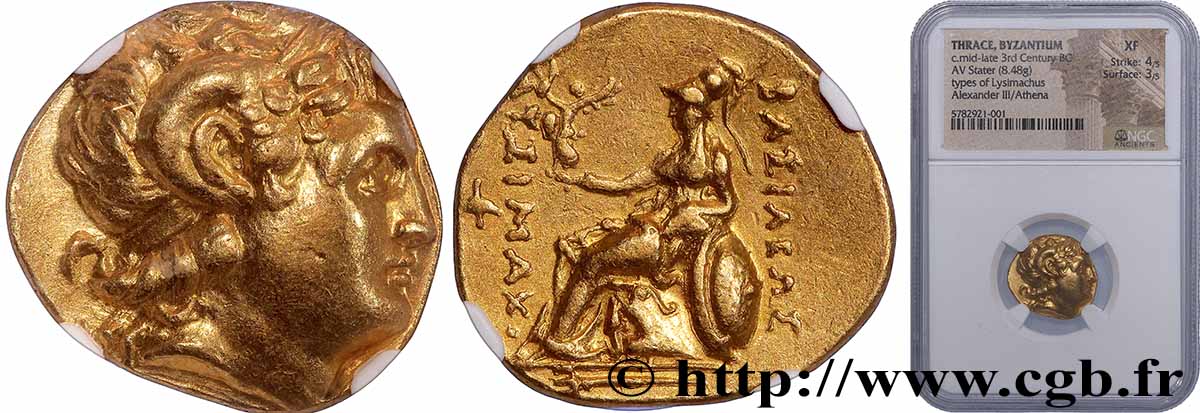
bgr_1128879 - THRACE - BYZANTION Statère d’or
5 500.00 €(Approx. 6380.00$ | 4730.00£)
Quantity
Add to your cart

Type : Statère d’or
Date: c. 250-220 AC.
Mint name / Town : Byzance, Thrace
Metal : gold
Diameter : 18 mm
Orientation dies : 11 h.
Weight : 8,48 g.
Rarity : R1
Slab

NGC :
Coments on the condition:
Superbe monnaie, centrée des deux côtés. Très beau portrait d’Alexandre, bien venu à la frappe. Revers finement détaillé. Patine de collection
Catalogue references :
Predigree :
Exemplaire sous coque NGC XF (Strike 4/5, Surface 3/5)
Obverse
Obverse legend : ANÉPIGRAPHE.
Obverse description : Tête imberbe d'Alexandre le Grand sous les traits de Zeus-Ammon, cornu et diadémé à droite.
Reverse
Reverse description : Athéna nicéphore assise à gauche sur un trône, tenant un petite Niké de la main droite qui couronne le nom de Lysimaque et le coude gauche reposant sur un bouclier ; dans le champ à gauche, un monogramme et à l’exergue, un trident.
Reverse legend : BASILEWS/ LUSIMACOU/ (DI)
Commentary
Notre statère d’or ne porte pas l’ethnique traditionnel (BY) placé normalement sur le trône. En revanche, à l’exergue, nous trouvons le trident, symbole caractéristique associé aux statères d’or de la Propontide et de la mer Noire jusqu’au Ier siècle avant J.-C..
Our gold stater does not bear the traditional ethnic symbol (BY) normally placed on the throne. Instead, in the exergue, we find the trident, a characteristic symbol associated with gold staters from the Propontis and the Black Sea until the 1st century BC.
Our gold stater does not bear the traditional ethnic symbol (BY) normally placed on the throne. Instead, in the exergue, we find the trident, a characteristic symbol associated with gold staters from the Propontis and the Black Sea until the 1st century BC.
Historical background
THRACE - BYZANTION
(3rd - 2nd century BC)
Coinage in name of Lysimachos
Byzantium, the future Constantinople and then Istanbul, was founded in 657 BC by Megarian settlers from central Greece. The city was besieged by Philip II of Macedonia in 340/339 BC and found itself in the share of Lysimachus during the division of the empire of Alexander. After Couroupédion, it regained its independence. Its location at the entrance to the Black Sea at the mouth of the Propontis as well as its rich fertile plains on the coast ensured great prosperity. The change of monetary standard in 357 BC seems to indicate a modification of the commercial circuits of the city which is then oriented more towards the eastern Mediterranean and Rhodes than towards the Black Sea where the Persian standard was dominant. When the city obtained its autonomy at the beginning of the 3rd century, it resumed, according to the work of Henri Seyrig, the typology of the Lysimaques which will be minted in the city for more than 150 years..
 Report a mistake
 Print the page
 Share my selection
 Ask a question
 Consign / sell
Your Recently Viewed Items
ASIA MINOR Unité AU
70.00 €

THRACE - BYZANTION Statère d’or AU
5500.00 €
CARIA - CARIAN ISLANDS - RHODES Demi-unité XF
180.00 €
DIVUS ANTONINUS PIUS Denier AU
125.00 €
CONSTANTINE II Centenionalis ou nummus AU
50.00 €
cgbfr.com numismatists


